 alt Hacker News
Ask HN: What Are You Working On? (March 2026)
What are you working on? Any new ideas that you're thinking about?
Comments
I’ve written a CBOR implementation as a mruby c extension in an afternoon and am about to officially release it soon.
It’s my first project where I’ve worked with claude: https://github.com/Asmod4n/mruby-cbor
I'm building out https://measuretocut.com, which started as a tool for myself to help with planning board cuts (and now sheet cuts). It calculates how much material you need for your project and gives you a plan for the materials and shows all the cuts you need to make and where to make them.
First release was in December for 1D cuts. Last month I released sheet cutting for 2D cut calculation. It's been working well for my own projects and it started getting consistent daily users since my last update in February. You can save projects now on the site for you to come back to later.
Any feedback is welcome. I'm always looking for what features to add next.
I was interested in the idea of generating vector graphics with simple scripting language. The "simple" did not happen, but... I launched https://scriptdraw.com and I have lots of fun with it. My goal is to make the language much simpler than it actually is and then create a lot of generators (for example, gears!).
Balance Buckets helps you set aside money for the things you care about.
It’s two-minute envelope accounting for your bank balance.
https://sauna-assistant.com - sauna master in your pocket
I've been celebrating five years of working on OnlineOrNot (https://onlineornot.com/) by adding more features for teams that build software:
- 2FA, PassKey, and password-based login for folks that hate magic links
- Moved my entire API from GraphQL to REST so I can fully dogfood the API I offer
- Added an audit log as standard on all plans
- Built a terraform provider (https://github.com/OnlineOrNot/terraform-provider-onlineorno...), and a way to download existing config into terraform files
- Started iterating on a CLI (https://github.com/OnlineOrNot/onlineornot)
Using a Muse EEG headset to read brain activity and use that to drive the output of a GAN. Similar to other projects that try to visualise or decode thoughts, but at the moment it's an art project. Obviosuly quite limited by compute and hardware. I'm sort of looking for collaborators / co-founders / opportunities in the AI + neuroscience + creativity space.
I'm working on arranging talks and poster presentations at various conferences/seminars to spread knowledge of my latest academic paper, "Specieslike clusters based on identical ancestor points". In the paper, among other things, I argue that (we should define species in such a way that) for any organism in any species, either the species is made up almost entirely of descendants of that organism, or else the species is made up almost entirely of non-descendants of that organism. This is a funny property because most people who hear about it fall into one of two camps, those who say it is obviously true, and those who say it is obviously false!
The paper in question: https://arxiv.org/abs/2602.05274 (published in the Journal of Mathematical Biology)
I'm writing a book, which covers the mental models for writing code in a functional style. The examples are in Scala, but it will be useful if you use other modern languages like Rust, Kotlin, Swift, OCaml, or Typescript.
https://getvalara.com - PDF appraisal document in, grounded appraisal review out in 5-10 minutes to aid in risk management for lending institutions and individual appraisal reviewers.
We use landing.ai to parse the PDF, as well as useworkflow.dev to durably perform other work such as rendering PDF pages for citations, and coordinating a few lightweight agents and deterministic checks that flag for inconsistencies, rule violations, bias, verify appraiser credentials, etc. etc. Everything is grounded in the input document so it makes it pretty fast and easy. We’re going to market soon and have an approval sign up gate currently. Plenty of new features and more rigorous checks planned to bring us to and exceed parity with competition and human reviewers.
There’s plenty of margin for cost and latency versus manual human review, which takes an hour or more and costs $100 or more.
Mostly art projects:
- VR version of Surface Browser (3d internet browser): https://boxc.net/surfacebrowser.html
- Crowd Strike: faster self-driving: an exhibition where the visitors help autonomous drones target a different visitor each minute with lasers
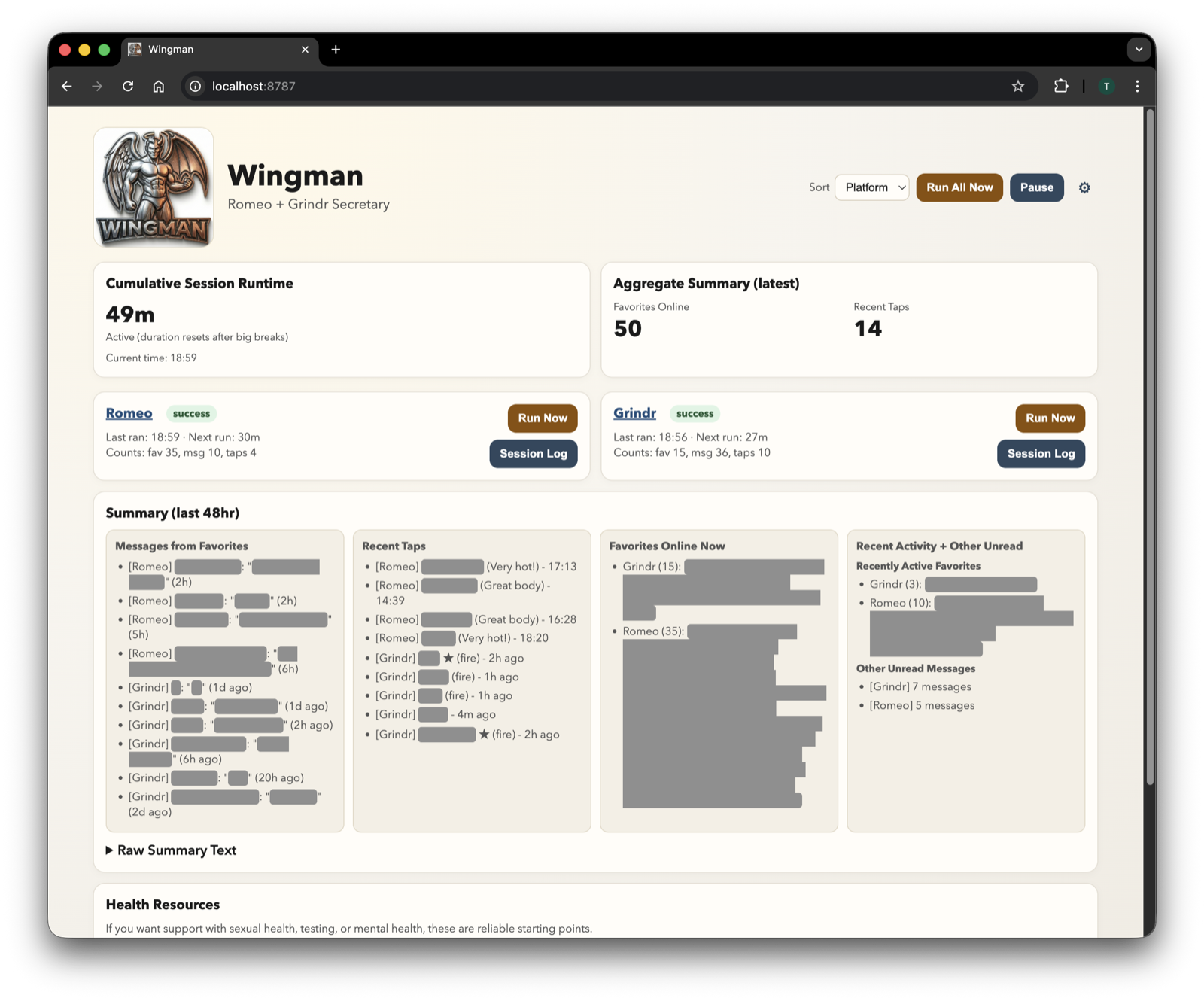
and also Wingman: a dating app secretary (privacy focus, runs locally on your computer for any dating app that has a web site. It tells you if favourites have messaged you): https://boxc.net/wingman_app.png I'll open source this one if interest.
I built Collider, A wrap-based package and dependency manager for Meson.
I needed a way to use and push my own artifacts in Meson projects. WrapDB is fine for upstream deps, but I wanted to publish my packages and depend on them with proper versioning and a lockfile, without hand-editing wrap files.
Collider builds on Meson’s wrap system: you declare deps in collider.json, run collider lock for reproducible installs, and push your projects as wraps to a local or HTTP repo. It’s compatible with WrapDB, so existing workflows still work: you just get a clear way to use and push your own stuff. Apache-2.0.
A music livecoding app[0], it's open-source[1] and it's been in the works for years in various iterations, but I've finally settled on the format and delivery. I'm now trying to make it as newbie friendly as possible by doing tutorials[2] and videos[3] and having ready-made instruments[4] to begin with. Thinking also to expand it as a general purpose creative editor in a standalone electron app and bundle in other livecoding languages as well, for graphics also.
[1]: https://github.com/loopmaster-xyz/loopmaster
[2]: https://loopmaster.xyz/tutorials
We have been homeschooling our kids. Homeschooling in India is not that widespread. So when a national newspaper covered our experiment, I got lot of questions around what we were doing. For a while I wrote blog posts answering them.
Now I've written quite a few posts (and given talks), I thought of writing a book. Just wrote two chapters. The draft lives here: https://www.jjude.com/books/hs/
I'm working on JRECC, a Java remotely executing caching compiler.
It's designed to integrate with Maven projects, to bring in the benefits of tools like Gradle and Bazel, where local and remote builds and tests share the same cache, and builds and tests are distributed over many machines. Cache hits greatly speed up large project builds, while also making it more reliable, since you're not potentially getting flaky test failures in your otherwise identical builds.
I'm building a small tool called FormBeep[1] that sends a notification to your phone when someone submits a form on your website.
It started as a client problem, then something which I also experienced so decided to built it. It's just one small script and work seamlessly across platforms.
Eazip (https://eazip.io) — ZIP remote files in one API call.
I built a service that lets developers bundle remote files into a ZIP with a single POST request. You send a list of URLs, we fetch, package, and return a signed download link.
The problem: creating ZIPs from remote files (S3, R2, CDN) usually means downloading to a server, zipping locally, managing temp storage, and cleaning up. It's surprisingly painful at scale — especially with large files or thousands of items.
Eazip handles all of that. ZIP64 support for files over 4GB, up to 5,000 files per job, zero egress fees on downloads, and no infrastructure to manage.
Use cases so far: e-commerce photo bundles, document delivery (invoices/contracts), creative asset distribution, and backup/export tooling.
Free tier available, no credit card required. Would love feedback from the HN community.
I have been using AI workflows at work to increase the productvity. I have shared these workflows internally and at a couple of tech meetups I went to. I got positive response.
Some of these are present here: https://github.com/vamsipavanmahesh/claude-skills/
Planning to package this as a workshop, so companies could be benefit from AI Native SDLC.
Put together the site yesterday https://getainative.com
Couple of the people I have worked with in the past agreed to meet me for a coffee, will pitch this. Fingers crossed.
I realized that there is no journaling program I like, so I wrote my own. Authoring is done purely by iOS shortcuts and is writer (the only thing I want is to create a new entry, or create a new entry with a photo and metadata from said photo)
Rendering is done by a go server. I wanted to learn go for quite a while and this is the perfect excuse.
NotifyButton - A simple script on the frontend of your site, a complete SaaS platform on the backend for DSA compliance.
If you operate in the EU and want to avoid heavy fines, this is for you. Once integrated, it allows users to report legal content issues directly to you, which you can then manage via a dedicated dashboard following official EU procedures. Without such a system, users are much more likely to file complaints through official state or EU channels, which can trigger investigations.
I've been working on a surfing game on my spare time for the past year. The idea is to keep it closer to the real sport, focusing on pumping, carving, nose-riding, etc. I shared a video of it on the Unity3D subreddit[1] and the feedback was quite positive, so planning on getting a demo ready as soon as possible!
https://talimio.com/ Generate fully personalized courses from a prompt. Fully interactive.
New features shipped last month:
- Adaptive practice: LLM generates and grades questions in real-time, then uses Item Response Theory (IRT) to estimate your ability and schedule the optimal next question. Replaces flashcards; especially for math and topics where each question needs to be fresh even when covering the same concept. - Interactive math graphs (JSXGraph) that are gradable - Single-image Docker deployment for easy self-hosting
Open source: https://github.com/SamDc73/Talimio
Letterboxd for live events. Currently a waitlist system in place, and we're very UK-focussed.
The long-term plan is to build a really enthusiastic community and then become a primary ticket seller.
I'm porting Jetpack Compose to Rust. The Rust would be the future default ai language. Having the familiar well designed by Google UI API will help Android developers to be in a loop. https://github.com/samoylenkodmitry/Cranpose
I wrote this little web app over the weekend, the idea was to make you think about your next purchase by introducing a 48 hour countdown. In 48 hours you come back and decide if you really need this product, or if it was just an impulse buy.
All data lives in your browser (IndexDB) - https://buyitlater.vercel.app
I've been working on an open source cat-themed virtual pet running on an ESP32: https://github.com/moonbench/catode32
It was inspired by tamagotchis of yesteryear (and my two cats). It uses a small common monochrome SSD1306 display with 128x64 pixels of resolution.
All of the pixel art is my own. And the cat features a bunch of different animated poses and behaviors, as well as different environments. And there are minigames (a chrome dino clone - but with a cat!, a breakout clone, a random maze generator, a tic-tac-toe game, and I plan to add more.)
I'm currently working on tweaking the stats so that they go up and down over time in a realistic way and encourage the player to feed and interact with the pet to keep stats from going too low. Then I plan on adding some wireless features, like having the pet scan WiFi names to determine if its home or traveling, or using ESP-NOW to let pets communicate with each other when they're nearby.
I made a reddit post with a video of it a few weeks ago [1] and have various prototypes of artwork for these little screens on my blog [2].
[1] https://www.reddit.com/r/arduino/comments/1r8i1vx/progress_o...
Google AI overview dissector
AIOs are a black hole - we dont know when they appear and whats in it. so i creates a tool thats starts with GSC data and enriches it via AIO data
works good and the major finding by now
the best AIOs you can get are ..... none.
doesn't matter if you are in it or not - as soon as they show up the CTR to tour web-property goes down massively ~60% to 70%
the CTR on the AIOs are ~0%
Nonograms! I built Nonodle[1], a daily nonogram puzzle game and I’m adding an option to access these puzzles from Nonoverse[2], my iOS nonogram app.
There is an API, and it’s a straightforward task, but one thing led to another and I’m also improving the app UI. The update will take some time but I hope it will only be better.
[1]: https://lab174.com/nonodle/
[2]: https://apps.apple.com/app/nonoverse-nonogram-puzzles/id6748...
Building a boring POS (1) using various AI tools just to check what can I do with these tools. I have used claude, gemini and now using antigravity. I have not done a single edit manually.
I got it all done in probably an hour or two. But done in 10-15 min blocks over many days.
I’m working on WC Price Hostory, a plugin that handles price tracking and Omnibus Directive compliance for WooCommerce.
It’s been available as a free tool for years, growing to over 45k active installs. I just rolled out the Pro extension to offer more advanced features, and the early traction has exceeded my expectations. If you're running e-commerce in Europe, this is a must-have for staying compliant with EU law.
Building Bloomberry to help sales teams find companies that use any technology or SaaS product.
Example: Slack: https://bloomberry.com/data/slack/
jsonmaps.dev its a way to create maps and create storytelling maps that you can embed in your react application, I was quite tired of how AI wasn't able to generate reliable maps in my applications.Every map library has its own imperative API and the AI output was always broken, hallucinated, or unmaintainable with so many different formats that you can put on the map.
The story map part came out of wanting to build Mapbox-style scrollytelling easily. You define chapters with a camera view and content, and it handles the scroll-driven camera interpolation.
Stack: MapLibre under the hood, React, published as an npm package.
Building Universal mobile devtool — control iOS Simulators, Android Emulators, and real devices from a single dashboard and CLI
GitHub: https://github.com/pranshuchittora/simvyn
Do give it a try, Thanks!
We are developing a single-passenger autonomous vehicle, capable of traveling over 1000 miles, performing fully automated vertical takeoff, cruise, and landing.
Info (not recent) available here: https://awz.us/docs
Group chat photobooks. Automatic layouts, no editor/app, unlimited free previews. Build a hardcover (up to 1000 image) and ship it in minutes.
Wanted a physical souvenir for everyone in my long running signal chat but didn’t want to spend hours curating in editors.
https://gitlab.com/usecaliper/caliper-python-sdk
An LLM observability SDK that let's you store pre and post request metadata with every call in as lightweight an SDK as possible.
Stores to S3 in batched JSON files, so can easily plug into existing tooling like DuckDB for analysis.
It's designed to answer questions like; "how do different user tiers of my services rate this two different models and three different systems prompts?". You can capture all the information required to answer this in the SDK and do some queries over the data to get the answers.
Started on making my own AI model benchmarks and leaderboard[0], after I tested MiniMax M2.5, which was supposedly good based on standard benchmarks, but peformed really poorly in practice and burned through hundreds of thousands of reasoning tokens for each request...
[0]: https://aibenchy.com
3D AI Modeling software intended for 3D printers.
Originally I made it for my grandpa, but I got a lot of interest so I made it into a full commercial product.
Just yesterday I published a set of 3 mini tutorials if you want to see how it works - https://youtube.com/playlist?list=PLKt1F5TvOjAHE07oBDlPXcrHc...
A lightweight framework on top of Temporal for building reliable, stateful AI agents on top of temporal.
Think OpenClaw, but durable, with long-term state, and enterprise-ready. We've been using it internally to build agents for a while now and have decided to open-source it.
I've been working on an app to track my son's 1000 books before kindergarten. I've also added QOL features like barcode scanning for adding books to the library and creating a rotation based on the last time the book was read and whether I actually enjoy reading it. (The books I don't like make it through the rotation just with less frequency.)
This was an excuse to ship a mobile app for the first time and get familiar with supabase.
After these last few bugs are fixed, its ready for a semi-public TestFlight with our friends who have kids.
Still working on:
A hobby project I started putting together late last year; a little spot on the internet for prayer and reflection. I've just shipped a small feature where you get a Bible reading (KJ only for now) in response to a prayer.
https://dugnad.stavanger-digital.no/
A pro bono tech consultancy for local (Stavanger, Norway) non profits. The idea is to help them use tech to better deliver on their mission. Last week I built a little bookmarklet for a non-profit to surface some of their data buried in a SaaS tool ... which will make their apple pressing operation easier.
Open Source screener of polymarket for insider tracking https://poly gains.com
Published a post that contains all of the blog posts by other people that I shared in my monthly mail-letter: https://bryanhogan.com/blog/other-cool-blog-posts-2026
Also moving to Sveltia as my CMS (Astro markdown blog), after exploring multiple other options. Changed the structure of my Obsidian vault, will write about that also.
I’m also still working on a few projects:
- https://game.tolearnkorean.com/
"Does a launch make any impact if there's no audience?"
We've found most early-stage startups ignore social media until after a launch. Things like “$0 spent on ads” sound cool, but they don’t help if no one knows your product exists.
I'm building Appents to provide a done-for-you social media solution for startups.
Would love feedback: https://appents.com/
I am building a voice interview/survey webapp that helps product teams conduct product research faster. You can try it at https://intervio.app
Any feedback is welcome :)
This week I'm on project #20 of my 25 projects in 25 weeks challenge! One was on the front page of Hacker News this weekend. It was humbling.
I am working on two small apps for my dungeons & dragons group. We're playing inperson and I really like to give them printed out cards for magic items they receive and also for spells, because they are quite new to the game.
So I build these two app to create items and spell cards and print them out.
JetSet AI (https://bit.ly/4besn7l) — flight search in plain English instead of the usual date-picker maze.
Type "cheapest flight from London to Tokyo, flexible on dates in April" and it returns live results with real pricing. I compared a few against Google Flights and they matched. Not mocked data.
The part I found interesting: it runs on a dedicated VM so it keeps context across the conversation. If you say "actually make that business class" or "what about flying into Osaka instead" it knows what you were looking at. Most chat-based search tools lose that between messages.
I didn't build it from scratch — it's a pre-built app in the SuperNinja App Store that I deployed and have been extending. The deploy itself took about 60 seconds. The extending part is what I've been spending time on: describing changes in plain text and watching them go live without touching a repo.
Still figuring out what the right UX is for flexible-date search. Curious if anyone has opinions on that.
I'm building Fillvisa: Turboxtax for Immigration [1]
It's a free USCIS form-filling web-app(no Adobe required). USCIS forms still use XFA PDFs, which don’t let you edit in most browsers. Even with Adobe, fields break, and getting the signature is hard.
So I converted the PDF form into modern, browser-friendly web forms - and kept every field 1:1 with the original. You fill the form, submit it, and get the official USCIS PDF filled.
I found out SimpleCitizen(YC S16) offers a DIY plan for $529 [2]
So, a free (and local-only) version might be a good alternative
[1] https://fillvisa.com/demo [2] https://www.simplecitizen.com/pricing/