 alt Hacker News
Making Graphics Like it's 1993
Comments
Graphics programming in the early to mid 1990s was pretty fun: write pixel data into the memory-mapped video RAM and it appears on the screen! A pointer to 0xA0000 was all you needed - no API or anything. The reason for the non-square-pixel 320×200 VGA mode they mention was that the video buffer took 64000 bytes, which fit into a 16-bit segment, making addressing it easy in 16-bit code/CPUs.
This is taking a lot of inspiration from Doom, but the actual raycasting engine is more like Doom's predecessors, the most well-known of which is probably Wolfenstein 3D: perpendicular walls, constant floor and ceiling height. Wolf3D didn't have textured floors and ceilings because of performance reasons, but several other similar games had them. Doom and IIRC Duke Nukem as well used a BSP engine which was much more flexible (walls could intersect at any angle, variable floor and ceiling heights), although the levels were still "flat" (you couldn't have several "stories" inside a level, e.g. you couldn't design a bridge that you could walk over and under).
This is a great write-up of your process and behind-the-scenes peek at the making of what looks to be a really fun game! Can't wait to play and delve into the code once you release it.
I just noticed that this might be one of the rare shooters with a female protagonist: the cat has a calico pattern, and those are almost always female (https://en.wikipedia.org/wiki/Calico_cat).
This is so great. Another fun trick we used in the 90s was palette animation -- by swapping the palette you can create incredibly cool effects at a low runtime cost.
I'm tinkering with a voxel space rendering tech demo as a PlayStation homebrew. After one weekend of work I'm getting decent results (like, 10-15 FPS) and I've yet to use the DMA, the GTE or even polylines primitives.
It's refreshing to dust up trigonometry and good old low-level optimization tricks. When the scratchbuffer has 1 KiB and the stack can only use a fraction of that, it makes me realize how spoiled I'm at work with the microcontrollers we have, with threads being allocated 8 KiB of stack and backtraces with over 50 functions of C++ templates on it.
>> What this actually means is, the constraints I have foolishly imposed upon myself are as follows....
Those kind of constraints can lead to increased creativity, and can also influence the overall style of a game. It's part of the reason early 80's arcade games had so much diversity.
This is terrific. I love reading about the creative process involved in a project like this, finding cool solutions to self-imposed boundaries.
I think the mix of highly rational reasoning and "it just feels right" is a killer combo too, it gives a rigorous basis for a lot of the decisions made, while also allowing for a strongly personal aesthetic to emerge. Very cool indeed.
A great writeup of excellent work!
The flight simulator / magic carpet easter egg in Microsoft Excel 97 used that same shaded-colormap palette trick, plus some dithering:
https://rezmason.github.io/excel_97_egg https://rezmason.github.io/excel_97_egg/about.html
I'm impressed by your sprite pipeline and gibs animations. Your attention to detail and navigation of constraints have really paid off, I can't wait to play this sometime
As a fellow 3d-engine-with-foolishly-unreasonable-constraints developer, I love the detail in the explanations here and seeing the process you went through.
For some reason I irrationally like the posterization effect that's created when something is darkened to almost zero.
I respect the amount of work that goes into projects like this; I can't wait to be able to play it.
Every time I think about graphics programming, I think about how we did it in the mid 90s when I was in high school messing around with exactly these things. XOR operations to drive animations, writing directly to memory, etc. (Clearly I do backend stuff now...)
Everything is perfect here. The hero, the graphics, the title... <3
Much respect -- at first glance when I saw the animated gif I thought this was just a project making assets from scratch for an existing game engine (e.g. Doom or Wolf 3D) but then I realize it's creating all the game code from scratch too! (But using similar techniques from the old days). Amazing work.
I really loved that article. Creating games always seemed so daunting to me since I don't know a lot about how it's done, there are so many different processes involved. The solutions described here are so satisfyingly compact and so easy to understand given the simple constraints, and yet they produce an actual game that looks nice.
Wow, this takes me back of making my own software renderer and game engine as a teen in the 90s. Then OpenGL came out and fixed pipelines and some of the cool magic of doing anything with pixels disappeared (until pixel shaders came back). One cool rendering technique you don't see much today is voxel graphics.
This game looks great I really like the style it is inspiring.
The author seems to consider open-sourcing the engine, I would also be interested in the mentioned scripts for asset creation. Those scripts would make a great toolset for asset creation in this style.
I love this! I have been working on a similar project, recreating the originale BBC Elite but with multiplayer networking. Though I have not limited myself as much (I use SDL).
This is a wonderful deep dive into your project. I'm early days on creating pixel art style procedural art systems, and this gives me plenty to think about.
As a side note, the visual style in the game reminds me a lot of Exhumed / Powerslave :-).
With the title I was expecting some notes about DeluxePaint, but it was still a nice read nonetheless. Wish you much success with the game! :-)
Really cool. It's also something LLM's are ridiculously bad at, so you kinda have to do it properly.
This is beautiful. I wish one day I'll have to time for a project like that. Looking forward to buying it on Steam.
Nice, i've used similar approach for the lighting in Post Apocalyptic Petra[0] though i did use per-pixel LUT offset calculation[1] because it uses a generic 3D triangle rasterizer (the levels are based on grids like in Tomb Raider but they're rendered as triangles). Later i added sprite support for another gamejam but i never ended up finishing it and the sprite support is very rudimentary (and unoptimized - i just noticed i'm doing the LUT lookup for every pixel when drawing shaded sprites which isn't necessary).
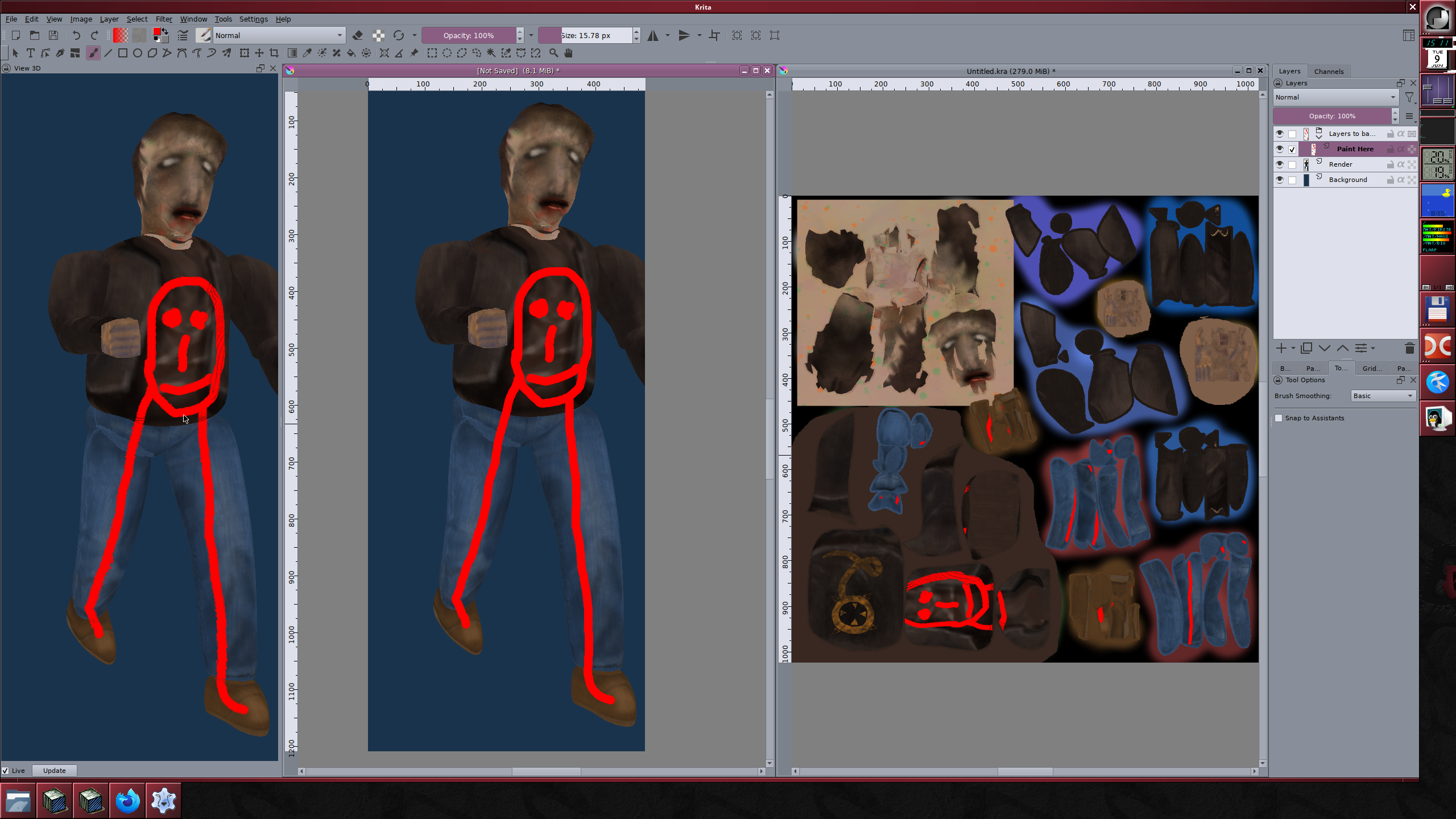
I did write a tool for generating the sprites from 3D models though[2]. It uses plain old OpenGL 1.1 to draw the sprite and grabs the framebuffer directly. It is drawn fullbright so i can paint the lighting directly on the sprite's texture (using a Krita plugin i wrote[3][4] - the model is something i threw together with Blender's default generated UV since i didn't care for the details).
I wonder if doing some sort of postprocessing (after rendering with with shading) like you do with your game would help with the finer details since i also found that rendering from 3D models to sprites creates very "mushy" results most of the time because of all the details getting lost. I notice the colors also become more saturated after postprocessing in your examples, is this after it finds the closest color in the palette or the result of the postprocess? I'd like to keep the overall hue+saturation of the model so maybe doing post-processing on a grayscale render to shade the shadows/dark areas but keep highlights as-is and then multiplying that with the fullbright image would produce results that wont shift the saturation.
[0] https://bad-sector.itch.io/post-apocalyptic-petra
[1] https://codeberg.org/badsector/PetraEngine/src/commit/14ca16...
[2] http://runtimeterror.com/pages/iv/images/95ddebc51e4dfa8a5af...
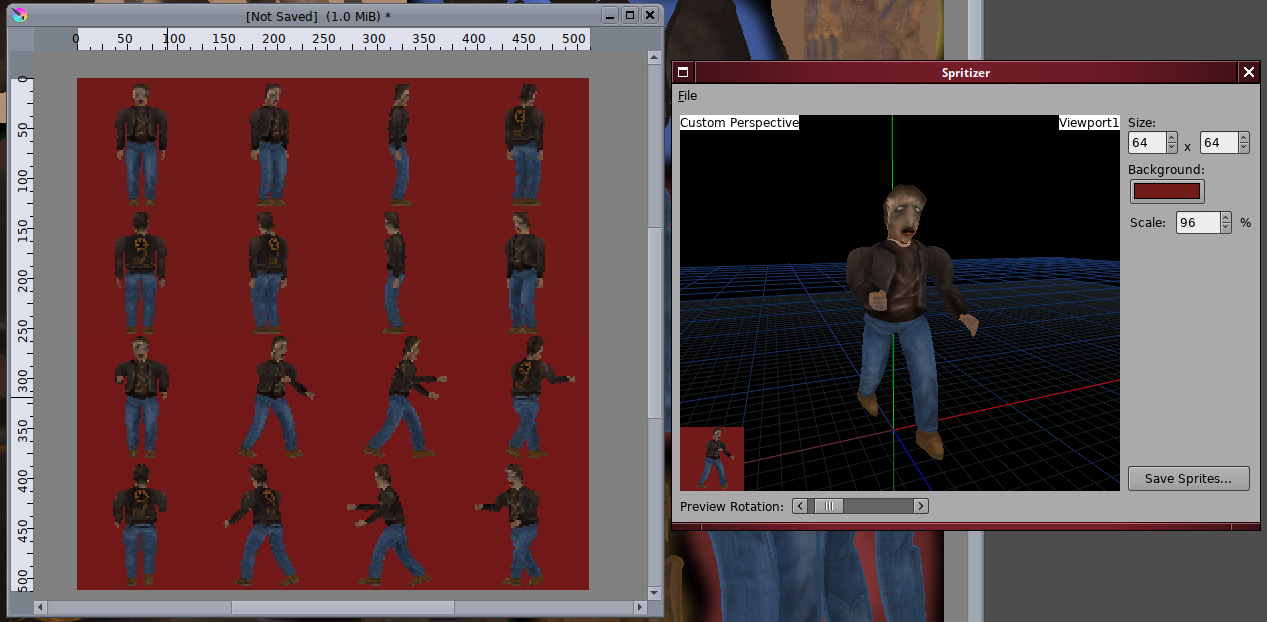
[3] http://runtimeterror.com/tools/kritaview3d/
[4] http://runtimeterror.com/pages/iv/images/535f0e09e590d8a1731...
cool cat game
what's unreasonable about this though?
I hope they leveraged Mode X :)
It'd be more interesting if you made a similar looking game using modern APIs imo
If you want to play with software rendering, here's probably the shortest code that will get an ARGB8888 2D array from main memory to the screen efficiently for all platforms using SDL2 in C https://gist.github.com/CoryBloyd/6725bb78323bb1157ff8d4175d... you'll need to do the translation from a 320x200x8-bit palletized framebuffer to ARGB yourself ;)
If you want to get inspired by what can be done with palletized framebuffers check out http://www.effectgames.com/demos/canvascycle/ (click Show Options) and the GDC presentation by the artist https://youtu.be/aMcJ1Jvtef0
With that you can fire up https://github.com/mriale/PyDPainter for that classic Deluxe Paint IIe vibe. Or, https://www.aseprite.org/ for something more modern.