 alt Hacker News
Ask HN: What are you working on? (September 2026)
What are you working on? What have you been curious about lately?
Comments
Don, a work companion.
Don helps you set goals.
Don reminds you to take breaks.
Don checks in how you fell.
Don judges you when you go off track.
Don celebrates you when you get stuff done.
A Godot framework for 2D games and (maybe) a new programming language specifically designed for gameplay logic.
i am working on a really cool word game that has a TUI graphical style, it looks like a roguelike but has a bit more going on. i also seem to have figured out a way to do automated "fun factor" testing and get bugs/frs that sound like real player feedback, as a little bonus treat. doesn't seem like anybody is attempting that kind of thing with agents, might try to codify it. trying to spend a lot longer thinking about a game's systems/meta and developing slowly vs. hypersprinting which is fun but exhausting.
Optimem, a spaced repetition learning app that aims to be a user-friendly alternative to Anki. Or a more effective version of Duolingo.
I just released an open-source AI pipeline that turns GitHub issues into merged PR's. It uses your Claude Code CLI subscription.
Looking for feedback from people who already run Claude Code and are testing out new AI software factories or tools.
Try it here https://github.com/Team1-dev/Team1-Factory
Please only run this on a VPS or isolated environment and not on your personal machine as it runs with full permissions.
I haven't been working on it as of late, mostly because i'm a bit deflated from software in general, but I started working on a programming language I called Grasp.
If lisp is a list processing language, grasp is a graph programming language.
The idea was that most other data structures can be represented with a graph ( adjacency matrices are matrices, a tree is a type of directed acyclic graph, a list is a graph where each node connects to at most two nodes, etc) and so if you designed a programming language where the language is itself a graph, much like how lisp is itself a list, you could get other esoteric programming languages like APL, forth, lisp, and so on as DSLs of Grasp. Also any program you write would be its own CFG.
I started it but honestly its mostly a hot mess of vibe-coded garbage. But I may get back on it and try to clean it up.
On a mission to prove you don't need YC to be successful.
I'm working on SpecPilot (https://specpilot.dev), a spec-driven development layer that sits in front of Claude Code, Cursor, Copilot and the rest. It deliberately doesn't generate code. It scaffolds a .specs/ folder and hands the actual writing off to whatever agent you already use, so the specs become the thing the agent is held to instead of a prompt you retype every session.
Open source, free, no login, nothing to sell. I'm not trying to build a business on this. I just want agents to write better code, and that only happens when they have something firmer than a chat prompt to work against. CLI is here: https://github.com/girishr/SpecPilot
It started as a TypeScript CLI in January. Enough people told me they either didn't want a CLI or didn't know how to use one that I rebuilt the front door as a guided chat: 27 questions, runs fully offline in the browser, outputs the .specs/ tree plus an onboarding prompt for your IDE.
Recently shipped an MCP server so the agent can run the questionnaire itself rather than the human doing it, published to the official MCP registry and Smithery. Next is brownfield: point it at an existing repo and backfill specs from the code. Honest state of things: the Product Hunt launch got 4 votes and around 100 visitors, and I had no event tracking wired up, so I couldn't even tell how many of those generated anything. Fixed since. Usage is small but real, and it's coming through MCP rather than the web app, which I did not expect.
The part I keep circling back to is that spec generation is easy to copy. Spec enforcement is where the value is: checking a diff against the spec and failing loudly. Feedback welcome, especially from anyone who tried SDD on an existing codebase and gave up.
Writing an article about compacting garbage collection for my website.
Trying to reduce my doomscrolling IG and FB usage
I created https://getnoloop.com to block the feed on iOS
Lots of things really:
1. Aetheris: geometry CAD kernel, https://github.com/yuechen-li-dev/Aetheris/.
Full code CAD capability with big coverage already and some functionalities that even OpenCascade/Parasolid/ACIS doesn't have, full sheet metal module, programmable part assembly, analytical fillets/chamfers, mathematical knots, auto-route for piping, built-in finite element analysis, etc. Had Astra make an improved version of the V8 demo that was going around on LinkedIn, so it can do general hard surface modeling pretty well too, turn all the Astra demo prowess into reusable capabilities/templates. The DSL is human writable too, so give it a try if you want. https://aetheris-editable-v8.yuechenli.workers.dev/
2. Concept language: https://github.com/yuechen-li-dev/Concept
I've said before that Carbon isn't a real programming language, never mind a successor to C++, so I decided to put my money where my mouth is. The idea of it is to be more TypeScript to C++'s JavaScript and to generalize C++20 concepts from template constraints to what C++26 is doing with contracts, and bring the equivalent of Rust's borrow checker to be opt-in by default instead of opt-out, fast compile time, in a syntax that C++ users are already familiar with (`const auto` instead of `let` for example) as well as templates and comptime. Language is done-ish, not self hosted yet, still compiles to C11, kernel and allocator libraries are finished, currently working on the scheduler right now.
3. Copeland TS, https://github.com/yuechen-li-dev/copeland
TypeScript for .NET without all the weirdness of Javascript, with full Nuget and NPM inter-op, Rust style exhaustive `match`, templates, etc. It's actually weird how much cleaned up TypeScript ended up looking like cleaned up C++. Compiles to JS, C#, WASM via Blazor WebAssembly, and SPIR-V via HLSL/DXC, and runs on V8 for JS and RyuJIT/NativeAOT for C#. The conclusion is that RyuJIT ended up being ~2x faster than V8 JS in hot loops but the cold startup time is higher, so replacing JS for UI really isn't worth it. Comes with full UI layout system, Vulkan renderer, and game/app runtime, but those are still pretty rough.
Keyboard pants https://mastodon.pirateparty.be/@utopiah/117157231799845118
TL;DR: magnets.
api for building apple and google wallets. launched it after ppl kept asking for one on the consumer app (launched on hn too) and gave it a shot. now it does enough mrr that i dont have to go back to work.
*walletwallet.dev
Making rent as an open source developer.
Desperately trying to attract new monthly sponsors and people willing to buy me the occasional pizza with my terrible HTML skills. Is it working?
If any individuals, companies (or bitcoin millionaires) would like to help a long-time OpenBSD slacker, unslack, I'd really like to focus more of my time on open source development (and advocacy), rather than making rent. Feel free to contact me.
https://brynet.ca/wallofpizza.html
(Native SegWit): bc1qwe6zv0ezq4gzlea6tw45qhsn5kckheljn0krvt
Baking eggless applesauce oatmeal cookies and chocolate chip cookies.
I took this existing 3d printed animated Frankenstein head: https://www.printables.com/model/620191-frankenstein-head-wi...
... and used Claude to crank the software up to 11. Network management console, RESTful API, added hands hands to the pupils so it serves as a clock, NTP, added sleep mode at night, added different eyes, OTA firmware updates, and more: https://github.com/michael-gebis/creeper-eyes
It's ridiculous and I love it.
lexera, a kanban board with full multimedia and document include support that saves to markdown, exports to marp to manage teaching materials. it also started out to be my editor of choice for agentic programming as each task is a card. hopefully i will manage to create a page and visible materials soon!
porting librespot to C using Zephyr RTOS. Mostly vibecode, to see how far LLM can go.
Im working on my own coding agent soon to be released.
While you might think "yey another coding agent" i went down some very different paths than other open source coding agents do right now. Ill not bore you with a ton of detailed breakdowns and rather list the main points that are relevant to understand why/how i build it.
Premise:
-The agent is meant to run against selfhosted environments first like Ollama etc with a focus on non cloud sized models, it should work properly on something like a 27b model already
-The agent with full intention trades execution time vs reasoning and result quality
So what does it do different:
1. The agent, instead of trying to let the model solve a whole task in 3-5 inferences, rather breaks down the "thinking process" in smaller chunks, basically decomposing the task into smaller tasks. While this is not a completely new concept, the agent will break it down to really simple single step variants which even for a smaller model can properly be solved. This involves not just file editings but all points along the way from interpreting user message to planing a task to defining acceptance criteria etc.
2. The agent is build in a way that it, apart from some fixed steps such as detect user intent at the beginning and synthesize response at the end, it will by itself decide what is the next proper step to execute/do based on the context i provide. While doing so the agent also revalidates its current execution and if it spots that, given the information i collected since it planned and started running, the current plan is not detailed enough or is missing out due to something he didnt "know" when he was planing, the agent will dynamicly mutate the coming plan stats, as in restructure/decompose/etc in order to have a properly layed out route to fulfill the task.
3. The agent has a rather complex system of how his context is composed which is combined by things like the chat history, previous step results, a backlog of what "single steps" it has done (updated file x , read range from file y etc) and in that it is strongly reason driven, so it will for most of the things it does also provide a small reason explaination for why it did that. Than the agent also has a working memory that contains facts and decisions it made along execution. There is more but thats just some thingsd to mention. The whole memory system and context is rather complex (tho not complicated). When i release it ill properly break down how all this works in the docs.
4. The agent provides full observability in the ui. At every point of execution you can basically in detail see whats in memory, whats the current composed context, whats the plan and what plan steps depend on what previous steps, you can look at artefacts it build and also you have basically a complete audit log of all single "actions" it has executed and can look into their details.
5. The agent allows to while in an execution send steering messages, meaning the message will be, using relevant current contextual information about its execution, send as inference with a prompt askind the agent to interpret on if its relevant, and how does it impact the current execution/plan. It than can decide either just do alter what it currently does, or even do a plan mutation in order to accomodate the users steering information.
6. The agent within its capabilities has a lot of error correction/self reflection logic. From dynamicly fixing json including a fallback to let LLM fix a response json, upon to if executions fail to much it will itself do a hypothesis on why this is happening, formulate a critique and with that reevaluate if it wants to try the steps again with the additional information, or if it wants to mutate the plan to accomodate the just spotted problems.
Theres quite some more i could list but i guess thats enaugh for now. The big trade off as mentioned earlier is execution time. In comparsion to cloud native agents, which will do giant editings and reasonings in just a hand full of inferences, my agent uses a ton of inferences. The big difference is that this allows (a) the agent to more precisly focus on specific tasks rather than overloading it with to much at once and (b) alot better spot problems/mistakes itself and adjust its execution plan to accomodate those without the user having to reprompt the agent 10 times until something is actually correctly solved.
Apart from the pure coding capability, the very same actions that allow for higher quality reasoning and coding at the same time allow the agent also be a good analysis and discussion partner.
So : what is it than used for if inferences and executions can take very long? Well for me its in terms of coding capabilities a hands off agent. Its meant to be informed once at the beginning with relevant details, and than should be fully capable (as long its in the capabilities for sure) to fulfill the task without the user having to permanently keep an eye open. I want to free time for myself and not change my time from coding to prompting.
Ill wrap it up here and say : the Agents name is "Loa" and i probably will post it on hackernews as soon i got a relatively stable beta to release. Im close to being fine with a beta release but i want to test some more runs before i publish.
working on building a way to make me me one of the best trader helper nexalione.com
I am learning math logic and two languages to use it: TLA+ and Lean.
finding simple bipartite expander graphs for better LDPC (expander) codes
I am working on these open source projects:
https://github.com/office-42/word42
https://github.com/office-42/math42
I'm working on an arcade joystick with full analog capability using a Hall effect sensor. It's along the lines of the Ultimarc Ultrastik, which I'm currently using, but it has so many shortcomings that I decided to build my own. I decided to go with a rp2350 microcontroller, and it will have inputs for 16 buttons, and outputs for RGB leds for every button. It should be a direct swap for any enclosure designed for a modern Sanwa stick, which it's based on.
I'm making a language. Its name is Pergyra Lang, and there's nothing particularly special about it.
I was curious if AI agents could go beyond just making SVGs and create entire skits with them.
So I built a platform to do that. Results were meh until Astra, so I finally open sourced it last weekend.
I want to try again using AI to build an app, and also learn some Rails. I consult at a company that uses ServiceNow for change control and it's absolutely horrible, and they have busted processes atop it. I dream of a change control app that has templates, has better visual indicators of an RFC's stage in the workflow and exactly what needs done to push it along, and just something that doesn't suck as much as SNOW.
I'm working through: https://modernaicourse.org/.
I appreciate that it makes me revisit some math which i've forgotten like directional derivative and why gradient points to highest ascent.
Interesting but hard as well.
I've been doing a bunch of stuff with using a PUT[1] to simulate an IF (Integrate and Fire) neuron[2]. Right now I'm experimenting with variations of pulse-width and frequency of the input spike train, seeing how that affects when the "neuron" fires. In a future step I'll add a resistor to bleed off some of the charge from the timing capacitor, to make it more of a "Leaky Integrate and Fire" neuron.
And then ... well, we'll see. I'm also reading a lot of books and stuff on neuroscience, neuromorphic computing[3], analog computing, etc. I don't have some "grand unified theory" or anything, just playing around in this space.
There's a lot more I could say about this, but I'll save that for a blog post or something. That said, if anybody wants to see some pictures and read some write-ups of some of this stuff, add me on LinkedIn[4] and you'll see some of that stuff in my activity there.
EDIT:
What the heck, here's a picture for anybody who's interested.
https://fogbeam.com/images/scope_20260913_202613.png
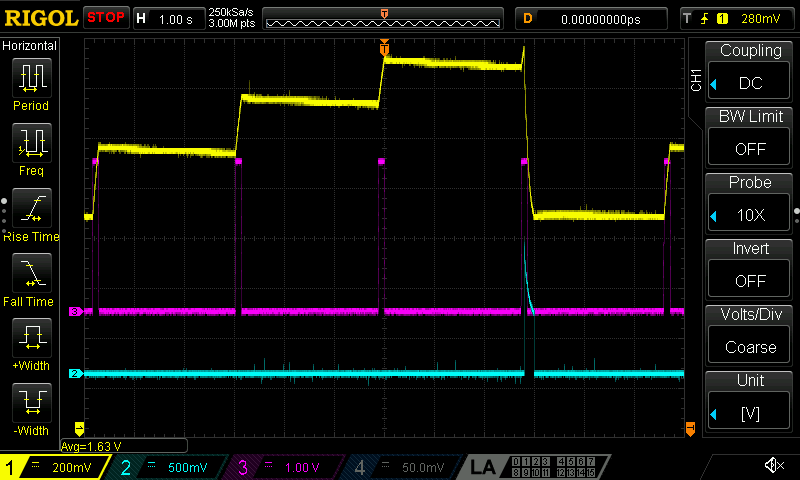
The magenta trace is the "spike train" which is output from a Rigol DG4162 Function Generator. The yellow trace is the voltage at the anode of the PUT, which simulates the "action potential" of the neuron membrane. And the cyan trace is the cathode of the PUT, which simulates the output of the neuron. What we see here are several input pulses hitting, with each bumping the action potential up a little, until it finally hits a threshold and then "fires" and resets. Lather rinse repeat.
[1]: https://en.wikipedia.org/wiki/Programmable_unijunction_trans...
[2]: https://neuronaldynamics.epfl.ch/online/Ch1.S3.html
https://github.com/amir734jj/symmetric-crypto-chat-room
Share an encryption key with someone offline, then chat with them (text + voice + video + file) encrypted with that key. Your JavaScript browser only knows that key. Nothing is shared. True end-to-end encryption in your browser.
ssh sshfighter.com
Been optimising an ssh ansi rendering engine for six months, starting to look great. Homepage is slop please forgive
LumifyHub.io
i don't know what to do in my 27 age
i don't know what to do in my 28
Recently got genomic DNA purification automated for yeast (plus have automated library prep for nanopore+ a promethion)! As part of the DNA purification task, I had to journey up to Healdsburg to buy some lysis enzyme (thank god for winemakers, 100x cheaper than the biotech grade stuff), and noticed catalogs of different yeast strains with all their flavor profiles and stuff characterized.
I'm thinking about buying all the strains and pushing them through my automated sequencing pipeline, and building a yeast genotype -> flavor converter. Then, I think it'd be neat if you could have someone try a bunch of wines to get their favorite, and then genetically engineer a yeast strain specifically for their favorite flavors. Think that could be neat.
a marketplace for people to safely collect their own AI sessions in their own S3 compat buckets so they can sell them later to dataset buyers.
I’ve been building an offline first animation webapp. CRDT-driven to support eventual team features. Just got tweening working this weekend, exporting to video is next.
An integrated softphone, email client, CRM and task manager https://www.benko.app/
1) I've been running a bunch of little daily puzzle games for my friends for a while, finally got around to polishing one for public release
Not like I'm gonna anything much with it, just was fun to get something nice-looking and presentable up for once. Working on polishing more of them and, of course, designing new ones.
2) A font generation system, inspired by Iosevka, albeit much much simpler. Learning tons of interesting technical things about TTF and WOFF2.
Software to promote live music and drink specials so I don't have to check dozens of Instagram accounts to find out what's happening tonight.
I wrote my own site parsing toolkit which removed the friction I have with the current ones. It's now easy to add new locations quickly to scale.
All those things I use once in a while, I put them on one place without ads or bs. Optimized for usability, not impressions or whatever.
If there's a tool you'd like to see there, let me know and I'll add it.
A social media platform trying to solve misinformation, astroturfing and inauthentic posting. I also thought there was a real space for some non-US-based social media, so this is based in Australia. This is owing to all the political instability going on in the US right now and especially stuff like users' identities being subpoenaed for criticising the government. It was a pet peeve of mine seeing threads of comments that are obviously artificially created to push some kind of narrative, and the ability to buy likes and upvotes to shape opinion. Nothing ever seems to get done about it on big platforms, so I wanted to make some small contribution towards fixing it. And there's an element of self-interest here, because I want to be able to read a platform where every comment is authentic.
I've been working on it since 2023 and launched in March this year. Recently, native mobile apps have been launched. It was also an experiment in seeing whether Swift Vapor can be used to build a complex backend and the answer appears to be yes. It's a lot of fun to see how bad actors are joining the site, then building automated mechanisms to counter them, using AI to improve detection, without impacting legitimate users. It's also been a great technical challenge to try to support features that the big players support, like video upload and encoding, image upload, CSAM detection, NSFW detection, LLM-generated text detection and auto-translation using DeepL.
There are also lots of legal compliance challenges now with age verification laws coming in around the world, and ensuring you employ all the correct Apple and Google-specific verification (Declared Age Range, Play Age Signals) in the correct global regions. It's also fascinating to see behind the scenes how tight or not so tight current age verification actually is.
Recently, I've been polishing the iOS version to try to hit the 120 Hz target frame rate while scrolling feeds and finding SwiftUI is much less capable at this than the old UIKit approach. I'm also trying to teach myself marketing and how to keep users engaged. I'm primarily code-oriented and historically haven't had to do any marketing myself, and this is a vertical learning curve. I have gained a great deal of respect for those who have 'figured out' marketing, seeing how difficult it is starting from nothing.
It's also satisfying to take a feature from a user suggestion in the morning to an app release including that feature in the evening. This is a speed of delivery that would be unthinkable in the corporate world, where I previously worked, and it's very gratifying to put a complete feature in a user's hands within 24 hours.
Anyway, it's a very long and tough road and may amount to nothing in the end. But if nothing else, it's been immensely educational and enjoyable. Thanks for reading and feel free to check it out:
https://play.google.com/store/apps/details?id=com.topicle.ap...
[flagged]
An Openclaw, Hermes Agent type system that is meant to be ran on a home server, built in Rails with a Tauri 2 front-end.