 alt Hacker News
Does this mean that we'll start to see SATA replaced with faster interfaces in the future? Something like U.2/U.3 that's currently available to the enterprise?
Replies
NVMe via m.2 remains more than fine for covering the consumer SSD use cases.
It's more likely that third party integrators will look after the demand for SSD SAS/SATA devices, and the demand won't go away because SAS multiplexers are cheap and NVMe/PCIe is point to point and expensive to make switching hardware for.
Likely we'd need a different protocol to make scaling up the number of high speed SSDs in a single box to work well.
SATA just needs to be retired. It's already been replaced, we don't need Yet Another Storage Interface. Considering consumer IO-Chipsets are already implemented in such a way that they take 4 (or generally, a few) upstream lanes of $CurrentGenPCIe to the CPU, and bifurcating/multiplexing it out (providing USB, SATA, NVMe, etc I/O), we should just remove the SATA cost/manufacturing overhead entirely, and focusing on keeping the cost of keeping that PCIe switching/chipset down for consumers (and stop double-stacking chipsets AMD, motherboards are pricey enough). Or even just integrating better bifurcation support on the CPU's themselves as some already support it (typically via converting x16 on the "top"/"first" PCIe slot to x4/x4/x4/x4).
Going forward, SAS should just replace SATA where NVMe PCIe is for some reason a problem (eg price), even on the consumer side, as it would still support existing legacy SATA devices.
Storage related interfaces (I'm aware there's some overlap here, but point is, there's already plenty of options, and lots of nuances to deal with already, let's not add to it without good reason):
- NVMe PCIe
- M.2 and all of it's keys/lengths/clearances
- U.2 (SFF-8639) and U.3 (SFF-TA-1001)
- EDSFF (which is a very large family of things)
- FibreChannel
- SAS and all of it's permutations
- Oculink
- MCIO
- Let's not forget USB4/Thunderbolt supporting Tunnelling of PCIe
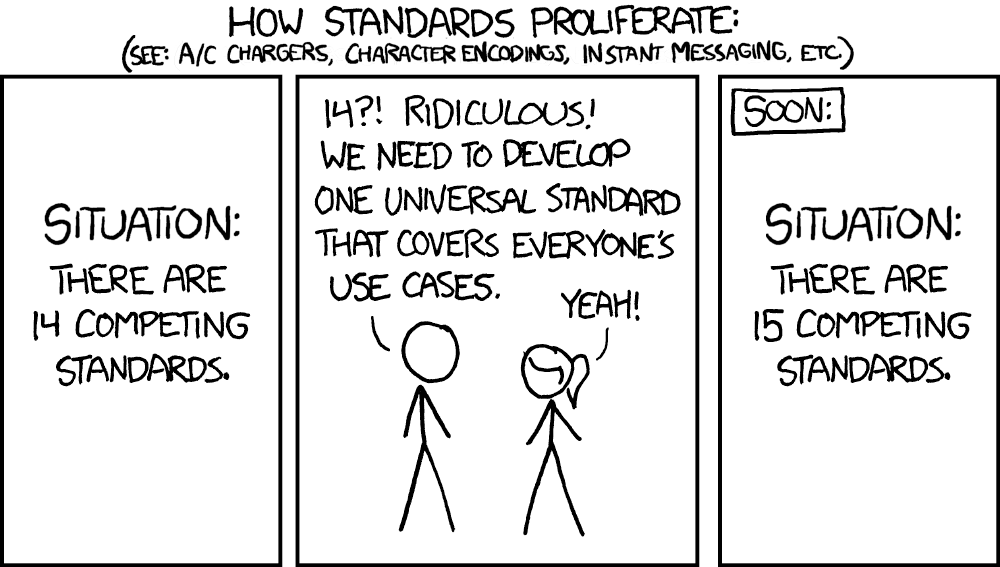
Obligatory: https://imgs.xkcd.com/comics/standards_2x.png
The first NVMe over PCIe consumer drive was launched a decade ago.
It's hard to even find new PC builds using SATA drives.
SATA was phased out many years ago. The primary market for SATA SSDs is upgrading old systems or maybe the absolute lowest cost system integrators at this point, but it's a dwindling market.