 alt Hacker News
I have a degree in fine art painting and drawing and that's not correct for oil painting. We would first put on a layer of earth tones, and work from the shadows to the mid tones. Once you got the form correct, you would work on things like adding color, details, and highlights.
In no way would you start with saturated colors. One, they're very expensive, so why would you apply them, just for most to be painted over? Secondly, the more saturated (strong) a color is, the harder it is to paint over. Try painting over a wall painted bright red with literally anything. Paint it over in blue and your blue turns brown. Paint it in yellow and you'll just get red again. That's why we (still) employ a very opaque, white paint to the canvas. Oil paint also becomes more transparent over time, so getting the form right with the earth tone underpainting is crucial for the painting to last hundreds of years.
Perhaps you're thinking of fresco painting? Then, the pigments are added to the medium (plaster) initially, and only very subtle highlights are added afterwards (if at all). This is a very, very difficult technique, and illusions like highlight and shadow are hard to pull off. But the painting over was frowned upon, because it doesn't last nearly as long as the embedded pigment in the plaster (and certainly not after cleaning/restoration). But adding highlight/shadow to a sculpture seems like not the play, as the 3D-ness of a sculpture would imply it brings its own to the table.
Makes more sense just to paint the sculptures the color you wanted them painted, like the (in comparison very contemporary) bust of Nefertiti in the article, which looks excellent. No need for highlight/shadow. I could only see that needed in the face, which would look and act much like makeup.
Replies
As the article points out, the more of the original color scheme that has survived, the better the reconstructions look.
Example: https://www.dailyartmagazine.com/wp-content/uploads/2022/09/...
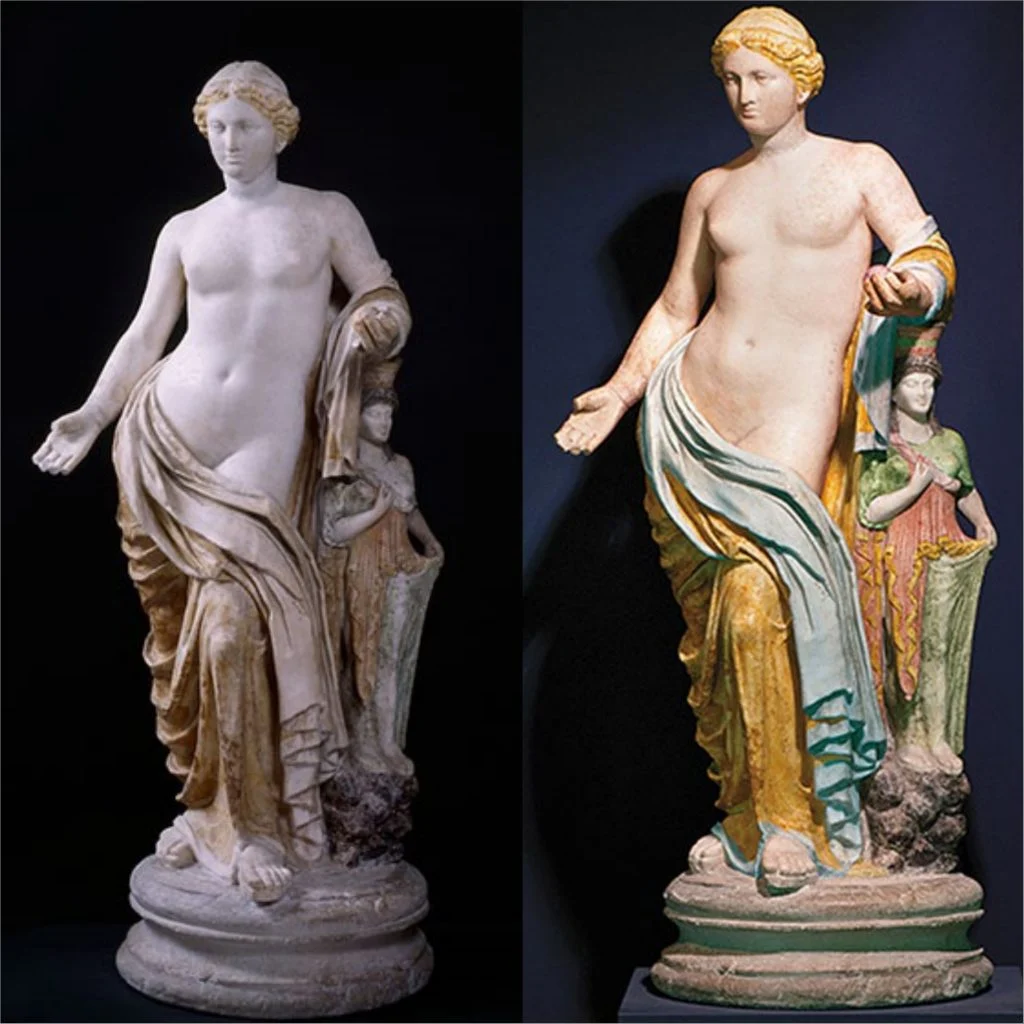
The author suggests that this minimizes the opportunity for mischief, but tbqh it's likely that the ancients were simply much better artists than the people carrying out these reconstructions today.
I'd love to see a modern artist attempt one of these reconstructions using original materials but with greater artistic freedom.
Romans didn’t have oil paints
friendly knuckle cracking I wouldn't normally do this, but I did say I'd die on this hill. I'm a tenured professor of art at a major research university. Firstly, maybe I shouldn't have said "saturated," but then again, you wouldn't argue that your earth tones, for example Yellow Ochre or Burnt Sienna aren't saturated in color?
I have a particular expertise in historical scenic painting, (granted, largely for theatrical and ceremonial practice, but that's where we have the oldest examples of painting a fake thing to look real, see trompe l'oeil https://www.britannica.com/art/trompe-loeil )
In these examples, it's clear that the painters started with relatively saturated midtones, and used washes to take the shadows down and clay filled light colors (think gouache) for the highlights: https://masonicheritagecenter.org/backdrops-gallery/
As to the expense of saturated colors, it's the scholars claiming saturated colors, so the expense was made, obviously. But was yellow the final color, when it is the perfect base coat for a two part skin tone using first yellow, and then pink? In the first image in the article, you can see that half of the face is yellow, but that the other half is light colored skin. This exact theatrical layering practice has been used, first yellow, and then pink.
The fourth and eighth images in the article looks extremely similar to the scenic backdrops I've linked above, but one is from the same time period as these statues, and the other is from hundreds of years later. There is a clear similarity in the final work. I believe it's obvious that both painters used dry pigment mixed down to a thin consistency, and used a series of 5 to 7 quick layers to achieve fast, one session results.
This practice doesn't have anything to do with what we call oil painting today, which can be quite laborious and is normally achieved over multiple sessions. These artists would have wanted to knock out a work and get down off the ladder.
Happy to discuss further, all the best.