 alt Hacker News
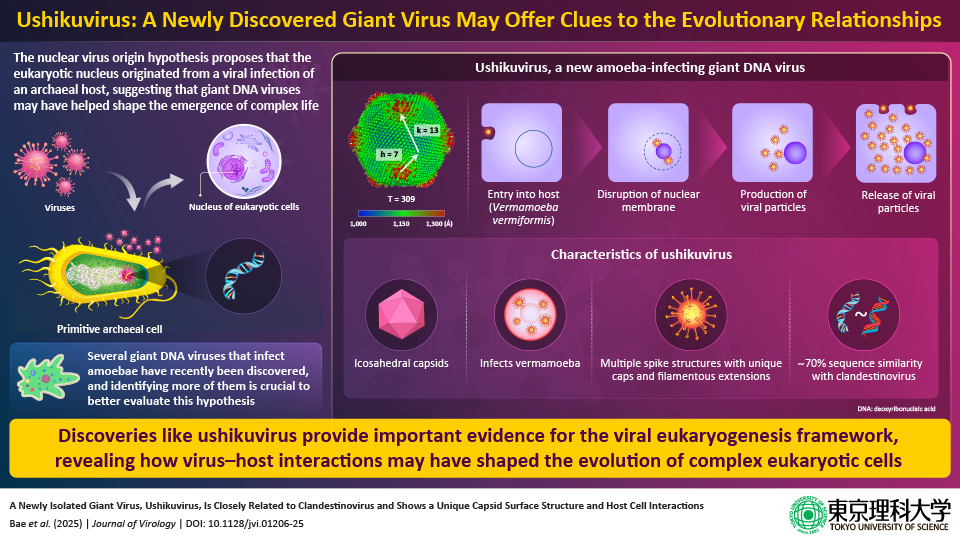
I remember someone talking about "last universal common ancestor" at some point, the single "origin of the cells" or something. Is that the same as the "archaeal ancestor" they're referring to here? And is the "archaeal ancestor" the same as the "Primitive archael cell" mentioned in the last image in the article? (https://www.tus.ac.jp/en/mediarelations/20251219_9539_03.png)
Replies
From what I know - There are two sister groups, the Archae and Bacteria. Their ancestor would be LUCA. The first Archae would be the archaeal ancestor. There should be a first bacteria to match that.
I believe that Eukaryotes then from Archae.
The article discusses the (highly speculative) hypothesis that eukaryotes arose from a virus merging with an archaeal ancestor to form a nucleus. If the hypothesis is false (it is widely believed that eukaryotes arose from a joining of archaea and bacteria, not archaea and virii) then "an archaeal ancestor" doesn't even have a referent.
The LUCA is the common ancestor of bacteria and archaea. That would have existed far earlier, as neither of those are eukaryotes.
I believe "archaeal cell" is referring to an Archaea, one of the three branches of life. All three branches derive from a more distant ancestor, LUCA. LUCA was undoubtedly preceded by other ancestors, but there is (by definition) nothing else branching from them that has survived.