 alt Hacker News
Xfce is great
Comments
I've been using XFCE for a long time now. I often give GNOME and KDE Plasma a try, but I have to tweak GNOME so much to make it usable, and KDE Plasma keeps crashing and has weird issues (Steam friends list being delayed for example), which just got worse when they switched to Wayland. I really do feel like XFCE on x11 is the logical choice, it "just works" and every app runs well (Discord has broken hotkeys on Wayland), it's stable, and whenever people see my XFCE setup they think it's something like KDE Plasma because it looks so "good" (or different at least). It even works well even on my 32:9 aspect ratio monitor, which isn't something I can say about some other desktops.
I'm a longtime fan of XFCE. I try all sorts of DEs from time to time on spare computers, but I reliably come back to XFCE, which is really just a fairly low-resource, stable embodiment of the classic GNOME feel. I used mainline Ubuntu for a few years until they released GNOME 3 (which I hated then and hate now) and then I switched to Xubuntu and was happy again.
I made a conscious decision a few years ago (after trying yet another distro that went tits up), I was going to stop playing around WITH linux and start playing around ON linux for computers that I needed to get actual work done on. If one wants a classic Linux feel that is fairly stable, XFCE and a Debian base is pretty good for that.
I am a little concerned about the whole Wayland situation, since the XFCE team seems to be taking a fairly anti-Wayland stance at the moment. It has forced me to manually move from Wayland back to X11 on new installs to get a relaible experience, which is not reliably straightforward and seemingly may become more problematic as time progresses.
Xfce is really good, used to have it as a daily driver.
His points about how they do not feel the need to change does seem correct, and it is amazing. As a windows user you should be able to figure it out pretty easily!
I just discovered alt-scroll just by accident.
Desktop Zoom (Xubuntu/Kubuntu): In Xfce (Xubuntu) and KDE (Kubuntu), Alt + Scroll is the default shortcut to zoom in and out of the entire desktop. This is an accessibility feature used to magnify specific parts of the screen.Xfce is way too minimal to be great. An great DE must be written mostly in JavaScript and hoard gigabytes of memory in order to render a single window.
Lovely post, Xfce indeed is what I also reach for, especially when I need something for limited hardware, a small install size or just something quite stable and dependable! It’s probably not the #1 in all of those categories, but does a good enough job across all of them that I’m satisfied.
> I stopped writing posts like this for years, out of fear of how people from specific desktop environments would respond.
I personally also quite liked Cinnamon with Linux Mint, which was similarly pleasant out of the box, but I’m also sorry that the author had to deal with people I guess getting kinda heated over their preferences?
xfce way back in the day was trying to clone CDE which is open source and actively maintained these days https://sourceforge.net/projects/cdesktopenv/ (really. last release was in november 2025)
Just in case you want an even more vintage experience.
There's also people trying to keep the SGI experience alive, but this one is a clone: https://docs.maxxinteractive.com/
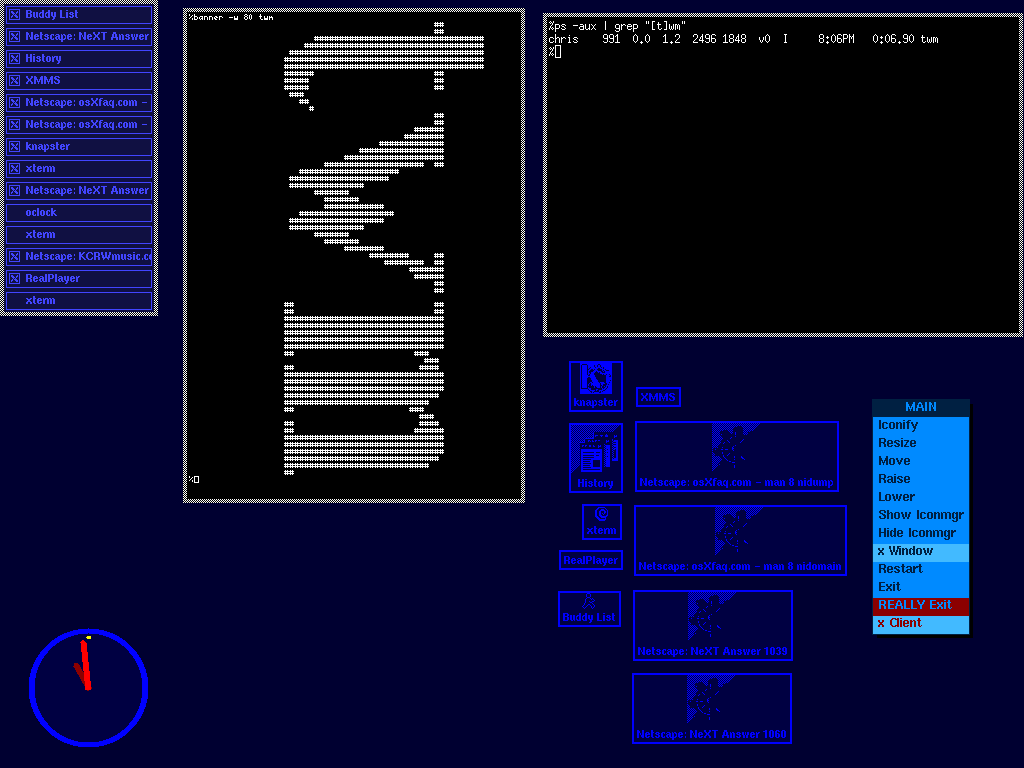
As for as early xfce check out https://xteddy.org/xwinman/screenshots/xfce-default.jpg (I'm actually on that site from 25 years ago: https://xteddy.org/xwinman/screenshots/twm-cjmckenzie.gif)

Long time user. It really is the absolute chefskiss. It's all about the small details, keeping things constant, and the minimalism. Can't praise it highly enough and I'm very grateful to everybody who works on it!
Xfce is the definition of comfy computing.
They have a visual language that's not changed for decades and just works.
I prefer tiling window managers with no decorations, but whenever I have an app that doesn't play nice with xmonad I open an xfce x server and do my work there.
Loved XFCE but it's borderline unusable with high DPI monitors and dual monitor setups that aren't the same.
When KDE 4 came out, I switched to Gnome 2. When Gnome 3 came out in (checks notes) 2011, I switched to XFCE. And that was that. I have a minimal taskbar at the bottom of my screen, with a little tray and a little button for the whisker menu. But I usually launch that using hyper + space. It gets out of my way, it gets shit done, I love it. Let's hope that it will survive the Wayland transition.
I ran XFCE back in say, 2005, 2006 or so. It looks almost exactly the same! I guess that's also the purpose of XFCE - to provide a minimal environment without the instabilities of modern GNOME and KDE or be exposed to Wayland quirks. Just roll with it like it's 20 years ago.
I've found Xfce with Wallis theme to be quite comfortable after I ditched Windows 7. Been using it for 3 years now.
Also I enjoyed how easily I could modify it:
- xfwm4: zoom only to multiples of integer, nearest neighbor only
- xfwm4: stop moving zoomed area after the cursor when Scroll Lock is on
- xfce4-screenshooter: supply custom actions with parameters %x %y %w %h of a selected rectangle, allowing me, for example, to select a rectangle and then launch a screen recording script.
Never found the use for multiple desktops, though.
The only part that irritates me is having to interact with the GTK file chooser (file open dialog). Someday I might be annoyed enough to replace it.
Xfce is what I settled on, when still using GNU/Linux desktops.
I used a multitude of UNIX environments since 1994, starting with IBM X Windows terminals connected to DG/UX, and thanks to the way Unity got dropped, the way GNOME 3.0 went down, windowmaker no longer being actively developed, Xfce it was.
Basically whenever I use a machine that has an nvidia gpu, I always use xfce, as it just works, has least amount of issues & babysitting nvidia drivers & breakages. For everything else I use KDE.
I have some old chromebooks (flashed with chromebox firmware) that uses xfce too, which works great!
So kde & xfce is the only two desktops I use these days & have patience for.
I love the idea of a minimal desktop environment, but I've never tried XFCE. Are there any themes that folks here would recommend to make it much prettier? I find the screenshots on their homepage very intuitive but a bit ugly.
If anyone is actually switching to Linux in the current hype cycle, I'd very much recommend starting with XFCE if you can. In my experience it really does seem to be the lowest-BS desktop out there, like the good parts of Windows XP.
This was my first DM, i even put my mother on it on her home laptop. I use i3 nowadays, glazewm on windows, and aerospace on macos. anything that’s not a tiling window manager nowadays just feels wrong to me. Even if sometimes my screen doesn’t look pretty because i randomly threw on virtual screen 7 all the windows i don’t currently use.
I ran a pretty vanilla xfce setup from about 2010 until 2024 until I moved to i3. Xfce is great generally, pretty easy to backup and share the whole config, ideal collection of apps. I'm sure gnome and kde have more features but for a good, solid, predictable desktop experience, cannae beat xfce.
Also try LXDE and LXQT if you would like a 'lighter KDE' vibe instead of the 'lighter gnome 2' vibe of XFCE.
Years ago, one of the most intelligent and brightest guys I worked with was using xfce
His setup was almost non existent apart from few customisations.
I remember he told me that xfce was the best one could get, while not being unpolite, he implied the problem was that people liked too much too have bells and blinking lights.
I kept using for a while what I was using, but after giving a try, yeah, that was all I needed.
I have to agree, XFCE is great!
It's weird that when using something like Windows, KDE, or Gnome, I notice a delay between clicking and the thing happening on screen. It's maybe 100ms or so, but after using XFCE for years, there's a notable and, for me, infuriating delay in many modern GUIs.
And it's not my computer; I'm sitting here with 32 cores, 128GiB of RAM, and a somewhat fancy AMD video card.
Anyway, I LOVE XFCE. I don't need a lot of bells and whistles in my DE, I just need it to launch applications, bind some hotkeys, and otherwise stay out of my way.
I used to like Xfce until KDE 4 won me over. Since Xfce switched to GTK 3, though... if you put Thunar and the Xfce system settings next to each other they don't look like they're part of the same project and that's a shame.
I made the jump to Mint Xfce when MS announced it would stop supporting Windows 7. Pretty seamless transition. I still enjoy that older minimal style reminiscent of the early 00s.
I've used Xfce exclusively since Gnome jumped the shark many years ago. It's fast, does the job nicely, and stays out of your way. I do hope they get stable on Wayland sometime soon, because X11 seems to have lost its momentum, and I would probably like to enable fractional scaling on my next laptop.
Is there something like a tilling extension for xfce? Not snappy corners but actually tilling by default?
I'm currently on popos (using GNOME) and enjoy the tilling of its GNOME extension. Actual tilling wms were too hackish for me whenever I tried them.
I used XFCE (MxLinux) for 5 years until recently when I moved to KDE Plasma (Fedora) because of Wayland support. Imo, KDE is better and more resource efficient. I also got a free 10 fps boost on DotA 2 on the same hardware and settings. Zed and a lot of other apps are better supported on Wayland.
If someone somehow enlarge the 1px handle for windows resizing by default (not default theme) I can say 'it's perfect'.
I really wanted to like XFCE, but the tiny tiny window grab area for resizing is just too damn frustrating.
I used to be on Gnome when it was the old interface (windows XP style), then moved to MATE. Never used Xfce. How does it compare to MATE? I remember mate being ever so slightly unstable (not sure if it was HW compatibility issues).
Xfce has long been the only DE that gets out of my way enough for me to actually be productive instead of excited by the possibility of different configurations.
Never liked it. Terrible font rendering.
I ve excludively used Xfce thru my linux journey, but cant make it work for a high dpi framework laptop. So Gnome it is :(
XFCE is great for VNC setups where a full desktop is unrealistic
Let me join on this XFCE love fest. I also think it rocks, but it's more than that. It's also my go-to install for "friends and family" linux installs (Debian stable and XFCE).
I've been doing a couple of these over the years, and the great thing about XFCE is that it doesn't change, while at the same time being fairly intuitive and discoverable to the tech-unsavvy people.
So, with XFCE, I explain things once and I don't have to explain things to that person ever again. It stays as is over the years!
One only have to make sure to disable the virtual desktop (4 screens by default) thing and be sure to only keep one. That's the most confusing thing to non-tech-savvy that ever was. "Where have all my windows gone?! I moved the mouse and poof! they were gone"
Also, it runs great on old hardware. It's mostly what I've been doing. Family and friends tell me how they'll need to buy a new computer because theirs can't go on the internet anymore. I tell them "no you won't!". And then their computer becomes super fast again. Make my Computer Great Again.
I concur with the author - XFCE is a great desktop.
I first used it on an eeepc because something light was the order of the day. But then Gnome 3 happened and I made the switch on my full-strength machines too.
It works and it works well. It's theme-able. It's not opinionated about how I should use it so I can put bars wherever I want, launchers, menus, systrays wherever I like, and I can do it all with a few clicks and dragging and dropping stuff.
Generally a great DE and one that won't screw you over on update, which is something I've come to value.
That 500x313 screenshot of the desktop does not help any argument.
Yeah, xfce is as close to an ideal desktop experience on Linux as it gets. A competent desktop environment really doesn't need that much.
Post-2010ish Gnome and kde are like some sort of sick joke. The fact that there are people who actually contribute their precious free time to these, feels to me profoundly sad.
xmonad is my main.
XFCE is when my backup when I break xmonad.
Anyone using it with Niri?
I used to use XFCE a lot, but since then, even though it sucks in its own ways quite a lot, Gnome defaults to a nicer environment nowadays and doesn't seem so resource intensive anymore.
I moved away from XFCE over the CSD drama, despite winning that battle, the resistance showed me the project lacks the backbone to resist GNOME long term
I like XFCE for capturing the spirit of an era, and it’s still lightweight, so in that sense it’s excellent.
If I was more purely looking for something lightweight I think I’d end up with some other choice with a more modern design language.
Even thinking about this subject still makes me a little miffed about the “need” to constantly evolve look and feel of the UI.
Liquid Glass changed looks without innovating on functionality. It added bloat and confusion without providing any innovation to justify it. The whole system is so bad that I followed through on selling my Mac to go with a Linux laptop.
At least with modern KDE/Gnome you can make a user experience argument over XFCE for why you’d upgrade. Okay, it’s not as snappy and lightweight, but you get a lot of functionality out of it.
But these commercial operating systems are changing the UI to satisfy a marketing department rather than users. It has to look different or else there’s nothing new to sell.
While I appreciate the author's enthusiasm for the traditional desktop metaphor, this analysis conflates interface familiarity with architectural efficiency. It is a pleasant sentiment please don't get me wrong but technically a bit short sighted. The author praises xfce's modularity and unix-like separation of components (xfwm4, xfce4-panel, xfdesktop), failing to realize that this design pattern is actually a performance antipattern in the modern display server model.
In the X11 era, the server arbitrated these components. In the Wayland era (which I must assume is the baseline context), the compositor is the server. Forcing the panel and window manager to communicate via IPC rather than sharing a memory space in a monolithic compositor introduces unavoidable frame-latency and synchronization issues. Issues specifically regarding VBLANK handling and tear-free rendering that integrated environments like plasma or sway solved years ago.
"Xfce is lightweight, typically using ~400-600MB RAM at idle"
ROTFL. Moksha, the lightweight desktop for Bodhi Linux, has very low RAM requirements, with a default install using under 100MB of RAM
[dead]
Xfcd is still a pc knockoff. Let's see more attempts to knockff macs, which have far, far better thought-out ui. Then maybe we can make something better! I'd pay serious money for a decent os that tries to copy macos.
The move to Wayland from X enables the commercialization of linux solidifying DRM stakeholders in the ecosystem. I assume this promotion of XFCE is a veiled protesting of DRM. I support this.
I used to love Xfce, when KDE felt clunky to me and Gnome went in directions I found insane. Since then Gnome remains Gnome, but KDE has matured to a stage where most of the defaults feel like they were designed for me - and any that doesn't can be easily changed. After a period of using more and more K* applications, I realized I might as well switch desktop... Xfce is now a fond memory, and the times have moved on.