 alt Hacker News
Parking lots as economic drains
Comments
Cars, and in particular, parking, kills cities. Parking is sponge that sucks all the life out of places.
The High Cost of Free Parking is an incredible book that shows exactly how awful parking has been for society.
Maybe surface parking lots aren't the answer, but I do know that if there are places that I can't easily park at, I just don't go there unless absolutely necessary.
Nice to think, "the people will take trains!" but sometimes it doesn't work that way.
This article goes too far and yet not far enough. By trying to build more buildings that increase parking in yet smaller footprints and then charge for the added expense of all of that, why not just eliminate cars in these districts altogether. Park outside of the city, walk/bike/scooter/mass-transit within the city. Now you aren't trying to extract value from the simple act of wanting to exist in a space leaving more value to core economic goods and services.
We need to attack The Modern Moloch (99pi).
I lived in Vancouver for years, near the downtown, near the SkyTrain and it was amazing. Back then I thought I would never live anywhere but the downtown of a city.
But, you know what, life changes. I know there’s hardcore folks out there who will cycle miles with their kids, or take them on transit, or even live with them in a 2 bedroom downtown apartment, but it is just too hard to live that way for many people. With a family, most people need more space, and they need to be able to get from their suburban home to some kind of shopping or work, in minimum time so that they can both take care of kids, maintain a career, and have a glimpse of a life for themselves.
We don’t need to have surface lots right in the middle of every downtown, but there needs to be somewhere for people to park.
I cannot recommend this Road Guy Rob video enough: https://youtu.be/K1TFOK4_07s?si=IwCK4sxVgw5Konu4
TL;DW: The difference in tax revenue between a surface parking lot and a business with subterranean parking is so vast, that cities can justify using value to underwrite the loans necessary for developers to do the work. (Called "Tax Increment Financing") This model is proving extremely successful with cities that try taking it on.
This is called out in the article as well but you're always welcome to join the party at https://parkingreform.org
It's a great group of advocates that are making impactful changes across the US and internationally.
Nary a mention of parking garages / underground parking?
Austrian cities have way more parking than one would expect, but it's nearly all underground and costs €
The benefits are huge, you have have dense commerical areas where you drive in, park underground, pay for some hours, then walk between the shops to do all your business.
Cambridge MA was rezoned in the mid-20th century to suburban standards, in a city where land in a mid-range neighborhood now costs $350-$400 per square foot. Besides putting in floor area ratio requirements that required most of the existing housing to be grandfathered, they added a requirement of one parking spot per unit.
If it's a traditional 1-car driveway that's about $70K worth of land, although in the end it's zero-sum because it takes away an on-street spot. Parking garages for larger developments probably cost as much or more per parking space - they use less land, but they're expensive to build.
It's insane, and they're trying to fix it, and approving special permits left and right to omit the spots.
If you don't like parking you need to start with cars: give people a reasonable alternative. Too many are looking at this from a standpoint of "lets just get rid of parking" - without asking what people will do instead. All too often the answer is they will drive someplace in the suburbs instead where they get free parking.
If you want your downtowns to not have parking you need an alternative. In most cases that means you need to improve your transit in the entire city so people can get there.
I enjoy the image [1] circling parking lots to show the land wasted right next to maybe 2x as much land consumed by a highway.
[1] https://substack-post-media.s3.amazonaws.com/public/images/2...
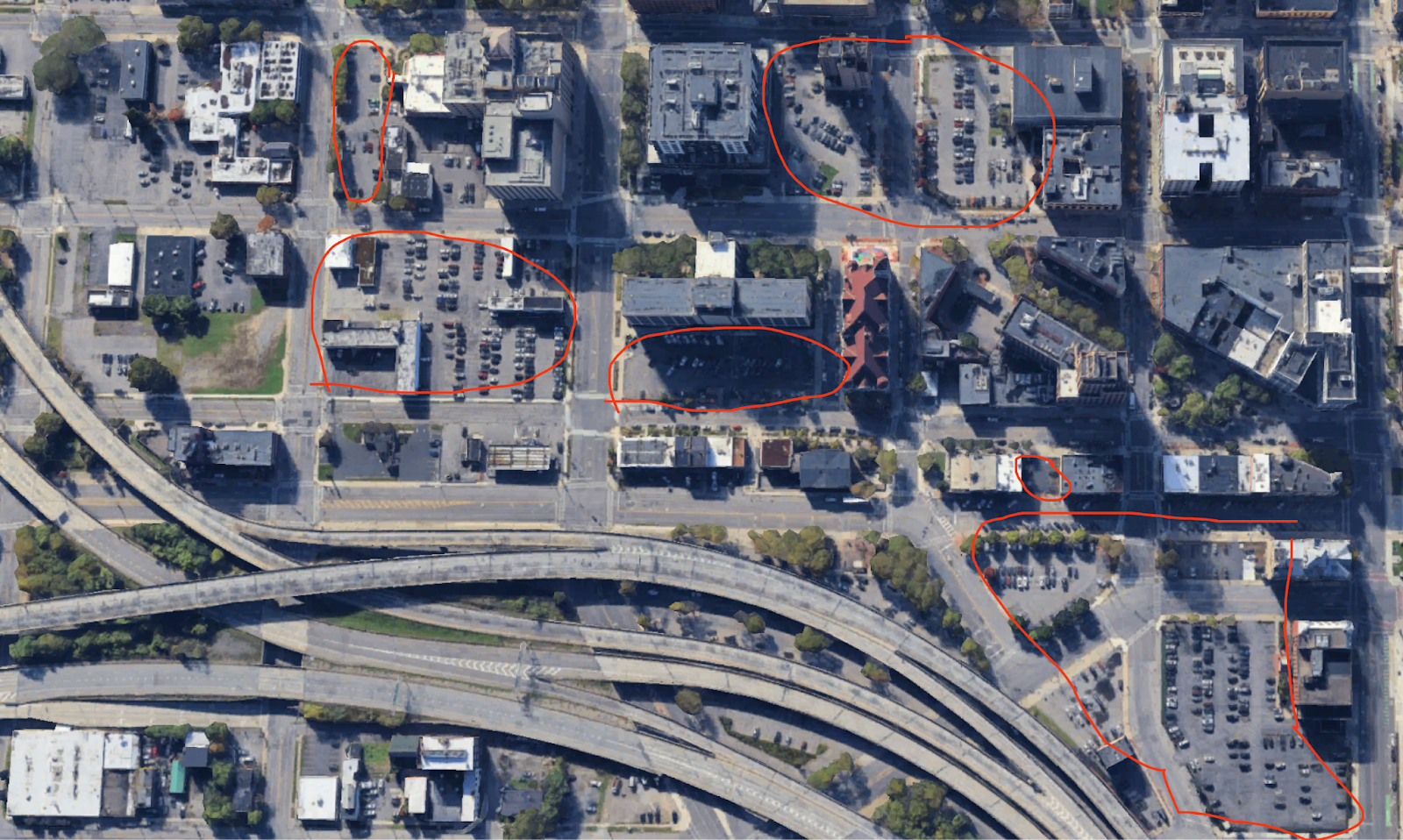
"That is, how much value a parcel creates for the community compared to how much value it consumes simply by existing as land. Think of it like this:
Net Contribution=(Economic Output in $)−(Land Value in $)"
This calculation is shady. Land value fluctuates and already "bakes in" the predicted economic output... but multiplied across decades. Not to mention, land doesn't consume value by existing. the value never goes anywhere. Its opportunity cost, not a decrease in actual value.
Yes, there is value "missed out on", but it hasn't been destroyed. Because it never existed. And that value wouldn't have appeared out of nowhere. it would've required using up other resources that the parking lot wasn't.
>> Our property tax policy punishes buildings and does not inflict enough cost on underutilized land. The result is a system that rewards holding valuable sites idle while penalizing those who invest, build, and contribute to the city’s productivity.
This is the exact reasoning for cutting taxes on the rich and let the upper middle class pay the highest percentages.
Maybe the family who has owned that lot for 80 years doesnt have the money to upgrade it for the "highest and best use" by someone else's standards, but the revenue allows them to live a little better.
I've never understood why constant growth is so often a priority. The world is headed for population decline so governments better figure out how to shrink instead of growing.
Im not against city planning, but this whole piece stinks of telling people what to do.
I first thought this was a joke. E.g.
> in economic terms, a parking lot doesn’t simply fail to add value; it actively subtracts value. Every year it sits idle
Idle. Cars park on it, right?
But no, it is sincere.
Solar panels is the answer. It keeps the people dry in the rain and the power can go right back to the city. Yes, it's not possible for all lots. For a vast majority of them, it's a net win.
Build it underground if feasible, or build a parking garage with high-economic-contribution units in upper floors.
Related: there's currently a bill in the NYS legislature which would allow cities to switch partly to a land-value tax. This is a pretty good local article about it: https://centralcurrent.org/how-a-state-bill-with-support-fro...
I currently live in a downtown area, and "walkable city" policies like this is why I'm going to move to a big open suburb when my lease is up. It makes life much more of a hassle, especially in cold weather.
> How can we get less parking lots?
Switch from a culture of car use to walking, biking and public transport (buses, trams, light rail). And if people outside the city are coming in by car - let them park outside the town center and continue with public transport from there (while public transport is developed further afield; after that they would only drive their cars as far as the nearest train station, or even bike there).
i live in one of these cities and it's impossible to explain.
Here's the thing - if I can't easily park somewhere, I won't go there. There is no public transit, but even if there was, I am not going to use it if it's anything like the NYC subway. You have to solve the problem of mentally ill people causing problems on the public transit, socially ill people blasting music from a bluetooth speaker, etc before anyone I know would ever consider using the public transit. It's just so much less pleasant than driving.
In effect, reducing parking reduces economic activity. Even if you increase public transit use, those users are overwhelmingly poor and don't contribute greatly to the economic activity where they go.
Parking maximums would be just as stupid as parking minimums. Instead of oversupply with inefficient use of space you'll get under supply with businesses starved of customers who can't find a convenient parking space.
Let the market decide how much parking is needed. It'll do a much better job than you ever could.
This is such a terrifying vision of the proper scope of government. We shouldn't use government to hurt people, and making someone's property too expensive to continue owning is definitely hurting them.
If you're really concerned with surface parking push the government to stop making it so expensive for companies to develop self-driving technology or to offer transportation services. If it's easier and less expensive for individuals to use transportation that they don't need to park anywhere the need for surface lots vanishes and those owning the property will look for something else to do with it.
Parking minimums prevent developers from free-loading on a commons, that commons being street parking.
So eliminating parking minimums by themselves will create nasty side effects.
But of course the correct answer to tragedy of the commons is pricing -- price the street parking appropriately and it won't be abused so you won't need worse solutions like parking minimums.