 alt Hacker News
Show HN: Smooth CLI – Token-efficient browser for AI agents
Hi HN! Smooth CLI (https://www.smooth.sh) is a browser that agents like Claude Code can use to navigate the web reliably, quickly, and affordably. It lets agents specify tasks using natural language, hiding UI complexity, and allowing them to focus on higher-level intents to carry out complex web tasks. It can also use your IP address while running browsers in the cloud, which helps a lot with roadblocks like captchas (https://docs.smooth.sh/features/use-my-ip).
Here’s a demo: https://www.youtube.com/watch?v=62jthcU705k Docs start at https://docs.smooth.sh.
Agents like Claude Code, etc are amazing but mostly restrained to the CLI, while a ton of valuable work needs a browser. This is a fundamental limitation to what these agents can do.
So far, attempts to add browsers to these agents (Claude’s built-in --chrome, Playwright MCP, agent-browser, etc.) all have interfaces that are unnatural for browsing. They expose hundreds of tools - e.g. click, type, select, etc - and the action space is too complex. (For an example, see the low-level details listed at https://github.com/vercel-labs/agent-browser). Also, they don’t handle the billion edge cases of the internet like iframes nested in iframes nested in shadow-doms and so on. The internet is super messy! Tools that rely on the accessibility tree, in particular, unfortunately do not work for a lot of websites.
We believe that these tools are at the wrong level of abstraction: they make the agent focus on UI details instead of the task to be accomplished.
Using a giant general-purpose model like Opus to click on buttons and fill out forms ends up being slow and expensive. The context window gets bogged down with details like clicks and keystrokes, and the model has to figure out how to do browser navigation each time. A smaller model in a system specifically designed for browsing can actually do this much better and at a fraction of the cost and latency.
Security matters too - probably more than people realize. When you run an agent on the web, you should treat it like an untrusted actor. It should access the web using a sandboxed machine and have minimal permissions by default. Virtual browsers are the perfect environment for that. There’s a good write up by Paul Kinlan that explains this very well (see https://aifoc.us/the-browser-is-the-sandbox and https://news.ycombinator.com/item?id=46762150). Browsers were built to interact with untrusted software safely. They’re an isolation boundary that already works.
Smooth CLI is a browser designed for agents based on what they’re good at. We expose a higher-level interface to let the agent think in terms of goals and tasks, not low-level details.
For example, instead of this:
  click(x=342, y=128)
  type("search query")
  click(x=401, y=130)
  scroll(down=500)
  click(x=220, y=340)
  ...50 more steps
Search for flights from NYC to LA and find the cheapest option
Smooth enables agents to launch as many browsers and tasks as they want, autonomously, and on-demand. If the agent is carrying out work on someone’s behalf, the agent’s browser presents itself to the web as a device on the user’s network. The need for this feature may diminish over time, but for now it’s a necessary primitive. To support this, Smooth offers a “self” proxy that creates a secure tunnel and routes all browser traffic through your machine’s IP address (https://docs.smooth.sh/features/use-my-ip). This is one of our favorite features because it makes the agent look like it’s running on your machine, while keeping all the benefits of running in the cloud.
We also take away as much security responsibility from the agent as possible. The agent should not be aware of authentication details or be responsible for handling malicious behavior such as prompt injections. While some security responsibility will always remain with the agent, the browser should minimize this burden as much as possible.
We’re biased of course, but in our tests, running Claude with Smooth CLI has been 20x faster and 5x cheaper than Claude Code with the --chrome flag (https://www.smooth.sh/images/comparison.gif). Happy to explain further how we’ve tested this and to answer any questions about it!
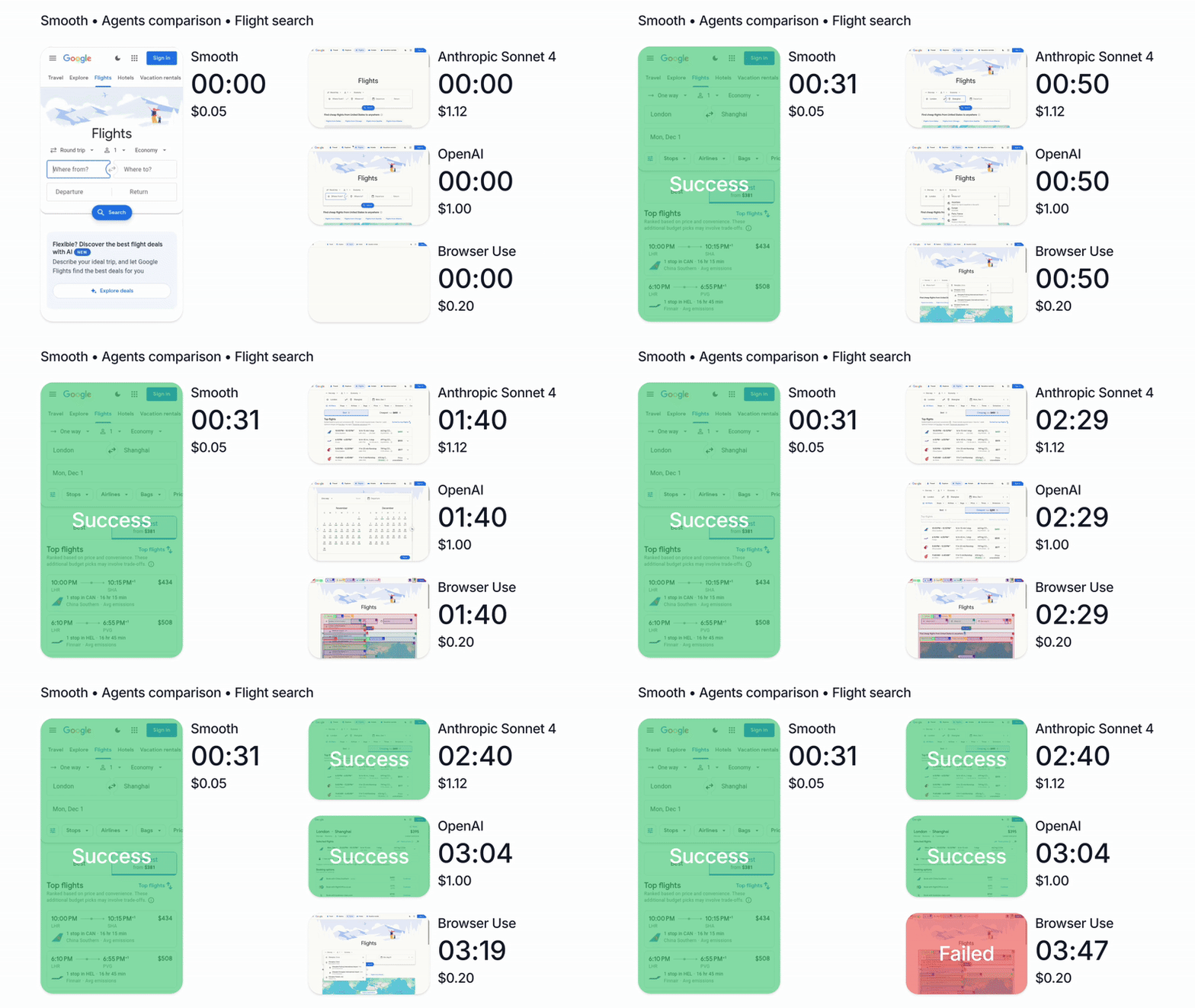
Instructions to install: https://docs.smooth.sh/cli. Plans and pricing: https://docs.smooth.sh/pricing.
It’s free to try, and we'd love to get feedback/ideas if you give it a go :)
We’d love to hear what you think, especially if you’ve tried using browsers with AI agents. Happy to answer questions, dig into tradeoffs, or explain any part of the design and implementation!
Comments
How does your approach differ from BrowserOS, not in the product sense(their product is ane enterprise browser based off chrome). but in how they designed the interface between the browser and the models?
This looks really interesting!
I _would_ be curious to try it, but...
My first question was whether I could use this for sensitive tasks, given that it's not running on our machines. And after poking around for a while, I didn't find a single mention of security anywhere (as far as I could tell!)
The only thing that I did find was zero data retention, which is mentioned as being 'on request' and only on the Enterprise plan.
I totally understand that you guys need to train and advance your model, but with suggested features like scraping behind login walls, it's a little hard to take seriously with neither of those two things anywhere on the site, so anything you could do to lift up those concerns would be amazing.
Again, you seem to have done some really cool stuff, so I'd love for it to be possible to use!
Update: The homepage says this in a feature box, which is... almost worst than saying nothing, because it doesn't mean anything? -> "Enterprise-grade security; End-to-end encryption, enterprise-grade standards, and zero-trust access controls keep your data protected in transit and at rest."
I'm a bit curious. Why did you link the docs instead of the site in this post?
Interesting idea as an open source tool I could hack locally, but no way in hell am I adding yet another bill and using a web browser of all things as SaaS. I'll make my own web-specialized subagent.
Interesting approach. Exposing high-level goals rather than UI actions definitely reduces token overhead, but reproducible comparisons with open-source setups would strengthen the claim. Also, remote browsers introduce a new attack surface—sandboxing helps, but I’d like to see clear isolation guarantees against malicious pages or rogue scripts.
I was actually very interested until I realized that this doesn't run on my computer…
I get the sandboxing, etc, but a Docker container would achieve the same goals.
Way too expensive, I'll wait for a free/open source browser optimized to be used by agents.
Look this is cool idea, but subscribing to anything these days is a hard sell, we are all tired of subscription plans. You probably would be more succesful if you could find this to package in a way that is not subscription.
Frontend QA is the final frontier, good luck, you are over the target.
The amount of manual QA I am currently subjected to is simultaneously infuriating and hilarious. The foundation models are up to the task but we need new abstractions and layers to correctly fix it. This will all go the way of the dodo in 12 months but it'll be useful in the meantime.
agent-browser helped a lot over playwright but doesn't completely close the gap.
i can see a new token efficient mirror web possibly emerging using content type headers on the request side
forms, PRG, semantic HTML and no js needed
Congrats for shipping.
How does it compare to Agent Browser by Vercel?
Ironically, the landing page and docs pages of Smooth aren't all that token-efficient!
I'm working on building a personal assistant concept. One test I've been running is asking different AI assistants to use a browser to check available appointment slots for my hairstylist. None of them has managed to do it successfully yet, but I'm going to keep trying.
https://n694923.alteg.io/company/656492/personal/menu?o=