 alt Hacker News
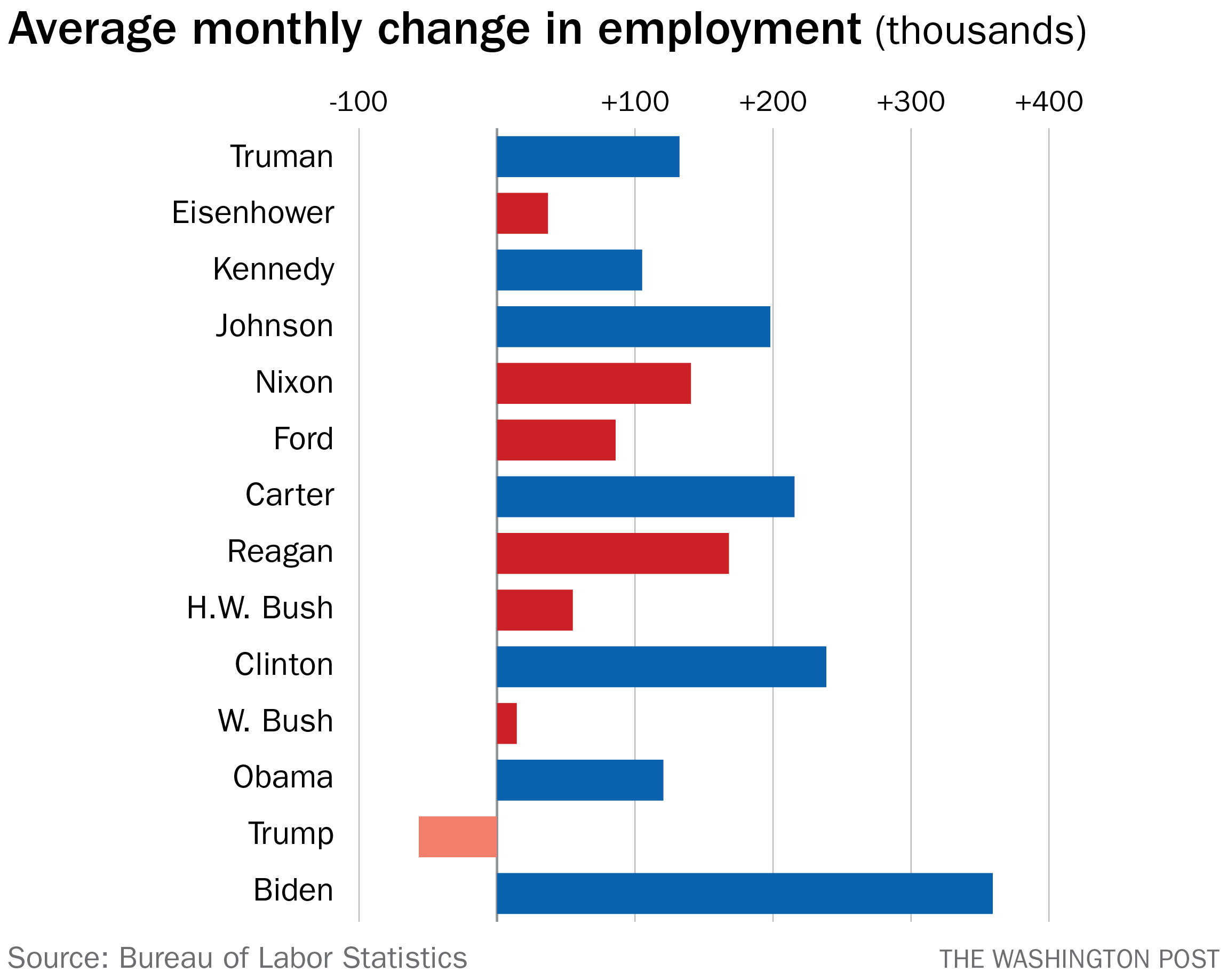
Since the end of WW2, Democratic administrations have presided over significantly higher job growth than Republican administrations.
https://arc-anglerfish-washpost-prod-washpost.s3.amazonaws.c...
Replies
I'll see if I can dig it up, but I remember reading that on average, under democratic presidencies going back to FDR, the economy in general performs better than it does under a republican presidency. If I'm remembering right, it's not as simple as mere ideological differences because there has been changes within the parties in those intervening ~75 years but the trend still holds.
There are many marginally employable swing voters who vote Republican when they have jobs and the Democrats in charge ask for taxes, then vote Democratic when they get put out of work and need a social safety net.
Carter has good employment, but terrible inflation making everyone poor in miserable. His Fed appointee, Paul Volcker raises interest rates, kills inflation, puts the country in recession, and drives unemployment up during Reagan's first years in office. Carter's job numbers look better than they should, and Reagan's worse, unless you look at the bigger picture.
I don't think presidents have all that much to do with the economy (vs. the legislature). Well... maybe the most recent example is to the contrary with certain actions that historically should have been the role of Congress.
I looked this up. "10 of the 11 recessions between 1953 and 2020 began under Republican administrations”. It seems Republican = Recession.
Is it possible that can be attributed to lagging effects of their predecessors’ policies?
Congress has a substantially greater impact on the business climate than the President.
CES establishment payroll survey monthly change averages is quite the choice of stats lol.
JOLTS is where stress shows first. Openings fall,[1] hiring slows,[2] quits drop,[3] and layoffs rise later.[4] Biden in particular shows the weakness of your provided stats.
[1] https://fred.stlouisfed.org/series/JTSJOL
[2] https://fred.stlouisfed.org/series/JTSHIL
I've always heard market forces and policies dont take effect until the following presidency.
Yea, you can create programs that create jobs, by spending taxes. So this should be zero surprise.
The question you should /really/ be asking, since taxes are involved, is, was that hiring actually effective? Did we create jobs that actually provided lasting value to the world? Or did we just juice the numbers for the polls?
>S&P 100 added more than 300,000 jobs — 94% went to people of color.
Democratic administrations also engage in and promote discriminatory hiring policies which flagrantly violate the civil rights act (Title VII specifically).
https://www.bloomberg.com/graphics/2023-black-lives-matter-e...
Is there a line chart or a stacked area chart of this over time?
This seems to confirm that Joe Biden created the most jobs of any president in recent modern history.
There has to be some lag, and it is more about who controls Congress.
For example, the housing crisis and bubble were largely driven by legislation passed years earlier, including the 1999 repeal of Glass Steagall under Clinton. That was passed by a Republican controlled Congress, and the crisis eventually exploded under Bush. So I do not think either Clinton or Bush can be directly blamed for the housing crash. It is the repeal of the glass steagall act.
And was the dot com bubble crash in early 2000s caused by Clinton or by Bush? Or some legalization passed a long time ago? Or it just a business cycle?
More broadly, I would argue that presidents, and even legislators, have limited control over the actual health of the economy. Are we going to say Trump is responsible for the AI boom? And if this AI boom collapses into a massive bubble burst under the next administration, will that president be blamed instead?
It's the ratcheting mechanism of bipartisanship.
One party develops, the other party cracks down on potential economic wins for the working class.
Both parties make sure the capitalist class stay in power.
Nothing happened in 2020 to affect this chart I'm sure. I would expect nothing less from the publication that falsely claimed Russians hacked into the US energy grid before an election.
I mean, part of this is just math. If a government spends more, it’s literally injecting money into the economy, so of course you get more jobs and growth in the short term. That spending is the jobs. If you tighten spending to cut waste or rebalance the books, growth slows and jobs shrink, but that’s kind of the tradeoff when you’re trying to fix long-term issues.
Over the last few decades, neither party has really cared about deficits anyway. Everyone’s been spending, just at different speeds. The real question isn’t “who creates more jobs,” it’s whether the spending is efficient, sustainable, and actually creates long-term value. Eventually the bills come due, interest costs rise, and priorities shift from growth to just keeping the lights on.
So yeah, Democrats tend to show stronger job numbers, but spending more will almost always do that. Whether it’s good spending is a separate debate. Budget discipline isn’t partisan, it’s just basic economics.
It's even crazier when you look at the data since the end of the cold war in 1989. Then the ratio of jobs created is 50:1 for democrats.