 alt Hacker News
Austin’s surge of new housing construction drove down rents
Comments
Meanwhile, California is also trying to build housing near transit, but Menlo Park wants to preserve the character of downtown by preserving dirty, cracked, flat, surface-level parking lots like it's 1950.
So glad we don't need to re-write the first chapter of almost every economics 101 textbook!
I am trying to build new homes in Washington state. I have been navigating a gauntlet of a five step process where eleven departments have to give approvals at each step and it has taken five years. This is just to split a twenty acre parcel into two ten acre parcels.
Before moving to Europe, I always had this conception of Germany as being very good at organizing things, especially anything involving engineering. It doesn't take long to set this picture straight.
> From 2015 to 2024, Austin added 120,000 units to its housing stock—an increase of 30%
Compare that to the following [1]:
> The [...] government [...] intended to build 400,000 new homes annually, including at least 100,000 social housing units. This target was significantly missed from 2021 to 2024. In each year from 2021 to 2023, fewer than 300,000 new homes were built.
So, the city of Austin alone build on average 12,000 new housings each year, while all across Germany, they failed to build 300,000 new units. That's roughly a 1:25 ratio.
So, how much bigger is Germany than Austin, Texas? More than 80 times bigger.
Is that just because big projects don't scale linearly? I would think that that's definitely one factor. Also, I'm not convinced that economy of scale laws apply here, given that this is not one company building 300,000 houses.
But it does show a number of problems inherent in Germany's current situation: (a) shortage of skilled laborers; (b) high cost of labor; and (c) exorbitantly much red tape. These three points alone are among the most frequently cited factors that companies feel inhibit business, and it holds across disciplines.
[1] https://www.wsws.org/en/articles/2025/08/20/vmjm-a20.html
Good news - experimental verification of the law of supply and demand!
I'm sure the analysis is welcome though and I hope policy makers try to learn from this. We could densify most american cities quite a lot more.
Dumb question, many cities suffer from extremely high property (i.e. land) prices. I understand the NIMBY barrier. But I don't understand why it isn't more common to simply.. start a new city. Especially in countries like Australia where property prices are sky high and alternative places for setting up a new city are abundant. Maybe internet connectivity was previously a barrier, but now.. starlink.
I put this question to grok; its response:
> Unfortunately, Australia's legal, regulatory, financial, and practical systems make this extremely difficult (bordering on impossible at any meaningful scale).
Crazy that the reason we can't have an order-of-magnitude reduction in the cost of the most important thing people need (shelter) is not due to resource constraints, but man-made ones.
Please bear in mind when you discuss "rent control" in the USA you really do mean the version you see in your locale. The idea that rent control sui generis failed worldwide is (in my personal opinion) a stretch.
Public housing also has many models. State owned. State funded but via cooperatives. Part state. state assisted co-buy. There's lots of models and so it is also a bit bogus to talk as if public housing has one shape.
I don't like the tone of input here, there is jeering and name calling and ACKSHEWALLY type responses so I am not going to continue, I just wanted to say: don't forget the lessons learned in Austin may not extend world-wide.
>>> The city changed zoning regulations to allow construction of large apartment buildings, particularly near jobs and transit. In 2018, voters approved a $250 million bond measure to build and repair affordable housing. Permitting processes were reformed to speed development and reduce costs.
All three of the five things most economists say about house building - and each one will hit house owning voters hard making it hard to replicate.
But none the less a triumph of common sense :-)
Sure, but it's not that easy. The swaths of new people need infrastructure and support: schools, hospitals, police, fire stations, roads, water, sewage, flood prevention, etc. That's a lot of money upfront. This is why most cities in the EU block many projects like these.
Also those people will saturate downtown making it lose its culture.
I'm always amazed at the American way of "just throw money at the problem".
Anecdote: I lived in Austin from 2017 to 2021. My rent was always very cheap (my baseline is Brooklyn which I guess makes everything feel cheap. But my rent went up $50 for the first 3 years and then down $200 during Covid and I checked recently and my aptmnt is still the same price). Around the time I left everyone was buying up houses to rent and Airbnb. Very palpably felt the growing supply when it came to bnb's (the owners having a harder time competing for renters etc). It's hard not to be surprised in spite of the tremendous growth in that city
At a glance, I'm a bit skeptical. It looks like they're cherry picking the high point for rent (the COVID spike).
> "Rents fell. In December 2021, Austin’s median rent was $1,546, near its highest level ever and 15% higher than the U.S. median ($1,346)."
Of course having more housing should, all things equal, lower rent. But all things certainly weren't equal, especially during this time period.
It's almost as though the well-known and proven method of building more housing works!
Similarly, the tested and proven solution to homelessness is providing housing up front. Don't have any requirements (employment, sobriety, etc) blocking housing. Those things are easier to achieve with a roof over your head.
The solution to ALL cost of housing problems globally is this.
Everywhere you look, Australia, Canada, UK, EU this is just a massive issue for young professionals with long-term disastrous downstream political consequences, and yet, the solution is so simple but hardly ever implemented in these countries.
Just BUILD MORE HOUSING. Mass build everywhere. Vast amounts of land is available. Just build homes and apartments everywhere!
You mean to tell me that increasing supply lowers price? Fascinating.
It's wild how the solution to housing is: stop the government from stopping housing from being built.
Another part of this - higher interest rates really put the brakes on home values. We own a rental property and the home value has more or less been locked in since 2022. In our otherwise hot metro area, nobody has raised their rental rates on similar properties in 4 years.
It's a win-win for our tenants. Prices seem to be stable and there's no rush for them to lock down a house RIGHT NOW.
It's sure not good for my bottom line as a landlord for them to keep adding homes and keeping rates up. But it sure seems like a no brainer for society at large.
Certainly, that can't be true?
Increased supply lowered prices for the same levels of demand?
Seems unlikely.
Same has been happening in Melbourne, Australia. The state government has basically steamrolled the boomers and allowed highrise construction next to existing train stations. Despite having huge population growth, rents are some of the most affordable in the country.
Has anyone also considered the possibility that Austin is just not that great? Like...those comparing it to the Bay area or a light weight NYC need their heads checked. Maybe people (like me) just realized it wasn't great and...left?
Can it be also related to demand not catching up or even declining? If place is in high demand and prices go down shouldn't it cause even more people coming to it (compensating for a possible price change). (Note: not an expert on this, I'm just curious how it really works - besides obvious thing: more supply -> price goes down).
Why do people accept that supply/demand works in so many industries when the private market is allowed to flourish, but won't accept it for healthcare, education, etc?
the problem in sf is building is incredibly expensive, and projects that have been planned, land acquired, are simply sitting as empty lots because developers don’t have the money.
interest rates for construction loans, reduced funding, labor and material costs, all contribute to the amount of housing built.
there is a bond being debated in the ca senate now that will help by giving loans for construction.
https://calmatters.org/politics/2026/01/2026-housing-agenda/
I'll admit ignorance here, but I've been skeptical of the claim that new construction drives rents down. What I actually see is: a luxury apartment building goes up, surveys the market, and sets its rents 30% higher for the privilege of living in a new building with a gym for dogs or ball pit or whatever. Then the older buildings say, "Well, we can raise our rents 20% and still be the best deal in town," and so on.
Maybe if you flood the market with 30% more housing units like Austin you get the Econ 101 effect. On the other hand, apartment owners realized intentional vacancy is a profitable strategy, which alone seems to defy that basic interpretation.
Did it actually drove down rents, OR did it only reduce the rate of yearly increasement?
:-)
Or...maybe...Austin just isn't that great? Maybe (just maybe) a lot of people (myself included) woke up one day and was like "why are we doing this?" and moved somewhere better?
Austin is not what people pretend. Same with Denver or SLC.
There are no tier 2 cities. Its like countries. There are first world, and third world. And thats it.
Is it simply normal supply and demand? They had massive surge of prices that made construction more profitable so after a time lag, building boom happened, bringing prices back to the average long-term trend. If some place becomes 'affordable', its economy suffers because good people don't like living in places where housing is affordable - they move out.
Hey, here's a good way to improve 'housing affordability' locally: dumb down schools. People with cash will move out and prices will fall. Something suggests me it's not the solution really lol.
Affordability is relative. System always balances itself on the level that barely over 50% of people can afford housing (because it's a democracy). There's no fixing to it unless one abolishes either democracy (so no one cares what people want and developers have a free roll building as much as they want), or market economy (when the Party provides housing as it pleases).
This is democracy in action: give the people what they want (and need)!
Interesting to see how building more housing in Austin actually lowered rents. The debate about rent control versus new construction is always thought-provoking.
Relevant: I just listened to an interview with Max Buchholz, US Berkeley assistant professor and the lead author of a new working paper titled "Inequality, Not Regulation, Drives America's Housing Affordability Crisis."
He says that building housing does bring prices down, but not very much. In his paper they argue that income inequality is a big driver of making housing unaffordable. (Not billionaires, but more those making more than the median income vs the rest) Because (among other reasons) those with higher income have leeway to spend more on housing versus those at the lower end of the income scale who can’t spend more on housing even if they get a raise.
https://www.youtube.com/live/ai76174930Q?si=R-FYO86COepRADhE...
This reads like some triumph but rent was up 100%+ from 2010, and it is merely back down 15%.
Even adjusting for inflation, and even if the measurement of inflation is decent, it would still need to go down by another 20%.
Germany could learn a lesson or two here...
saved for later. exactly the kind of deep dive i was looking for
You say progress, I say enshittification.
What this article says: *The median apartment rent in Austin has dropped X% over the past 5 years*
What this article does not say: *Apartments in Austin cost X% less to rent now than they did 5 years ago*
It's completely possible for the cost of the average apartment in a city to go down, while the cost of existing apartments increases. How does this happen? The enshittification of rentals. Units get smaller (apartments in Austin are shrinking), they get built near highways (air pollution), they lose amenities like parking, they pop up places where they previously weren't allowed (smaller ADUs, basement units, see article), they get subdivided (landlord throws up a wall and turns a large 1br into a cramped 2br).
If supply and demand were really working the way its heralds claim, then we'd see the price of existing units going down. This article offers no evidence that this is happening. I don't believe for a minute that it is.
Instead, it's the same story as always: your rents will keep going up. You can move somewhere cheaper and shittier if you want. The people who profit will congratulate themselves while decrying the thing they actually fear: rent control.
https://www.statesman.com/story/business/real-estate/2025/05...
Similar phenomenon in several cities: https://substackcdn.com/image/fetch/$s_!vg94!,f_auto,q_auto:...
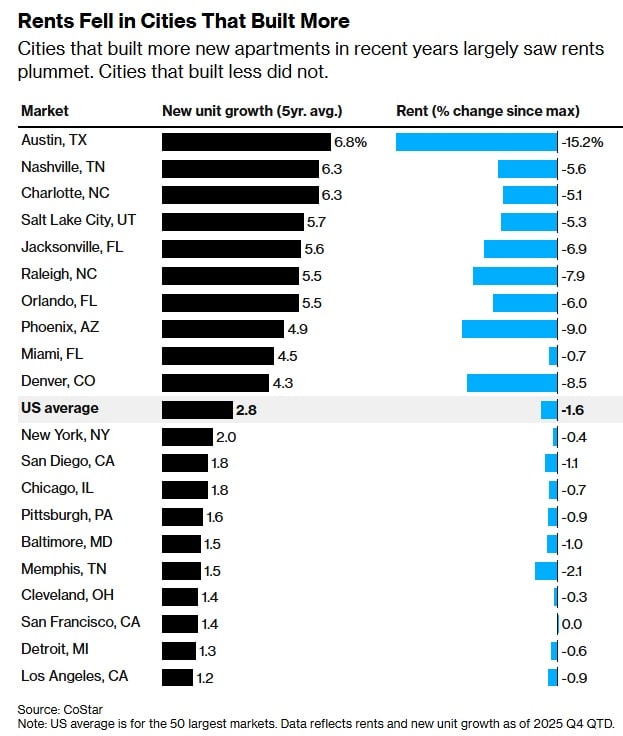
I mean… duh? Genuinely baffled at people struggling to understand this. When there’s more of a thing, it costs less. Which is good when that thing is essential, like housing.
Not sure the idea of housing being an asset which endlessly accrues value is good for anybody involved, long-term. Open to disagreement, though! I’m no economist.
Anyone ever drive around Austin, its highways and its endless new construction of new superhighways, to the point that Google Maps is confused?
As annoying as NYC (and driving) are, there are downsides to unlimited housing and lack of zoning - as it turns out, the same states that do this sort of thing we all praise, are the same laissez-faire philosophies that oppose communal public transportation and walkable urban communities.
I would buy more complex arguments around housing price solutions if ALL housing price problems everywhere else hadn't been solved by building more housing
Austin is a good reminder that supply does matter — but also that it needs to be added at scale before people actually feel it.
Small incremental changes probably just get absorbed without visible impact on rents.
Supply glut aside... Quality of life down... Traffic up... Kind of makes sense rents are down. Density needs transit investment too
Supply glut aside... Quality of life down... Traffic up... Kind of makes sense rents are down.
“Great, now let’s see California…” - Patrick Bateman
Thats cool. Now do LA. Sorry but I want beaches and housing options.
what they didn't mention is that supply didn't impact rents until the large remigration back out of Austin
I feel like there was something else at play.
For reference, I moved to Austin in 2018, my rent for my apartment was about 1200/month. In 2022 (the year I left), my rent jumped suddenly to 1600/month despite new apartments near me, and all of the apartments I looked into had similar jumps. And anecdotally speaking my coworkers all reported similar massive rent spikes.
It feels more like this is associated with the tech industry cooling significantly in Austin so they can't get away with pricing bumps. This isn't to say new housing doesn't help, but it certainly didn't prevent me from getting fucked on rent.
In other news: Water is wet. Still, it probably bears repeating. I'm sure some NIMBYs said more housing would drive up prices.
Water, still wet.
Wow it's almost like the law of supply and demand is in fact accurate. Who would have thought basic economic 101 would be proven out? It's almost like when you allow supply to increase to meet demand the price equilibrium can move down. Shocking.
I say this with a bit of righteous anger though because the moronic democrats in California want to virtue signal about housing and homelessness but they make it downright as difficult and expensive as possible to increase housing supplies. The democrats in California have done nothing but make our problems worse, even as there are states we can look to with proven examples to solve our problems. Nope... more housing lotteries and BMR units will be required instead of just making it easier to actually build..
Its wild how the solution to housing costs is really just:
Build more housing. Keep law and order.
No it doesn’t need to be “affordable”. Yes rent control is a terrible idea.
Just build more housing.
Note: that the US already has plenty of housing and housing costs basically go up in areas of low crime relative to economic opportunity. If you build housing, but allow crime to rise, you have wasted everybody’s time.