 alt Hacker News
VitruvianOS – Desktop Linux Inspired by the BeOS
Comments
I ran BeOS as a daily driver for a few months in the early 2000s. I had a winmodem and Linux couldn't connect to the internet for me, but for some reason, BeOS had drivers, so I used it. It was faster and the desktop environment felt more polished than KDE/Gnome.
Of course, at that time, it was impossible to know which OS would win the wars, so BeOS became my favorite. However, Linux developed very quickly during those years, I got into college and started using UNIX there, winmodem drivers appeared, and that's what I ended up using.
But BeOS still holds a very dear place in my heart. It really was superior to anything else during that era.
If you like BeOS, take a look at Haiku https://www.haiku-os.org/ , it's very nice and very usable system based directly on BeOS.
My favorite part of BeOS is the file system. The book can be found freely here: https://www.nobius.org/dbg/
25 years ago, I configured GNOME to run a BeOS-like tabbed window manager. On a sun workstation.
But that's not what this is. Or not only:
Nexus Kernel Bridge
Nexus is Vitruvian's custom Linux kernel subsystem that brings BeOS-style node monitoring, device tracking, and messaging to Linux — making it possible to run Haiku applications on a standard Linux kernel.
It claims to run apps from Haiku, the current open-source implementation of a modern BeOS.
The important question becomes can you stack the window decoration "tabs" of different apps into a single stack of tabs like in BeOS?
Demonstrated here (animated):
https://www.haiku-os.org/docs/userguide/en/images/gui-images...
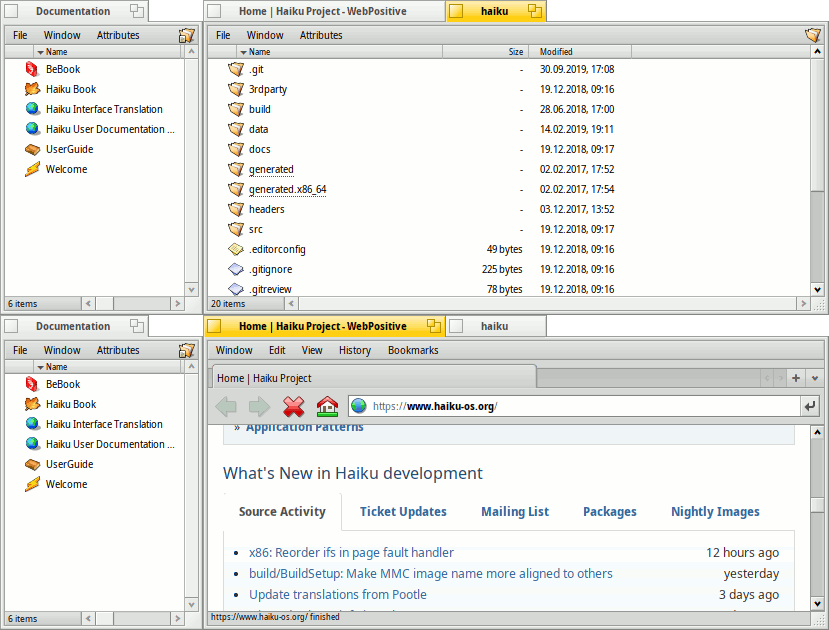
UI elements that have depth look so mouth-wateringly good now. So over the minimalism and bouncing back hard.
This is interesting - a Linux distro that really differentiates itself technically, instead of just having a different GUI / desktop environment.
I almost overlooked this, and then when I didn’t, I almost dismissed this as Yet Another Linux Distro with a custom skin. But no, there’s novelty and exploration in here. There’s attempt to venture off the local maximum. This is a breath of fresh air.
BeOS was such an amazing experience back in the day. It really felt magical. Too bad it got shutdown. I wonder what the evolution of it would be like today
Pleasant surprise to hear about this. I've had a fascination with BeOS & Haiku for decades. I am now actually developing a custom website layout themed after BeOS (good excuse to learn Figma!)
Sort-of unrelated (but very on-brand for people into BeOS I think), it's so satisfying when a webpage is so free of bloat that navigation and latency to clicking on things in general feels instant.
Vitruvian asks a different question: what would I actually want to do with my computer that I currently can’t?
Only be able to drag a window around the screen from the top left corner
Is this using haiku as a kernel or is it a complete re-implementation of BeOs/Haiku API's? I can't tell by their website or github.
I hope it’s not just the look. The ability to group tabs from various apps into a single window was the best UX feature it had, and I still miss it sometimes.
Anyone remember BlueEyedOS? It had exactly the main goal, building a beos compatible OS on top of the Linux kernel.
Little known fact, a small piece of BeOS survives to this day and is an integral part of Android
BeOS came up with “Binder” for doing inter process communication. Just before Be Inc. was acquired by Palm, some Be engineers somehow convinced management to release Binder as open source, which came to be known as OpenBinder.
After the Palm acquisition many Be engineers moved to a startup called Android Inc, and adopted OpenBinder for IPC. And the rest as they say, is history.
Related interview with VitruvianOS dev:
https://www.desktoponfire.com/interview/846/an-interview-wit...
Can someone list what are some cool/novel BeOS features that other OSes didn’t have at the time and maybe still don’t have?
"Real-time patched Linux kernel for low-latency desktop use" - does this really make sense? I think there have been various efforts like this over the decades but as far as I remember none of them really made a huge difference for the end user.
Ok maybe I’m too young, but what is BeOS? Everyone here is linking other alternatives, but no one’s linked to the original BeOS. Or is it gone now?
Thank you everyone for commenting! We are going to pubblish small articles on the website to clarify some of the common questions that are popping around. We will also do our best to improve our wording and marketing, thanks everyone for the suggestions and stay tuned!
I’ll try this out with my eink display, interface might look good in grayscale. So far my favorite desktop for this is the Chicago95 theme for xfce
Even if the cheaps are weak... is the code strong?
I was never cool enough to run BeOS but I coveted it. It looked so cool and futuristic compared with Windows.
I'm not cool enough to run VitruvianOS either, but i'm glad it exists.
Is this a new window manager and tracker or something skinned for this use case? Wayland, X11? There’s a screenshots section but the details are sparse.
is there a debian distro that is close to win98. Sorta like ReactOS but can be daily-driven.
Why does the marketing read like slop ?
"VitruvianOS is an alternative Linux desktop with a singular philosophy: the human at the center."
So this is a lighter weight alternative to other Linux desktops?
> It’s very easy to use. It features an intuitive desktop
> and adopts KISS principles. Anyone can rapidly feel at
>home and use V\OS. User experience, workflow and comfort
> is key.
What is more intuitive than a button to close a window without a X, in order to make people from every other OSes feel at home https://v-os.dev/img/photogrid.png
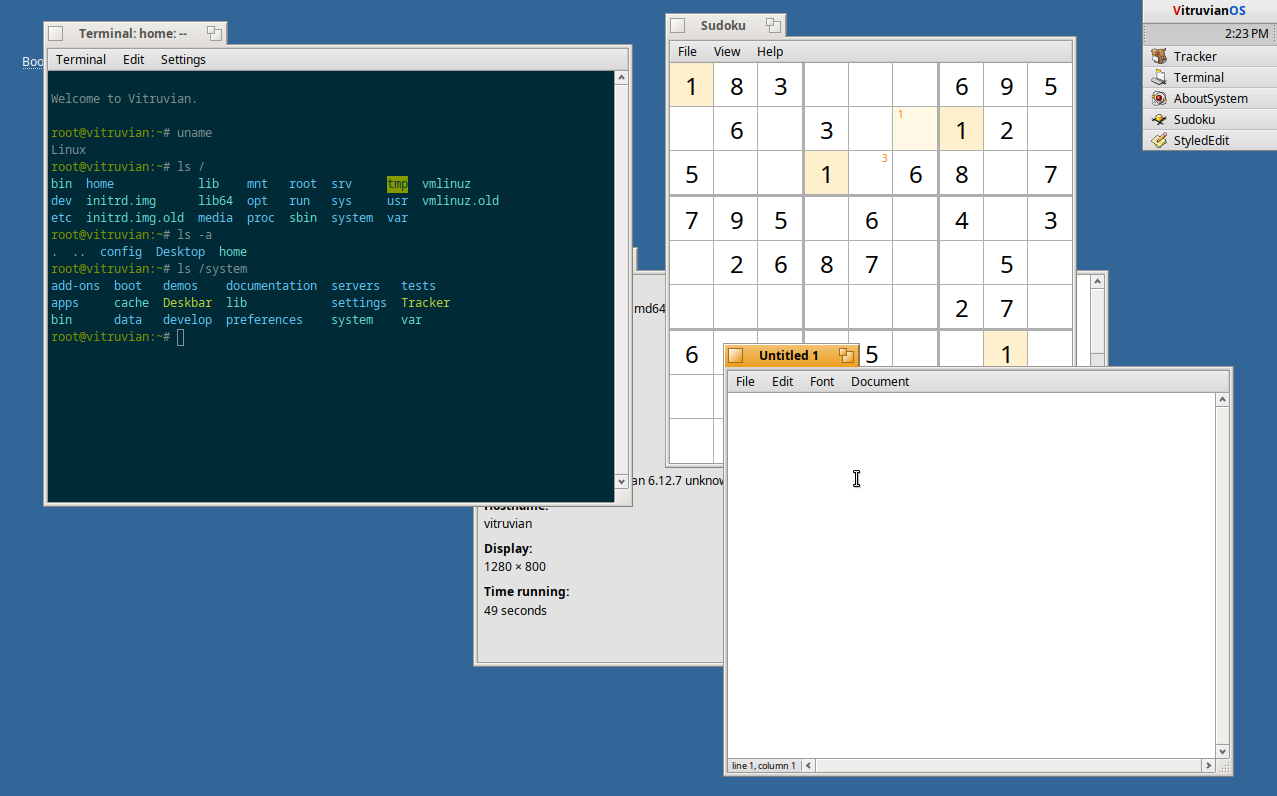
-- When words have no meaning
It's been a pain to try to get ruby to work on Haiku, so I expect that this will be like linux - but worse, in that barely anything works. I like the design choices made by BeOS, but we have 2026 now. Linux kind of showed that practical considerations beat theoretical superiority (except for the desktop segment, where Linux keeps on failing hard; see GTK5 not supporting xorg, it is now the all corporate-dictated wayland era).
I bought an Amiga in the early 90's and enjoyed it immensely. Commodore went under and Amiga died.
I bought BeOS in the late 90's and enjoyed it immensely like a breath of fresh air in a sewage pipe. BeOS died.
With my track record I really, really should've bought Windows. Twice, to make sure.