 alt Hacker News
>"They were not adequate" - yet, after the redesign, they kept those same O-rings
presumably "redesign" means some stuff changed. why is it not possible that the O-rings were inadequate for the old design, but adequate for the new design?
Replies
>why is it not possible that the O-rings were inadequate for the old design, but adequate for the new design?
Boneheads getting lucky, happens to the worst of them more often than lots of people want to admit :\
I came from Florida and am not a fan of cold weather.
That morning of course nobody knew about defective engineering at NASA contractors when it comes to o-rings. I got in to work, and the office people had turned on the seldom-used little black & white TV in the office manager's room so they could watch the Challenger launch. That was about the only time anybody watched TV at work, except for baseball playoffs when they occasionally occur in the afternoon.
It was 19 Fahrenheit at the launch site so I never thought for a minute that they would go through with it. It was simple common sense. You don't even try anything "normal" during the one day per decade when it gets that cold, and that would be in north Florida. You wait years for it to get below freezing at 32 F, especially on the central Florida Atlantic coast. And no matter what, you never have to wait long for it to get above freezing. I just naturally couldn't imagine anyone not fully on board with living to wear shorts another day. I was thinking about the rubber seals that must be there to keep the crew hatches airtight, for one thing, but aware there were countless other variables which I didn't have a clue about that could also be cold sensitive, like electronics.
I went into the back where my lab office was, thinking they were surely going to delay the launch, at least to later in the day. I didn't get back to the front office until a little after liftoff time, where I expected to find out how much of a delay or reschedule there was. It was very quiet. I asked what happened and they said "it blew up!" I actually thought they were kidding me because I missed the liftoff. Then I saw the tragic replay that was enough to make anybody sick.
Eventually, the o-rings were pointed to, and publicly disclosed and it was stupidly worse than I imagined.
A few years earlier I had experienced a dramatic o-ring blowout on some high-pressure apparatus that one of our engineers had designed at a previous employer. That was an engineering lab, and I'm no engineer but it turned out they needed more help than just chemistry lessons for experiment design. Since I was the one who had taken a reading within the blast zone minutes before I went back to my desk, I took over the redesign of the heavy-walled high-pressure custom cylinders, going over every little thing from alloy properties, dimensional characteristics, reinforced thread strength, etc. It was helpful that I had worked in a machine shop before, but I was the only one there who had any full time experience at metal fabrication. Well constant overtime really. When I got to the critical o-ring design parameters, that alone required more engineering effort than the rest of the project. Each standard o-ring has its own precision design parameters, highly dependent on the durometer hardness of the rubber among many other things.
Without considering durometer, here's a very simplified chart of some key parameters (primarily US inch units):
https://d2t1xqejof9utc.cloudfront.net/pictures/files/186532/...

There's way more data than this and most of it was gathered over decades of serious destructive testing & analysis.
And here's a pretty good article about the Challenger fiasco:
https://clearthinking.co/the-teleconference-before-the-chall...
Plus a color diagram that may be a little clearer:
https://onlineethics.org/sites/onlineethics/files/Challenger...
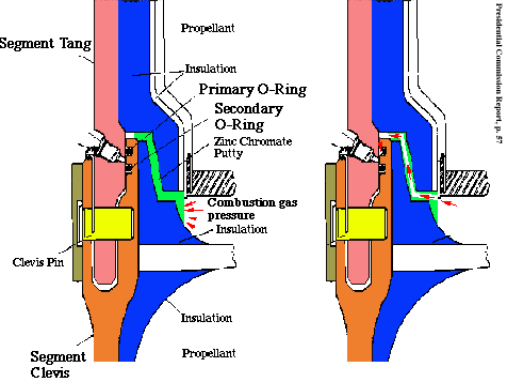
Never did look into the Challenger o-rings this much until now, all I knew was that defective o-ring design is more likely than not, and you would be a fool to use any o-ring that was not standard size without the equivalent of decades of destructive testing yourself.
All I needed to know was these o-rings circled the entire booster, so that alone was a no-no since it was nowhere near standard. Now in the clearthinking article I see the nominal measurements, 38 feet in circumference but only 1/4 inch thick. Yikes, what were they thinking? No wonder they used two o-rings, it was plain to see that one would never be enough :\
Look back at the d2t1xqejof9utc.cloudfront chart. Notice that a 1/4 inch thick o-ring is not expected to have nominal reliability outside the tolerances listed.
Notice the Groove depth and the gland depth are two different things but actually need to be as close as you can get in practice, within 3 thousandths of an inch altogether across the entire (38 foot!) diameter, or half of that when measured at any one point on the arc. This requires some precision machining and quite rigid metal substrates or it will never come true. This is precise enough that large temperature swings would always be a factor, but more so the greater the diameter of the substrate. And the maximum eccentricity of the groove relative to its substrate must be within 0.005 inch. The widest tolerance on this little chart is the "squeeze" of the rubber to be between 0.040 and 0.055 which is not for the machine shop but depends on the o-ring thickness being within its own design specifications. Not surprised to find out they were Viton rubber which is widely known to be some of the most chemically resistant for a non-teflon compound. Probably would have been better if Thiokol also was aware how "good" Viton is for its intended purpose, strong resilience at temperatures 200 F and above, below which it doesn't seal as well as ordinary rubber. Viton is just too hard and non-tacky at room temperature by comparison.
After all these decades, now I'm even more convinced it was always an accident waiting to happen :(
Exactly. They re-designed the tang and clevis joint so that the metal parts of the joint did not spread under gas pressure and the o-ring did not lose compression. They added a heater to ensure that the o-ring remained in it's usable temperature range. And added a superfluous third O-ring.
Speaking of which, has anyone ever adequately explained why Challenger's Right SRB joint temperature was measured as -13 deg C using infrared pyrometers, when the lowest ambient temperature that night was -5.5C, and the Left SRB was measured -4 C? What subcooled the right SRB?
Allan McDonald's "Truth, Lies, and O-Rings" is mandatory reading for anyone who wants to discuss the details of this particular bit of corporate and government malfeasance. It's 600 pages of technical detail and political intrigue. He suggests that a plume from a cryo vent could have impinged on the field joint and cooled the o-ring to lower than ambient temperatures. No proof though.