
logoalt Hacker News

windowsrookietoday at 4:30 PM1 replyview on HN

I'm not really sure why your neo is performing better than the M4.

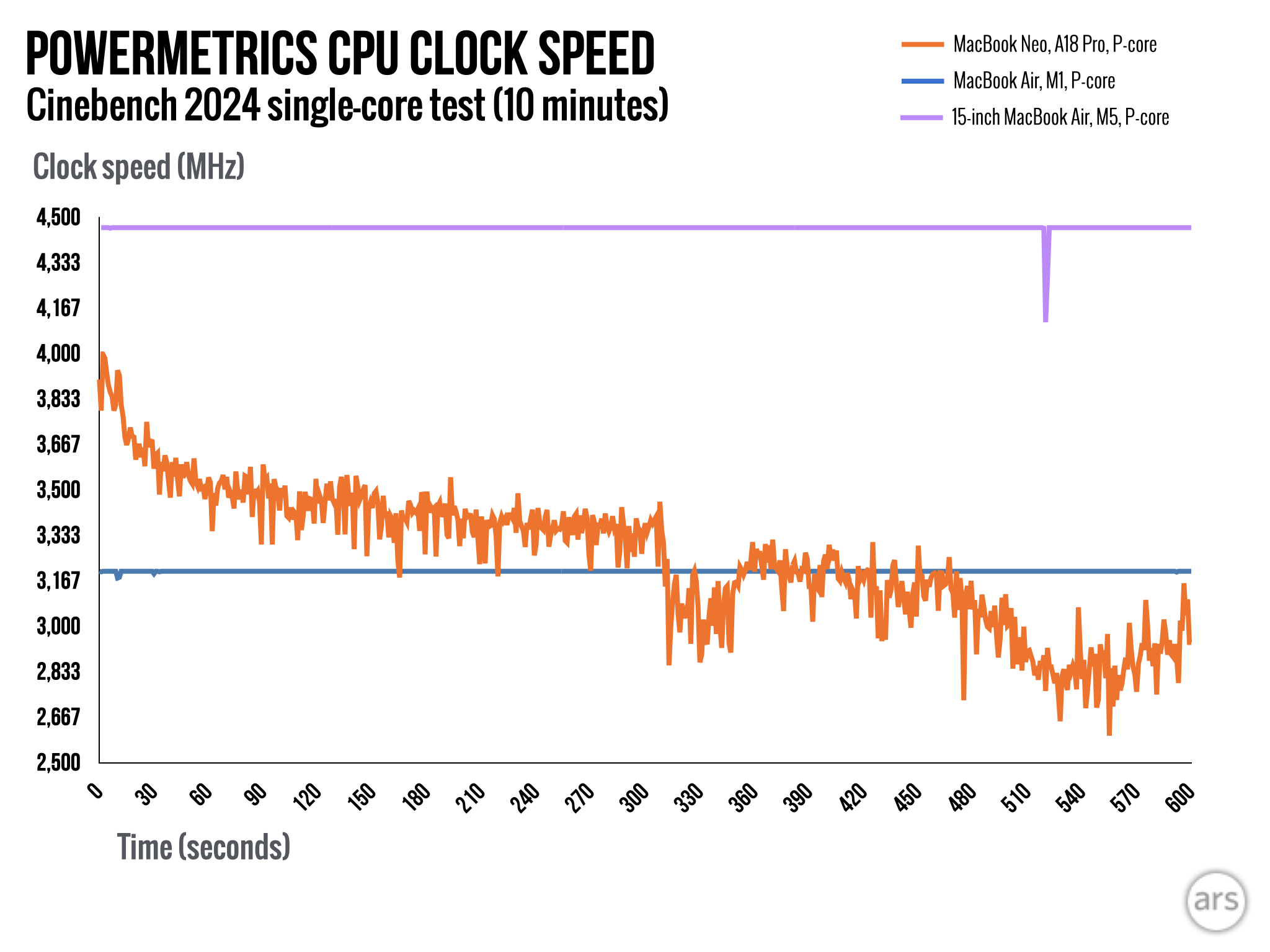
The M4 and the neo share the same CPU architecture but the M4 has 4 performance cores at 4.4ghz, while the neo has 2 performance cores at 4ghz.

The neo also does not have any CPU heatsink so it thermal throttles after only a few seconds:

https://cdn.arstechnica.net/wp-content/uploads/2026/03/MacBo...

Replies

wang_litoday at 4:53 PM

Yes, all the M-series have more cores, they often have better thermal management, and they have more memory bandwidth. (The the Neo still has crazy high bandwidth.) But, for a single threaded, strictly compute task that runs in 10 seconds, it outperforms the M4 cores. I don't know why, I'm just sharing my experience.

The actual code I am using for this is:

    #include <stdio.h>
    #include <sys/time.h>

    int gettimeofday(struct timeval *tp, void *tzp);

    int main(int argc, char *argv[]) {
      double xmin, xmax;
      double ymin, ymax;
      double x, y, xs, ys;
      int max_iter;
      int i, px, py;
      int width, height;
      volatile double wx, wy, t;
      double start, now;
      struct timeval tv;
      int count;

      xmin = -2.0;
      ymin = -1.5;
      xmax = 1.0;
      ymax = 1.5;

      max_iter = 1000;
      width = 200;
      height = 200;

      xs = (xmax - xmin) / (double) width;
      ys = (ymax - ymin) / (double) height;

      gettimeofday(&tv, NULL);
      start = (tv.tv_sec * 1000000.0 + tv.tv_usec) / 1000000.0;
      count = 0;
      now = start;
      while (now - start < 10.0 /* && count == 0 */) {
        for (y=ymin, py = 0; py < height; py++, y += ys) {
          for (x=xmin, px = 0; px < width; px++, x += xs) {
            wx = 0.0;
            wy = 0.0;
            for (i=0; i < max_iter && (wx * wx + wy * wy) < 4; i++) {
              t = wx * wx - wy * wy + x;
              wy = 2 * wx * wy + y;
              wx = t;
            }
          }
        }
        gettimeofday(&tv, NULL);
        now = (tv.tv_sec * 1000000.0 + tv.tv_usec) / 1000000.0;
        count ++;
      }
      printf("%d iterations in %.2f seconds.\n", count, now - start);
    }