 alt Hacker News
Speaking as an Australian, our productivity has been lagging[1] compared to the US, largely due to the availability of cheap labour (attributed by economists to foreign students)[2].
I heard one economist on the ABC give the example of carwashes[2]. From the 1990s to the early 2000s, car washes in Australia were largely automated and hand-wash car washes were relatively uncommon. However, the abundance of cheap labour has since led to a proliferation of hand-wash car washes.
1. https://files.littlebird.com.au/SCR-20260525-ietj.png
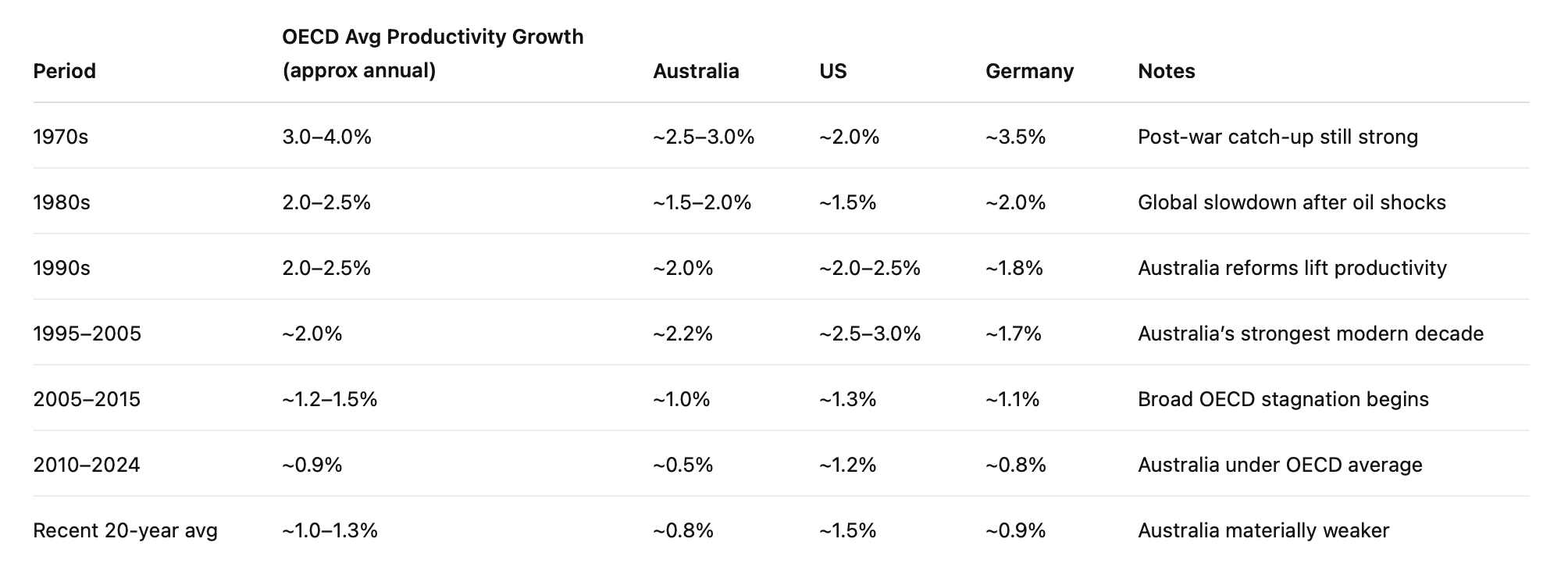
2. https://www.abc.net.au/listen/programs/abc-news-daily/the-pr...
Replies
The car wash example is interesting, as something I’ve seen and experienced but never thought about in that way.
I wonder how it truly factors into productivity, though. How is productivity measured, and does that measurement capture what is true?
You mention automated car washes as a baseline. I never used those in the past because I figured they’d be rubbish or would scratch the car or whatever. So I’d occasionally wash the car myself, and that’s it. Now that we have manual car washes available, I use them from time to time. They clearly (I assert) do a better job than anything automated. And they do it inside and out.
So I find the comparison interesting, but in need of elaboration.
> Speaking as an Australian, our productivity has been lagging[1] compared to the US
Good.
Developed countries should not aim to emulate the US. To get the same productivity you’d have to lower the standard of living of all the employees to the same level as those in the US.
No. Don’t do it.
Quality of life matters much more than profits.
As a fellow Australian, this is likely an early window on what the next 5 to 10 years will yield with our recent mass immigration. Economically speaking we could well see a race to the bottom in wages whilst we continue to experience exceptional housing pressure.