 alt Hacker News
Backtrack-Free Cursive
Comments
Huh, I just indirectly learned from this article that the way I write a lower-case "t" in cursive is a Dutch way of doing so (edit: sollniss' comment implies it was a common style in Germany too). A quick search suggests it has been replaced with an English style of "t" in the last decades too.
I wonder if that makes my handwriting harder to read for anyone who isn't Dutch and over 40 years old.
Anyway, just bringing it up because you don't need to lift up your pen to write that kind of "t".
Search for "koordschrift" on https://primarium.info/countries/the-netherlands/ to find the illustration showing how I was taught to write it in the late 80s. It's the letter vaguely shaped like a pine tree.
I like writing in cursive, but I don’t see backtracking as a problem. I backtrack quite a lot in Cyrillic, even in Russian, e.g. I always underline ш and write a line over т (which looks like m) to distinguish them (otherwise they look quite similar, see the famous example лишили лилии — you might want to google it if you haven’t seen it yet). I also normally write д as ∂, which breaks the flow.
Belarusian Cyrillic requires more backtracking: we have і, ў, obligatory ё, apostrophes. Never saw it as a problem.
I am not sure what country the author is in, because when I learned to write English in school (decades ago, and it was the language of instruction) very few letters required backtrack, pretty much only ‘i’ and ‘j’. I just looked at an image of the US Declaration of Independence and the same is true (the ‘t’ has a wiggle in the middle).
Other languages are similar: for German if you look at either Kurrent or Sütterlin really only i gets special treatment. The umlauts are given as two dots in examples, but when i read letters and other informal documents they usually end up being a bar.
I like the connected dot for i and j! Clever, and i will try to adopt it. Most of my handwritten writing these days is for myself.
Wondering how many people are like me and hate writing in cursive.
I stopped using it right after graduating high school (where it was required), never used in drafts after elementary school, and only ever used normal print letters in the university (and also included TeX commands because I was typesetting lecture notes later and was figuring out the optimal command set on the fly).
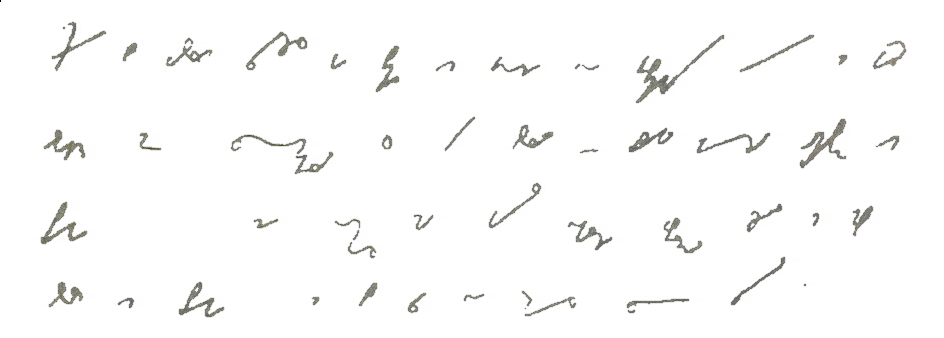
For anyone interested in optimising this further, orthographic (letter-based) cursive shorthand systems are the answer. I personally only know part of the Melin system[1], but there are variants designed for English as the primary language too. (Melin is of course perfectly usable with English also.)
The flow of a cursive shorthand system is unmatched by anything else. I highly recommend learning enougnh to experience it.
(The drawback with more phonetic systems like Gregg is that one has to learn entirely new ways of spelling words. But normal English spelling is so complicated that tradeoff can be worth it for heavy usage. Orthographic systems often also contain phonetic components, but they tend to be optional extensions that improve efficiency, rather than required like with purely phonetic systems.)
I really like the result. Especially the i and j with the connected dot. I expected them to look off but they really integrate nicely.
That being said I don't think it is about Cyrillic vs Latin but more about traditional cursive vs modern.
The traditional Latin cursives were all pretty much optimized to be written in one running flow. Kurrent and cursive all come from Latin currere which means running.
Admittedly none of them go as far as connecting the i and j dots but otherwise they are pretty much completely connected. But then again I also never seen anyone writing a word and doing the dots afterwards. With traditional cursive you do your upstroke, lift the pen, place the dot (or short short stroke), reverse and do the downstroke. Lifting the pen yes, backtracking no.
With the connected dots OP's Backtrack-Free Cursive still wins here and I really like that because someone found an optimization to something that already has been optimized for centuries.
You may want to look into Sütterlin script. It's a bit harder to learn than standard cursive, but it's very pretty, and a level-0 encryption since few people can read it nowadays.
The t I've learned in school in the 90s is a single stroke.
An italian influencer started speaking in italics/cursive. It's a silly thing, but the thought of pronouncing words differently because they are on bold or italics is interesting
You only need 1 backtrack if you do the dots and crosses after you've written the word
Super interesting article.
I don't cross ts either, I tested out on a piece of paper and what I do is a vertical (slightly curved) stroke, loop to the left, cross the stroke and then a downwards stroke.
I tried the jitter example and instinctively I dotted the j but not the i for some reason. Would love to see some research on this.
I really miss cursive honestly, at least for me I feel a much closer connection to the writing than when typing.
> Only й and э require two strokes
Wouldn't the ф as well?
> [for the x], I draw two mirrored c’s
Isn't that what everyone is doing, or are we Frenchmen the exception?
For reference if the author reads this, we write the latin x exactly like the cyrillic х, i.e. reverse c, bottom-left to top-right diagonal, normal c.
I have had similar thoughts recently when attending language courses where I write a lot of notes by hand. This problem is exacerbated by umlauts. If the language doesn't have letters like ō (are there any? i only see this letter to represent a sound, never in a word), then the two dots can be replaced with a line and so, I guess, the lowercase T technique from the blog post could be adapted to it. I think I know what I am gonna do after work today
All images on the site appear broken to me, using Chrome on Mac. Is it a site-issue or a me-issue?
Usually writing small, in all-caps, except code: in lowercase, and the "t" and "i" retain their lower curve. Cursive is difficult; easy to write, but (later) hard to read.
Can see how penmanship there would be appreciated.
> Single-stroke letter t often appears on logos.
Somehow, this caption appears to the right of two logos which clearly require two strokes for their ts. What happened?
> ... in Russian. Only й (short i) and э (pronounced like e in end) require two strokes.
Plus some uppercase e.g. A, B, H, right?
This is unrelated to the main thesis of the article, but worth pointing out as too many people equate the Cyrillic script with Russian language.
The Cyrillic script was invented in Bulgaria (during the First Bulgarian Empire), and was used to write Bulgarian language, creating a huge literary corpus, long before it began spreading to Kievan Rus. The Russian language itself comes from Old Bulgarian / Old Church Slavonic, as does Serbian and other "Slavic" languages.
And no, Bulgaria was never part of Russia nor the Soviet Union.
This is the kind of thing that makes cursive painful to read. The `i` and `j` in this script are harder to quickly lex, and the `t` (especially in the `tt` ligature) with the added loop flourish diverges sufficiently from a standard `t` to make it hard to decipher in running text.
In text, as in code, I prefer to optimize for easy reading rather than faster writing.