 alt Hacker News
> computationally cheap to encode and decode
Well I'm not sure about decode, but as of a few years ago weren't h.265 and AV1 able to do much better compression than h.264 at almost all levels of compute? https://people.videolan.org/~unlord/SVT-AV1_BD-rate.png And h.266 encoders can probably go faster now too.
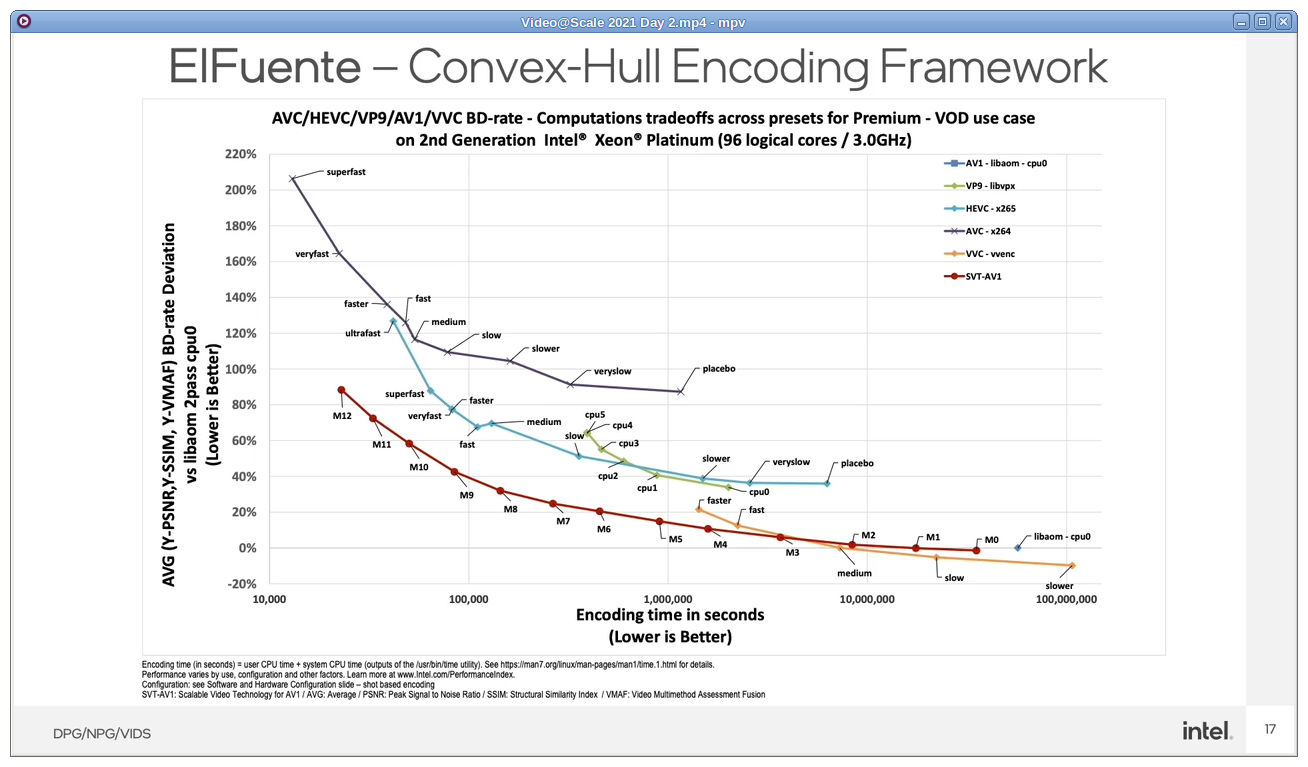
I would hope so! Otherwise the Pareto front wouldn't have moved in ~20 years which would be rather hard to believe.
However, at the same time, h265, h266 and AV1 are all vastly more complicated, and will have less broad hardware acceleration support than h264, which, again, even if it is not optimally efficient use of compute, just doesn't require a whole lot by modern standards.
So I'd argue there is really no reason to be rushing away from h264 unless you have a compelling reason. There are some obvious compelling reasons in some cases; nobody is going to be terribly surprised that an entity like Netflix is eager to switch to codecs that will save bandwidth, because at their scale saving bytes definitely adds up, bonus points if it can increase the quality at the same time.
On the other hand, though, unless you are absolutely sure you can switch to only new codecs, you will probably want to keep some h264 encodings around to act as a fallback baseline for legacy devices. And thus, you also have to take into account the complexity brought on by needing to store and maintain multiple encodings - in many use cases, like simple <video>s thrown into website backgrounds, I can see just eating the extra bandwidth costs and keeping it all h264 as a valid strategy.