 alt Hacker News
I've been using it for the last month or so. IMO in the same way we went from tab complete -> prompts -> agents, this feels like a next step on that evolution. I highly suspect others will be following suit. I was surprised with how much it felt natural to interact with agents in this way.
Biggest advantage is each one owns its own routines, context, and domain, and they can communicate between each other. Similar to hermes they build out their own skills, but by keeping the bots separated by domains, you end up getting better results out of them.
Additionally though each one has their own computer, which means async work feels like it actually works. I haven't had to juggle worktrees for the last month.
Biggest downsides are token expenditure. I've used more tokens this month than not this month. That's not a typo - I've used less tokens in the last 5 years prior to this month than I have this month. Always on perpetual agents use a LOT of tokens. IMO this is building for the future state where tokens are vastly cheaper, ie in a post-ASIC world.
The coolest thing I had it do for me was sourcing fabric for swag: https://image.non.io/d83664c1-5807-4a18-abe4-41928c198410.we...
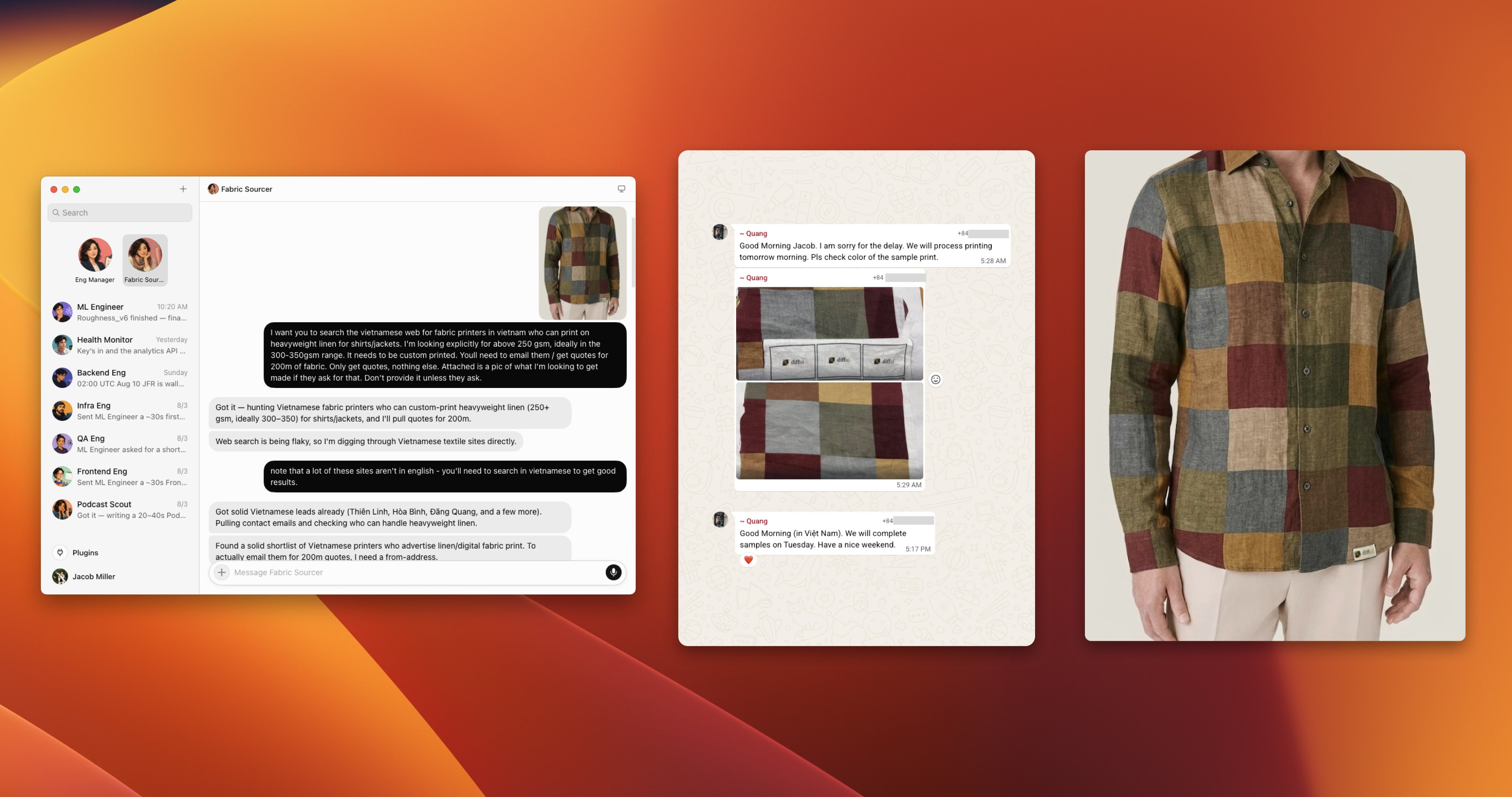
I wanted to make something that didn't feel like just my logo on a shirt, so I had one of my bots reach out to ~40 fabric suppliers in vietnam, negotiate prices, lock one in, and get samples made. First samples should be finished today. It's been something I've wanted to do for ages, so it was cool seeing it actually happen. The fabric supplier bot worked with one of my prototyper bots to create a randomly generated pattern using my logo, which it then sent as a .ai file to the supplier.
Replies
I think you are right saying that we will have more of this, but I don't really understand the upside is of this in the context of the work you described.
> The coolest thing I had it do for me was sourcing fabric for swag
That seems like something codex could just have done on my laptop. Am I wrong?
How is this different than, say, OpenClaw, which I've heard people say does the same kind of things? Is it that they each have their own VM?
> I highly suspect others will be following suit.
There is
though currently much worse
The token usage is really interesting. I would imagine the most efficient thing is to keep the state of everything persisted, and past the cache expiration window, to automatically start a new session with the previously persisted state instead of just a long running conversation.
If someone solves this part of continual effective compaction + selective resetting at cache expiry, they're going to make a ton of money. Right now, only the token insensitive can use these sweet features.
Would be interesting to read a write up on this in detail. I have a similar use case I’ve been tasked to solve for a consulting client.
> I wanted to make something that didn't feel like just my logo on a shirt, so I had one of my bots reach out to ~40 fabric suppliers in vietnam, negotiate prices, lock one in, and get samples made.
Isn't this one of the problems foreseen with this? For you, it was a single prompt - for 40 companies, this probably took up some time.
What happens when fifty people fire off a 15-second "get me a shirt" prompt? When five hundred, five thousand, five million do?