 alt Hacker News
Choosing an AI model: one prompt, 11 models, different results
Comments
> Build a one-page site for a neighbourhood coffee shop: opening hours, the address, a short menu and a photo. Nothing on it changes unless I edit it myself.
If that's the entire prompt, it's quite depressing how much alike these all look. I appreciate some of the details from the Opus 5 version, but I can't help but strongly feel the AI vibes emanating from that design.
Same model over 11 days, one prompt, different results?
I've been doing a lot of benchmarking for a long time now with a number of local models for the purposes of spam filtering. The major observation is that there is a lot of variance in model performance. This should not be surprising, as these are probabilistic machines based on random numbers, so your performance will vary from run to run. But this also means that any sort of evaluation of benchmark with a sample size of 1 is essentially worthless for the purposes of model comparison.
In my benchmarks, I started insisting on having at least 5 runs.
This also makes me very suspicious of some of the posted benchmarks that compare models. If the results don't say how many benchmark runs were performed and what the variance was, there is really no basis for comparison. You are just guessing.
Building ad-hoc evals is trivial these days. And you can place an LLM judge in front to disambiguate between output. e.g. I have Frigate gating a video feed so that an LLM can watch our home cameras and the labeling task takes a few minutes and then the evals run at fairly low cost https://wiki.roshangeorge.dev/w/images/4/4e/Screenshot_-_Eva...
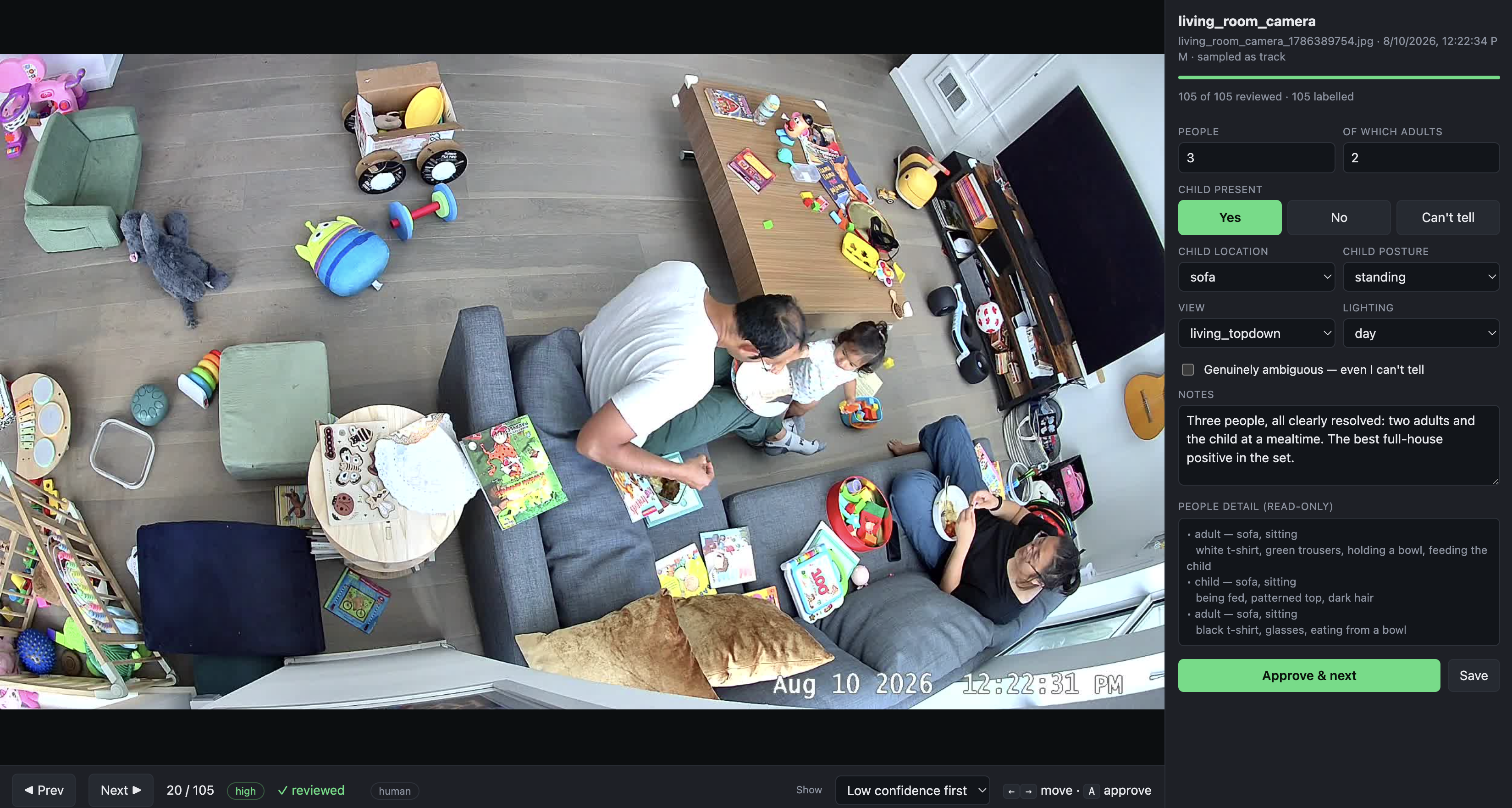
This means that generic benchmarks and evals are sort of passé. There's no need to have them write "make a coffee shop page" or whatever. Instead, simply focus on the real problem you have and evaluate whether they solve that problem. You want to move along the price-performance frontier alone and the SOTA models are decidedly at the top of the performance curve but very expensive so they serve very well to produce the gold standard and to judge.
The change from prior to today is that benchmaxxing and per-token pricing allowing for evaluation point to the same direction: do not proxy results. Instead deploy the highest end model you have as a judge for others until you have statistical confidence in discrimination and move along the task-specific frontier.
Finally some really useful apples-to-apples comparisons rather than endless benchmarkmaxxing and anecdata. I want to see this test run again for the open-weights models that fit into 128GB combined RAM. Like how does Muse-glimmer compare with qwen3.6-35B?
You betta lose yoself in the context
It’s not theft, you own it
You betta neva use Go (go) (go)
You only get 1 prompt
Do not use canvas (No!)
Cause opportunity comes once in a lifetime
I like the output of the cheaper/older models better, surprisingly, say Gemini 3.1 or DeepSeek V4. They're mostly no frills and just text, and ironically look less AI-generated to me because of the lack of hip slogans and graphics. Definitely closer to what I'd want for my own site, but I don't claim to know what people want from a website for a coffeeshop.
In my opinion, this kind of a benchmark doesn't tell much about the models' capabilities on normal software development tasks. It's fun to look at the differences in the output of course, but how often would anyone prompt with very brief instructions, without even hinting the model about caring about any of the details in the outcome nor the implementation?
When there are implicit boundaries, negotiable tradeoffs, taste, whatever, in the mix, then the differences in the model capabilities become way more interesting.
Benchmarks are so difficult with ai because as soon as one gets popular it enters the dataset so the next iteration of the model is trained on the solution. I’m not sure if there’s any potential work around here or anyone doing interesting work but would love to hear about it if so
My "favourite" site was <https://6a6fa3376288679d094a8437--ar-testing-coffee-2b15c6a0...> with footer image captions that are amazing. Precision Late Art being the best one.
Pretty interesting how DeepSeek V4 Flash 0731 has such disparate (and cheap!) results. I would never guess they come from the same model and prompt.
I'd be curious to see Terra xhigh vs Sol low, only in that the visual languages are actually kinda different, that Terra work was a lot less "llm" feeling than a lot of the other designs, wonder if pumping up the effort would result in a more in-depth design but within that style.FWIW I enjoyed reading this way more than any usual benchmark posts we see.
This seems to be the easiest way to get on HN front page:
Come up with an arbitrary test, let a bunch of LLMs work on it. Make some very subjective judgement about the result...
I think we should establish a professional evaluation organization for models; otherwise, it will be difficult for informal evaluations to form standards.
Approaching this from the perspective of a potential customer and not a designer - I find that I actually like the smaller/open model output quite a bit more.
Kimi, GLM, and Deepseek all absolutely run away with the "Can I quickly read the menu and find the address" challenge.
Most of the rest of the pages are stylistic, but hard to parse.
If I were in a car on a mobile phone trying to find the address of the place to meet a friend for coffee... I don't want a bunch of fluff and stylistic design that makes it hard to parse the information on the site.
I always enjoy these comparisons between models, especially when they demonstrate the actual costs in addition to the outputs.
Interesting exploratory comparison, but I be cautious about treating it as a model benchmark With only three runs per model, the results are highly sensitive to randomness
this is fun!
> Vector graphics actually require a lot of work from the models
How so? Surely they can just steal such generic graphics off existing web sites.
[flagged]
[flagged]
Am I wrong or are these evaluations, while interesting, not really meaningful for anyone doing serious development work?
I'm asking because I personally only use AI with specific and detailed instructions, building my projects piece-by-piece.
I mostly don't look at the low level code and some of it I don't understand as much as I'd like, but I very much give much more technical instructions than a simple, two sentence prompt.
So, it seems to me this "oneshot from a simple prompt" eval is fairly meaningless when it comes to model evaluation itself, as it is in no way representative of real world application.
This would be more something for "vibe coders", people with little to no programming background wanting a website?