 alt Hacker News
Solar surpasses nuclear power globally for first time
Comments
> From March 2025 through June 2026, either solar or wind individually generated more electricity than nuclear every month. In March, April and May 2026, both technologies independently surpassed nuclear generation.
> Global solar capacity increased by 510 GW to 2,383 GW, up 27% year on year, while wind added a record 159 GW to reach 1,291 GW, an increase of 14%. By comparison, installed nuclear capacity rose by just 1.5 GW to 399.5 GW, while operating nuclear capacity declined by 0.5 GW to 368.6 GW.
> More recent data from IEA PVPS indicate that global PV additions reached around 690 GW in 2025, about 180 GW more than the figure used by WNISR. This suggests the gap between solar and nuclear capacity – and their respective growth rates – was even wider than indicated in the report.
> The report identifies falling battery costs as a potential enabler of continued PV expansion, particularly as grids contend with growing volumes of variable renewable generation and periods of low or negative electricity prices. Grid-scale battery deployment accelerated sharply in 2025, with 104 GW and 257 GWh connected during the year. More than 78% of cumulative battery energy storage system (BESS) capacity was installed between 2023 and 2025.
You know what I call solar--fusion power. There's a giant fusion reactor running for free. We simply need to extract the useful energy. Want to build a terrestrial fusion reactor? A conventional nuclear reactor? You still need to extract useful energy and deal with excess heat. The way I see it, from an economic perspective, long-term, solar wins. Of course, this is just my long-view
It is a shame that nuclear power has stagnated - we could have been moving towards fossil fuel free grid half a century ago. We've lost decades of progress there. But it's a good thing that solar power is coming into its own more and more.
Late is better than never.
Always good to see the future arriving, but the job is not done yet by far. We need to be sure not to take our foot off the gas (figuratively of course).
We need to accelerate clean energy generation even more so we can replace not just dirty electricity sources but dirty energy sources entirely, and produce synthetic petrochemical feedstocks. Modernity runs on hydrocarbons-as-chemicals, not just hydrocarbons-as-fuels, so despite electrolysis and synthesis being hugely energy inefficient, there is literally no alternative. We just have to brute force it at petascale.
On a monthly basis. News articles about solar power tend to quote maximum capacity, confusing the issue. This is about energy rather than power, aggregated over a month, so it's a somewhat more meaningful statement.
In order for renewables like solar and wind energy to truly take the burden off a grid, we have to have large capacity energy storage solutions that balance the grid over a 8+ hour period. That way we can handle peak demand of the grid during high load which often happens when there's little light and on hot days when the wind doesn't generate nearly as much electricity.
We're getting to a point where we can stop boiling water for electricity.
What a time to be alive.
Of course, the officially titled World Nuclear Industry Status Report is actually produced by anti nuclear activist Mycle Schneider (https://en.wikipedia.org/wiki/Mycle_Schneider).
80% of global energy consumption is still fossil fuels (oil/coal/gas), however.
That’s good. I wonder how much longer it will take for countries to make their energy supply dependent on fossil fuels or nuclear power, thereby becoming pawns of unpredictable or hostile regimes and being helplessly at the mercy of geopolitics. It’s so baffling that many countries, even those with plenty of sun and wind, still prefer to rely on fossil fuels rather than make life a little easier for future generations.
And no, there will be better solutions for base load as well. Battery storage, for example. Sure, it’s a transformation, but those who refuse to think for the future can see the consequences of stubbornness and backward-looking attitudes today.
Because the damp rock we live on happens to have humans living mostly on the North half rather than split 50:50, there's a noticeable shift in solar generation over seasons.
So e.g. a few months ago in July because it's Summer in the North, solar production peaked significantly higher than the less fluctuating Nuclear but come January it may well produce less globally than Nuclear.
The cited publication is based on Ember's data, which was published in this case a few months ago. It doesn't cite anybody else, so if you're interested in the data and its sources you should look at Ember themselves. This particular publisher (pv magazine) cares about solar specifically, but the nuclear industry publication actually also talks about wind.
Globally wind is much less seasonal (not entirely non-seasonal, but much less so) and it's also generally only sane to build wind farms where there's plenty of wind because they're relatively expensive whereas solar panels are cheap. As a result there's a smaller fluctuation maybe 5:4 between the windy and less windy seasons. However wind power is also growing much more slowly than solar.
You can wake up tomorrow, buy some panels and stick them on a roof, buy an inverter and next week you have solar electricity. Good luck going from "I want a wind turbine" to owning a working wind turbine in anywhere close to that time, even in the unlikely case that you own a hilltop or somewhere to put such a thing.
There needs to be more general understanding of energy density and scalability, which is why I don't think we'll get away from fossil fuels without nuclear or fusion.
Unless nuclear gets dramatically cheaper one should expect to see basically just the minimum amount of it to maintain grid stability / heavy industry, or something in that direction (I think). Obviously this is quite path dependant.
The one thing I really wish people would take away from thinking about energy / grid composition and so on is that its a portfolio construction problem.
If you ever, ever, see anyone banging on about how expensive or cheap a particularly type of generation is please just write them off as either an idiot or a liar - what matters is the cost of constructing a portfolio of electricity production that meets the requirements of a nation e.g. running an industrial economy solely off solar power is probably impossible but it seems realistic to imagine a "modern" (politics aside) economy that runs off sending emails on a mixture of solar power and storage.
Now that PV panels are less expensive than cabinet grade plywood, it makes a lot of sense to get some independence through local generation.
This can't be true. It must be fake news, because my telescreen told me that nuclear is the only viable future. Coincidentally most of the world's uranium comes from Russia.
I wonder if we will run out of battery materials in a hundred years, then what?
The power of the sun in the palm of my hand.
Another milestone in our journey to become a Kardashev I civilization.
Well technically it is nuclear power, just a free fusion reactor we don't have to maintain. :)
[flagged]
[dead]
[flagged]
So despite a borderline fanatical implementation of solar by almost every major government for 20+ years and virtually no new Nuclear plants for 30+ solar is just barely surpassing solar?
Whenever there is a discussion about nuclear I always remember this XKCD https://imgs.xkcd.com/comics/log_scale.png
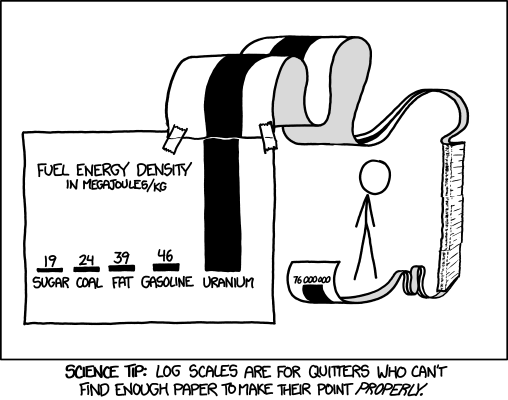
The Sun is #1 die nukes die! very happy now. had some issues with my off grid solar powered house and shop last week, but bounced back quickly and ran a small welder as part of the system verification test, still running massivly outdated gear, holding out till I can integrate car charging in a bigger upgrade. saw a smaller farm last week that paved a small padock out by the road with 30~50 kw grid tie array , ground mount to concrete blocks, drop it and run, zero out the powerbill.
Color me unsurprised. Industry in which it's been basically illegal to build gets taken over by booming subsidized industry.
There is very little actionable information here. Nuclear is still worth building, in countries that don't overregulate it (China is doing it, even while they export the solar panels that everybody is buying). Solar is hitting pretty steep marginal returns on the value of generated watt, because it's all running at the same time and not necessarily when energy is most needed. We still haven't solved cheap battery storage. etc.
Publication says that specialty of the publication is booming. Noted.
quite sad to see that even educated hackers ain't getting this is a bad news - solar is dirt. nasty chemicals on it's production, nasty thrash after it's commercial span is over. nuclear is much more reliable, has tons of space to improve, cheaper and greener over the long term. such a shame this greenwashing
Note that this is actual generated terawatt hours. Nuclear power has a substantially higher capacity factor, but solar has been growing so rapidly that it has taken the lead on generated output too. Wind is just about to surpass nuclear generation also, though solar is racing ahead much faster. The next big milestone, not to be reached for several years at the present rate, would be solar generation overtaking hydroelectric generation. You can see data up through 2025 here:
https://ourworldindata.org/electricity-mix
Even though solar power has been a significant part of the energy conversation for decades, the majority of solar growth is very recent. Nuclear power generated 2762 TWh in 2021, when solar generated 1054 TWh. Solar power generated 2779 TWh in 2025.