 alt Hacker News
I will die on this hill, because I'm right. Painters put on the first layer in saturated colors like this, then add detail, highlight and shadow. The base layer stuck to the statues, and the rest was washed away.
This whole thing just won't go away because many people are operating outside their area of expertise on this subject.
Painters layer paint, starting with a saturated base color. These archaeologists are simply looking at the paint that was left in the crevices.
Replies
I have a degree in fine art painting and drawing and that's not correct for oil painting. We would first put on a layer of earth tones, and work from the shadows to the mid tones. Once you got the form correct, you would work on things like adding color, details, and highlights.
In no way would you start with saturated colors. One, they're very expensive, so why would you apply them, just for most to be painted over? Secondly, the more saturated (strong) a color is, the harder it is to paint over. Try painting over a wall painted bright red with literally anything. Paint it over in blue and your blue turns brown. Paint it in yellow and you'll just get red again. That's why we (still) employ a very opaque, white paint to the canvas. Oil paint also becomes more transparent over time, so getting the form right with the earth tone underpainting is crucial for the painting to last hundreds of years.
Perhaps you're thinking of fresco painting? Then, the pigments are added to the medium (plaster) initially, and only very subtle highlights are added afterwards (if at all). This is a very, very difficult technique, and illusions like highlight and shadow are hard to pull off. But the painting over was frowned upon, because it doesn't last nearly as long as the embedded pigment in the plaster (and certainly not after cleaning/restoration). But adding highlight/shadow to a sculpture seems like not the play, as the 3D-ness of a sculpture would imply it brings its own to the table.
Makes more sense just to paint the sculptures the color you wanted them painted, like the (in comparison very contemporary) bust of Nefertiti in the article, which looks excellent. No need for highlight/shadow. I could only see that needed in the face, which would look and act much like makeup.
The archaeologists know that and say as much in TFA:
"The paints used in the reconstructions are chemically similar to the trace pigments found on parts of the surface of the originals. However, those pigments formed the underlayer of a finished work to which they bear a very conjectural relationship. Imagine a modern historian trying to reconstruct the Mona Lisa on the basis of a few residual pigments here and there on a largely featureless canvas.
How confident could we be that the result accurately reproduces the original?
This point is not actually disputed by supporters of the reconstructions. For example, Cecilie Brøns, who leads a project on ancient polychromy at the Ny Carlsberg Glyptotek in Copenhagen, praises the reconstructions but notes that ‘reconstructions can be difficult to explain to the public – that these are not exact copies, that we can never know exactly how they looked’."
Yeah, I've likewise always figured the reason these reconstructions ended up looking so awful is because paint is generally applied in layers (even to this day), so what they're likely reconstructing is the primer layer.
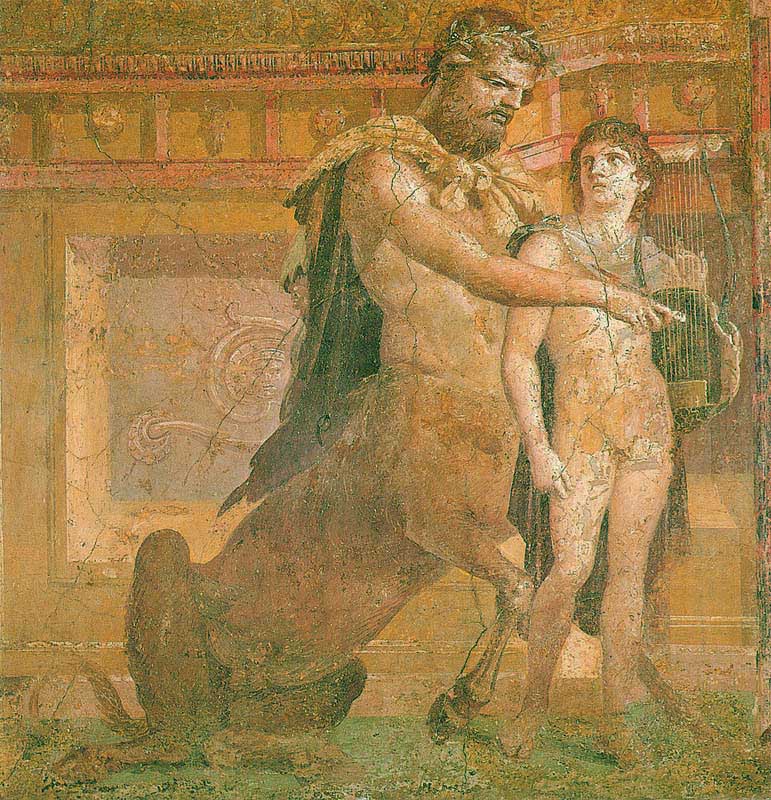
Like we know from Roman frescoes[1] and mosaics[2] that they were pretty skilled painters and solving the problem of how to paint something to have more hues than a King's Quest 3 sprite is unlikely to be an unsolvable aesthetic problem.
[edit] Changed from Secret of Monkey Island since that game has too many versions and remakes.
[1] https://upload.wikimedia.org/wikipedia/commons/6/6e/Chiron_i...
[2] https://en.wikipedia.org/wiki/Plato%27s_Academy_mosaic#/medi...

"many people are operating outside their area of expertise on this subject."
Exactly. I takes years of really hard work to get good at this stuff. Decades.
I do realize research budgets are not that awesome, but when claims are of aesthetic in nature (explicitly and implicitly) and deal with human craftmanship there should definetly be collaboration with also craftsmen subject experts.
A good example where this was executed really well was the Notre Dame reconstruction (I _guess_). Craftsmen and academic diligence hand in hand.
Not everyones archeological reproduction has such a budget unfortunately.
Not all painters, and not in all cases: See, for instance, grisalle painting. One can then sketch the highlights and shadows first, and then come in with pretty translucent pigments. When the pigment is what is expensive, it can be more economical. We know for sure many a renaissance painting and fresco was done this way, and some of us do it today.
Now, was it possible that, given the pigments available, they were better off just going with the most saturated thing they could possibly have, and then work from there? Absolutely. But the right argument here isn't that "Painters layer paint this way", but that, as the article indicates, they are unlikely to be unsophisticated artists that don't believe shadows and highlights. So the highlighting and the shading must be in the place where we can't see, because we assume they must exist.
That's what TFA is saying
> Another may be that they are hampered by conservation doctrines that forbid including any feature in a reconstruction for which there is no direct archaeological evidence. Since underlayers are generally the only element of which traces survive, such doctrines lead to all-underlayer reconstructions, with the overlayers that were obviously originally present excluded for lack of evidence.
Makes sense. This is basically how skilled painters of miniatures (Warhammer) do it.
I will die on an adjacent hill: when the details had washed away with time leaving behind merely the sturdier and ugly base, people removed the garish base coat cause that thing is uuugggo! Our ancestors were thinking what we're thinking: It looks better white than with only a base.
That is certainly how oil painters paint. But painting on absorbent stone is likely very different - more akin to fresco, and would probably not support a very layered approach.
Thank you. I know nothing about painting, but I bought the original story about the statutes being painted these garish colors.
I assume you didn't read the article, since that's their exact point...
"Since underlayers are generally the only element of which traces survive, such doctrines lead to all-underlayer reconstructions, with the overlayers that were obviously originally present excluded for lack of evidence."
The other side is lack of colourfast pigments back then. Underlayers would be cheap and colourfast. Top layers would usually be more expensive and deteriorate much more quickly.
Agreed.
Armor historians from the 1960s, all the way back to Victorian age, sat in their offices smoking pipes and imagining what purpose the armor served, and and what constraints molded it.
Then the SCA and Renaissance Faires sprang up, and it was no longer purely theoretical. Recreationist research became a thing. And historical analysis became practical.
The most glaring example are the rectangular epaulets on funereal brasses and sarcophagi. Historian used to claim they were used to deflect blows from the shoulder.
Nothing is flat after a blow. All real armor is built on pressure-spreading arches, often first two-dimensionally, but ultimately in three dimensions (the armor over a 16th-century knight's legs are never conic sections, but more fluid curves).
So, those rectangles? Not defensive metal, but purely decorative, and probably leather or paper-mache. (None survive, and in fact there's some argument they exist only in art.)
Any historian who tried to make one and use it would learn this in a short exercise. But the fallacy survived for decades, because the people were operating outside of their area of expertise, while falsely claiming otherwise with no criticism.
Another example is the still-pervasive myth that medieval people used spice to mask the flavor of spoiled meat; I've heard it used by academics a couple decades ago at a conference presentation. Ever eaten spoiled meat? Ever think to yourself, this bellyache wouldn't be so bad if I didn't taste the source of my poisoning? That myth was tracked back to a singular author in the 1950s, IIRC, and copied without any rational criticism ever since.
Are there really no statues with surviving full paint remnants?
This would be a great time to use AI, because it is very good at style transfer. Feed it a lot of contemporary painted art, feed it the base-coat version of the sculpture, and ask it to style-transfer the paintings on to the sculpture. You'd likely get something very close, and for once we can use "The computer said it, I'm not responsible for it!" for the power of good, by making it so no human is responsible for the heinous crime of assuming something without historical evidence (no matter how sensible the assumption is).
(And lest someone be inclined to downvote because I'm suggesting an AI, the real sarcastic core of my message is about our faith in computers still being alive and well even after we all have decades of personal experience of them not being omniscient infalliable machines.)
looking at it from the absolute simplest of perspectives, money/time/effort, then the notion of a base, or primer layer that seals a surface and provides a non absorbant layer for the much more expensive coulor coat. primer bieng applied by aprentices and the finnish coat applied by specialists who would be very likely be useing ALL of the tricks of the trade to bring a statue to life, but then wejump forward to Bernini and the total lack of paint, which makes it even more likely that there were competing philosophies around statuary, with everything from vegas type full primary coulors put on with a mop, and others that were master paintings done on 3d canvases, and still others who believd in.the purity of the "raw" sculpture
Even a middling warhammer miniatures painter would have done a better job of painting these statues than the reconstructions.
>This whole thing just won't go away because many people are operating outside their area of expertise on this subject.
The point the author made in the article is that the reconstructors are well aware of this, and are, in a way, trolling the masses to raise awareness and attract attention to the classical art and museums.
Keeping history alive generally isn't a profitable enterprise.
Yes, this is what tfa says, and it's a good point. But tfa also points out that the archaeologists/reconstructionists know that what they're producing differs from the original. The thing is the discipline of reconstruction means that they only use pigments that they have direct evidence of, and this is just the saturated underlayers. The problem is this is seldom explained when the reconstructions are presented to the public