 alt Hacker News
So where are all the AI apps?
Comments
It is incredibly easy now to get an idea to the prototype stage, but making it production-ready still needs boring old software engineering skills. I know countless people who followed the "I'll vibe code my own business" trend, and a few of them did get pretty far, but ultimately not a single one actually launched. Anyone who has been doing this professionally will tell you that the "last step" is what takes the majority of time and effort.
Maybe the top 15,000 PyPi packages isn't the best way to measure this?
Apparently new iOS app submissions jumped by 24% last year:
> According to Appfigures Explorer, Apple's App Store saw 557K new app submissions in 2025, a whopping 24% increase from 2024, and the first meaningful increase since 2016's all-time high of 1M apps.
The chart shows stagnant new iOS app submissions until AI.
Here's a month by month bar chart from 2019 to Feb 2026: https://www.statista.com/statistics/1020964/apple-app-store-...
Also, if you hang out in places with borderline technical people, they might do things like vibe-code a waybar app and proudly post it to r/omarchy which was the first time they ever installed linux in their life.
Though I'd be super surprised if average activity didn't pick up big on Github in general. And if it hasn't, it's only because we overestimate how fast people develop new workflows. Just by going by my own increase in software output and the projects I've taken on over the last couple months.
Finally, December 2025 (Opus 4.5 and that new Codex one) was a big inflection point where AI was suddenly good enough to do all sorts of things for me without hand-holding.
I AI coded an entire platform for my work. It works great for me. I also recognize that this is not something I want to make into a commercial product because it was so easy that there's just no value.
I think this might be more of an comment on software as a business than AI not coding good apps.
I deleted vscode and replaced with a hyper personal dashboard that combines information from everywhere.
I have a news feed, work tab for managing issues/PRs, markdown editor with folders, calendar, AI powered buttons all over the place (I click a button, it does something interesting with Claude code I can't do programmatically).
Why don't I share it? Because it's highly personal, others would find it doesn't fit their own workflow.
AI makes the first 90% of writing an app super easy and the last 10% way harder because you have all the subtle issues of a big codebase but none of the familiarity. Most people give up there.
I think this article is making a pretty big assumption: that people making things with AI are also going to be publishing them. And that's just the opposite of what should be expected, for the general case.
Like I've been making things, and making changes to things, but I haven't published any of that because, well they're pretty specific to my needs. There are also things which I won't consider publishing for now, even if generally useful because, well the moat has moved from execution effort to ideas, and we all want to maintain some kind of moat to boost our market value (while there's still one). Everyone has reasonable access to the same capabilities now, so everyone can reasonably make what they need according to their exact specs easily, quickly and cheaply.
So while there are many things being made with AI, there is ever-decreasing reasons to publish most of it. We're in an era of highly personalized software, which just isn't worth generalizing and sharing as the effort is now greater than creating from scratch or modifying something already close enough.
The article measures the wrong thing. PyPI package creation is a terrible proxy for AI-assisted software output because packages are published for reuse by others, which requires documentation, API design, and maintenance commitments that AI doesn't help with much.
The real output is happening in private repos, internal tools, and single-purpose apps that never get published anywhere. I've been building a writing app as a side project. AI got me from zero to a working PWA with offline support, Stripe integration, and 56 SEO landing pages in about 6 weeks of part-time work. Pre-AI that's easily a 6-month project for one person.
But I'm never going to publish it as a PyPI package. It's a deployed web app. The productivity gain is real, it just doesn't show up in the datasets this article is looking at.
The iOS App Store submission data (24% increase) that someone linked in the comments is a much better signal. That's where the output is actually landing.
This remains me so much of the .COM bubble in 2000. A lot of clueless companies thought that they just need to “do internet” without any further understanding or strategy. They burned a ton of money and got nothing out of it. Other companies understood that the internet is an enabling technology that can support a lot of business processes. So they quietly improved their business with the help of the internet.
I see the same with AI. Some companies will use AI quietly and productively without much fuzz. Others are just using it as a marketing tool or an ego trip by execs but no real understanding.
Not sure that I'd look at python package stats to build this particular argument on.
First, I find that I'm using a lot fewer libraries in general because I am less constrained by the mental models imposed by library authors upon what I'm actually trying to do. Libraries are often heavy and by nature abstract low-level calls from API. These days, I'm far more likely to have 2-3 functions that make those low-level calls directly without any conceptual baggage.
Second, I am generalizing but a reasonable assertion can be made that publishing a package is implicitly launching an open source project, however small in scope or audience. Running OSS projects is a) extremely demanding b) a lot of pain for questionable reward. When you put something into the universe you're taking a non-zero amount of responsibility for it, even just reputationally. Maintainers burn out all of the time, and not everyone is signed up for that. I don't think there's going to be anything remotely like a 1:1 Venn for LLM use and package publishing.
I would counter-argue that in most cases, there might already be too many libraries for everything under the sun. Consolidation around the libraries that are genuinely amazing is not a terrible thing.
Third, one of the most recurring sentiments in these sorts of threads is that people are finally able to work through the long lists of ideas they had but would have never otherwise gotten around to. Some of those ideas might have legs as a product or OSS project, but a lot of them are going to be thought experiments or solve problems for the person writing them, and IMO that's a W not an L.
Fourth, once most devs are past the "vibe" party trick phase of LLM adoption, they are less likely to squat out entire projects and far, far more likely to return to doing all of the things that they were doing before; just doing them faster and with less typing up-front.
In other words, don't think project-level. Successful LLM use cases are commit-level.
It's simple. AI speeds the 80% of development that was never the blocker.
Arguably makes the remaining 20% even harder to handle.
I'm sure that AI can be a huge boost to great, mature developers. Which are insanely rare in an industry that has consistently promoted brainless ivy league coders farming algo quizzes for months.
But those with a huge sensibility and experience can definitely be enabled to produce more.
But the 20% is still there and again, it's easy to make it way harder because you're less intimate with the brittle 80%.
I have published 4 open source projects thanks to the productivity boost from AI. No apps though, just things I needed in my line of work.
But I have been absolutely flooded with trailers for new and upcoming indie games. And at least one indie developer has admitted that certain parts of their game had used the aide of AI.
I also noticed sometimes when I think of writing something, I ask AI first if it exists, and AI throws up some link and when I check the link it says "made with <some AI>".
So I'm not sure what author is trying to say here but I definitely feel like I am noticing a rise in software output due to AI.
But with that said, I also am noticing the burden of taking care of those open source projects. Sometimes it feels like I took on a 2nd job.
I think a lot of software is being produced with AI and going unnoticed, they don't all end up on the front page of HN for harassing developers.
Please, be patient. Wrangling AI agents, writing and rewriting prompts, waiting for the start of another month because tokens ran out - there are so many challenges here, you cannot expect everyone to ship an app a day or something.
Does the data not support a 2X increase in packages?
Pre-ChatGPT, in ~2020, there were about 5,000 new packages per month. Starting in 2025 (the actual year agents took off), there is a clear uptick in packages that is consistently about 10,000 or 2X the pre-ChatGPT era.
In general, the rate of increase is on a clear exponential. So while we might not see a step change in productivity, there comes a point where the average developer is in fact 10X productive than before. It just doesn't feel so crazy because it can about in discrete 5% boosts.
I also disagree with the dataset being a good indicator of productivity. I wouldn't actually suspect the number of packages or the frequency of updates to track closely with productivity. My first order guess would that AI would actually be deflationary. Why spend the time to open source something that AI can gen up for anyone on a case by case basis specific to the project. it takes a certain level of dedication and passion for a person to open source a project and if the AI just made it for them, then they haven't actually made the investment of their time and effort to make them feel justified in publishing the package.
The metrics I would expect to go up are actually the size of codebases, the number of forks of projects that create hyper customized versions of tools and libraries, and other metrics like that.
Overall, I'd predict AI is deflationary on the number of products that exist. If AI removes the friction involved with just making a custom solution, then the amount of demand for middleman software should actually fall as products vertically integrate and reduce dependencies.
Claude Code was released for general use in May 2025. It's only March.
Also using PyPI as a benchmark is incredibly myopic. Github's 2025 Octoverse[0] is more informative. In that report, you can see a clear inflection point in total users[1] and total open source contributions[2].
The report also notes:
> In 2025, 81.5% of contributions happened in private repositories, while 63% of all repositories were public
[0]: https://github.blog/news-insights/octoverse/octoverse-a-new-...
[1]: https://github.blog/wp-content/uploads/2025/10/octoverse-202...
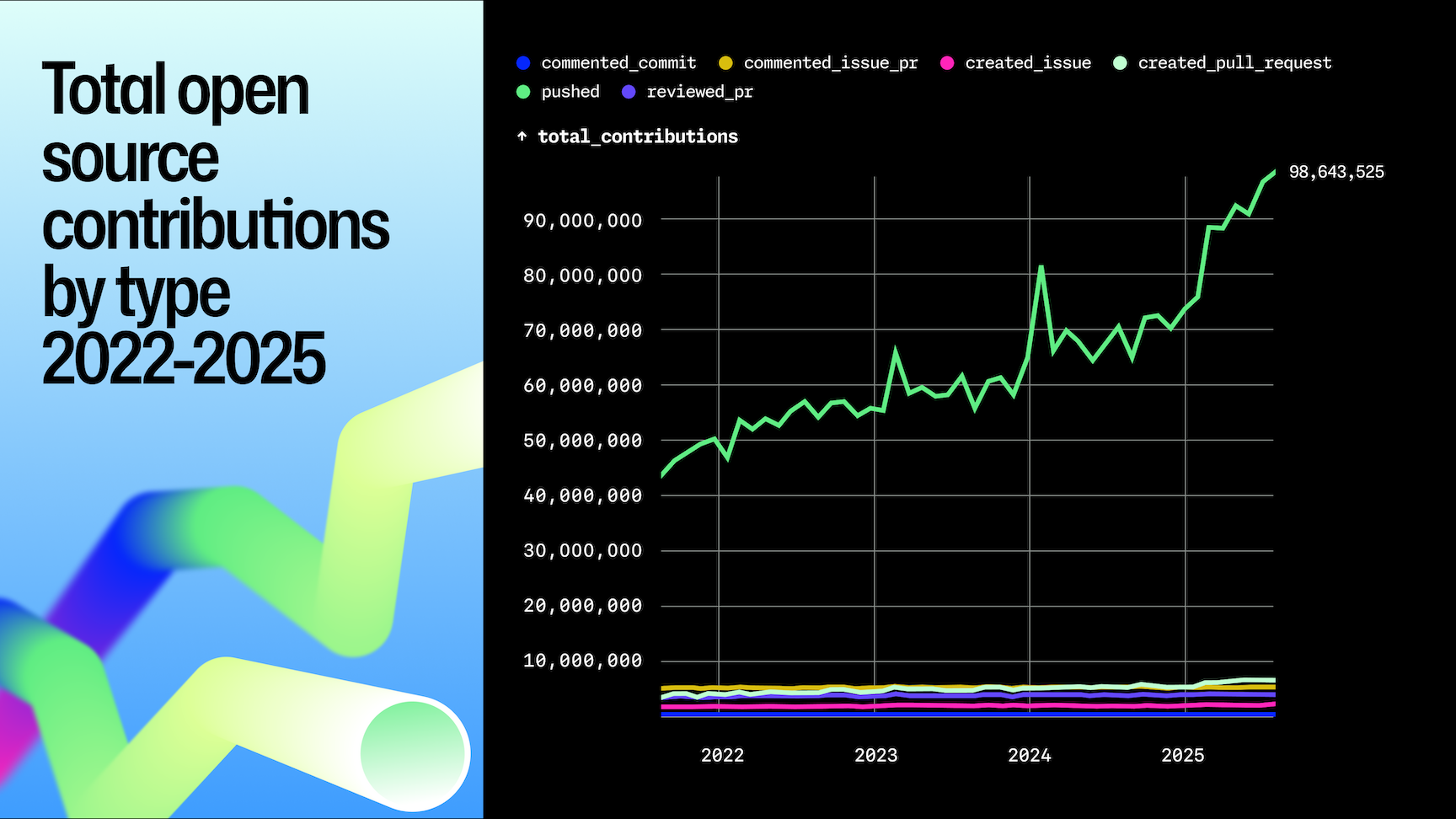
[2]: https://github.blog/wp-content/uploads/2025/10/octoverse-202...
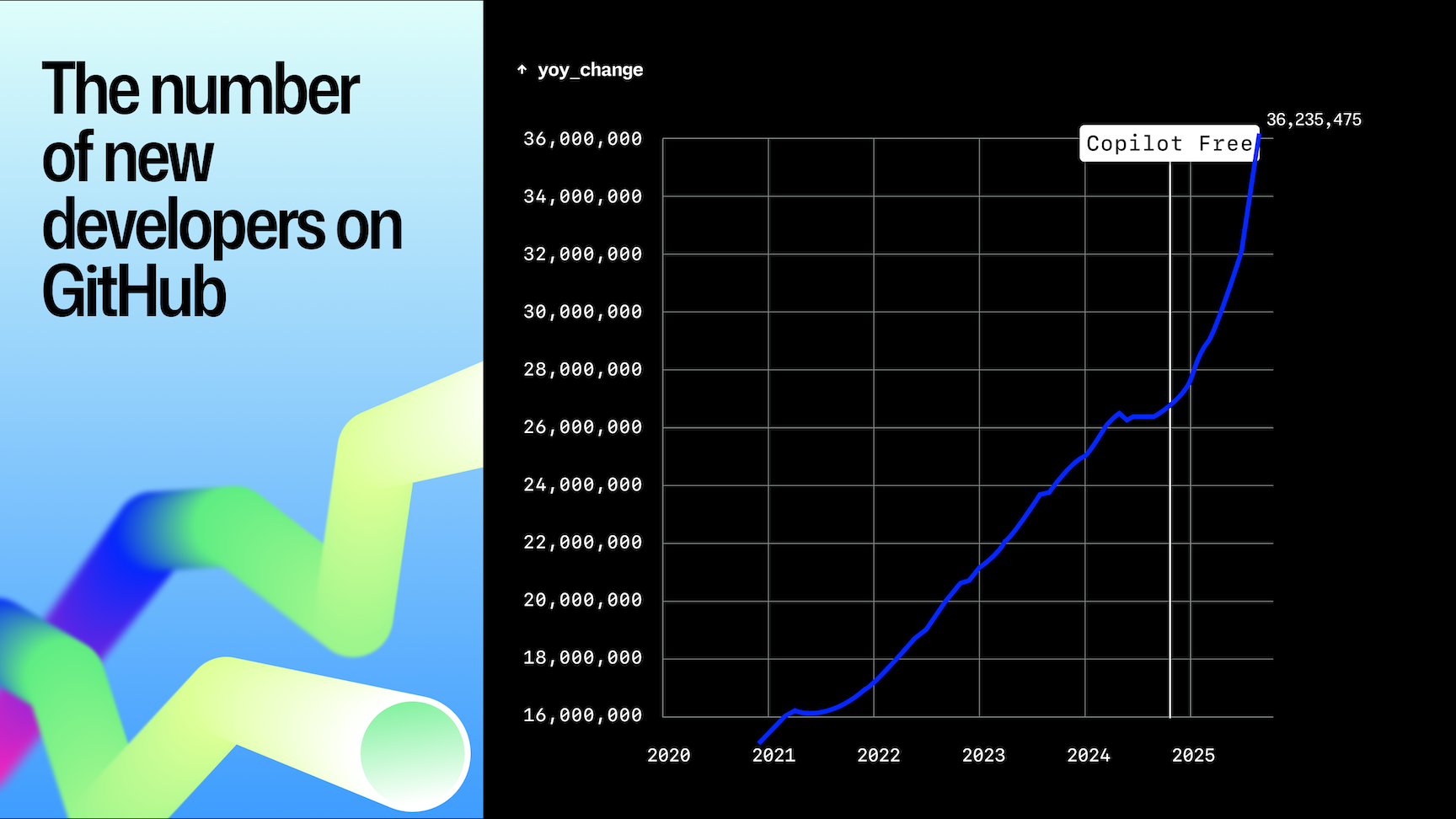
Is this the best way to measure this? I think the biggest adopters of AI coding has been companies who are building features on existing apps, not building new apps entirely. Wouldn't it make more sense looking at how quickly teams are able to build and ship within companies?
It seems like all tech executives are saying they are seeing big increases in productivity among engineering teams. Of course everyone says they're just [hyping, excusing layoffs, overhired in 2020, etc], but this would be the most relevant metric to look at I think.
The thesis has it backwards. We will see fewer published/downloaded apps/packages as people rely on others less. I'm not sure we're quite there yet but I'm increasingly likely to spend a few minutes giving an LLM a chance to make a tool I need instead of sifting through sketchy and dodgy websites for some slightly obscure functionality. I use fewer ad-heavy sites that for converting a one text file format to another.
Personally, I see the paid or adware software market shrinking, not growing, as a testament to the success of LLMs in coding.
The models are not well trained on bringing products to market.
And even “product engineers” often do not have experience going from zero to post sales support on a saas on their own.
It is a skill set of its own to make product decisions and not only release but stick with it after the thing is not immediately successful.
The ability to get some other idea going quickly with AI actually works against the habits needed to tough through the valley(s).
Thoughts: 1. Some hype-types may have been effusive about AI-assisted coding since ChatGPT, but IMO the commonly agreed paradigm shift was claude code, and especially 4.5, very very recent. 2. Anchoring biases in reaction to hype is still letting one's perspective be defined by hype. Yes the cursor post is a joke, but leading with that is a strawman. This article does not aim to take it's subject seriously, IMO. 3. While I agree the hype is currently at comical levels, the utility of the current LLMs is obvious, and reasons for "skilled" usage not being easily quantifiable are also obvious.
IE, using agents to iterate through many possible approaches, spike out migrations, etc might save a project a year of misadventures, re-designs, etc, but that productivity gain _subtracts_ the intermediate versions that _didn't_ end up being shipped.
As others have mentioned, I think yak-shaving is now way more automated. IE, If I want to take a new terminal for a spin, throw together a devtool to help me think about a specific problem better, etc, I can do it with very low friction. So "personal" productivity is way higher.
Coding assistants/agents/claws whatever the current trend is are over-hyped but also quite useful in good hands.
But the mistake is to expect a huge productivity boost.
This is highly related to Amdahl's law, also The Mythical Man-Month.
Some tasks can be accomplished so fast that it seems magical, but the entire process is still very serial, architecture design and debug are pretty weak on the AI side.
I won't make any claims as to the Python ecosystem and why there is no effect seen here (and I suppose no effect seen of the Internet on productivity) but one thing that is entirely normal for me now is that I never see the need to open-source anything. I also don't use many new open-source projects. I can usually command Claude Code to build a highly idiosyncratic thing of greater utility. The README.md is a good source of feature inspiration but there are many packages I simply don't bother using any more.
Besides, it's working for me. If it isn't working for others I don't want to convince them of anything. I do want to hear from other people for whom it's working, though, so I'm happy to share when things work for me.
I fail to see why the author thinks Python packages are a good proxy for AI driven/built code. I've built a number of projects with AI, but I haven't created any new packages.
It's like looking at tire sales to wonder about where the EV cars are.
How do packages measure anything? This is a biased sample. Average user of AI/developer would not ever in their life make a package or any open source contribution. They would probably work on the proprietary software. Not to say that conclusions are wrong though.
There are actually a lot of new startups coming out with agentic workflows, and they're probably moving fast. But to your point, there's probably still a lot of friction that keeps the average person/dev from launching new companies.
I’m not a developer by trade. I’ve screwed around with some programming classes when I was in school, and have written some widely used but highly specific scripts related to my work, but I’ve never been a capital-D developer.
In the last few months, Gemini (and I) have written for highly personal, very niche apps that are perfect for my needs, but I would never dream of releasing. Things like cataloguing and searching my departed mom‘s recipe cards, or a text message based budget tracker for my wife and I to share.
These things would never be released or available as of source or commercial applications in the way that I wanted them, and it took me less time to have them built with AI then it would have taken me to Research existing alternatives and adapt my workflow/use case to fit whatever I found.
So yeah, there are more apps but I would venture to say you’ll never see most of them…
I think part of the mismatch is that people are still looking for “more apps” as the output metric.
A lot of the real value shows up as workflow compression instead. Internal tools, one-off automations, bespoke research flows, coding helpers, things that would never have justified becoming a product in the first place.
AI does make me more productive. At least until the stage of getting my idea to the "working prototype stage". But in my personal experience, no one has been realistically able to get to the 10x level that a lot of people claim to have achieved with LLMs.
Yes, you do produce more code. But LoC produced is never a healthy metric. Reviewing the LLM generated code, polishing the result and getting it to production-level quality still very much requires a human-in-the-loop with dedicated time and effort.
On the other hand, people who vibe code and claims to be 10x productive, who produces numerous PRs with large diffs usually bog down the overall productivity of teams by requiring tenuous code reviews.
Some of us are forced to fast-track this review process so as to not slow down these "star developers" which leads to the slow erosion in overall code quality which in my opinion would more than offset the productivity gains from using the AI tools in the first place.
There is one AI app that is not just an app it is your personal assistant which will work on your assign task and give you the results you can connect it with your social media it will deploy in just 3 single step also has free trial try it now becuase your saas needs an personal assistant that work on behalf of you Give it try:https://clawsifyai.com/
Isn't most of the positive impact not going to be "new projects" but the relative strength of the ideas that make it into the codebase? Which is almost impossible to measure. You know, the bigger ideas that were put off before and are now more tractable.
Vibe coding is actually a brilliant MLM scheme: people buy tokens to generate apps that re-sell tokens (99% of those apps are AI-something).
This is going to cause people to react, but I think those of us that truly love opensource don't push AI generated code upstream because we know it's just not ready for use beyond agentic use. It's just not robust for alot of use common use cases because the code produces things that are hyper hardcoded by default, and the bugs are so basic, i doubt any developer that actually cared would push something so shamefully sloppy upstream with their name on it.
The tools for generating AI code aren't yet capable of producing code that is decent enough for general purpose use cases, with good robust tests, and clean and quality.
Where are they? Well they aren't being uploaded to PyPI. 90% of the "AI apps" one-off scripts that get used by exactly one person and thrown away. The rest are too proprietary, too personal, or too weird to share.
Well, it's kind of like asking about streaming media. If anyone can have their own "tv show" or anyone can be their own "music producer" then the ratios are so radically altered vis-a-vis content/attention calculation. The question has never been "more means more success stories" because musicians make $.000001 per stream, so even if they stream millions of songs ... you get the point. So surely there are good apps, but the accompanying deluge makes them seem less significant.
I am worried for people using write ups like this as a huge, much appreciated dose of copium.
Try it out and don't stop trying. If something improves at this rate, even if you think it's not there right now, don't assume it is going to stop. Be honest about the things we were always obviously bad at, that the ai has been getting quickly better at, and assume that it will continue getting better. If this were true, what would that mean for you?
I don't think people are using AI to create new dependencies that they're then submitting to open source package managers (which is what this shows)
This is more useful for discussing what kind of projects AI is being used for than whether it's being used.
The reason why the release cadence of apps about AI has increased presumably reflects the simple facts that
a) there are likely many more active, eager contributors all of a sudden, and
b) there's suddenly a huge amount of new papers published every week about algorithms and techniques that said contributors then eagerly implement (usually of dubious benefit).
More cynically, one might also hypothesize that
c) code quality has dropped, so more frequent releases are required to fix broken programs.
This is just counting pypi packages. Why would I go to the effort of publishing a library or cli tool that took me ten minutes to create? Especially in an environment where open source contributions from strangers are useless. If anything I'd expect useful AI to reduce the number of new pypi packages.
I feel they're largely here, on this platform. Hacker News, currently, could be renamed to AI News, without any loss of generality.
I’ve done a event ticket system that’s in production. Stripe integration, resend for mailing and a scan app to scan tickets. It’s for my own club but it’s been working quite well. Took about 80 hours from inception to live with a focus on testing.
I’ve done some experiments with reading gedcom files, and I think I’m quite close to a demoable version of a genealogy app.
Biggest thing is a tool for remotely working musicians. It’s about 10000 lines of well written rust, it is a demoable state and I wish I could work more on it but I just started a new job.
But yeah, this wouldn’t have been possible if I hadn’t been a very experienced dev who knows how to get things live. Also I’ve found a way to work with LLMs that works for me, I can quickly steer the process in the right way and I understand the code thats written, again it’s possible that a lot of real experience is needed for this.
> So, let’s ask again, why? Why is this jump concentrated in software about AI?...Money and hype
Don't get me wrong: there are real productivity gains to be had, but the reality is that building small one-offs and personal tools is not the same thing as building, operationalizing, and maintaining a large system used by paying customers and performing critical business transactions.
A lot of devs are surrendering their critical thinking facilities to coding agents now. This is part of why the hype has to exist: to convince devs, teams, and leaders that they are "falling behind". Hand over more of your attention (and $$$) to the model providers, create the dependency, shut off your critical thinking, and the loop manifests itself.
The providers are no different from doctors pushing OxyContin in this sense; make teams dependent on the product. The more they use the product, the more they build a dependency. Junior and mid-career devs have their growth curves fully stunted and become entirely reliant on the LLM to even perform basic functions. Leaders believe the hype and lay off teams and replace them with agents, mistaking speed for velocity. The more slop a team codes with AI, the more they become reliant on AI to maintain the codebase because now no one understands it. What do you do now? Double down; more AI! Of course, the answer is an AI code reviewer!. Nothing that more tokens can't solve.
I work with a team that is heavily, heavily using AI and I'm building much of the supporting infrastructure to make this work. But what's clear is that while there are productivity gains to be had, a lot of it is also just hype to keep the $$$ flowing.
I'd take this info with a grain of salt. You have to understand how new some of these developments are. It's only been a couple of months since we hit the opus 4.5+ threshold. I created 4 react packages for kicks in a weekend: https://www.hackyexperiments.com/blog/shipping-react-librari...
I am learning music. I used codex to create a native metronome app, a circle of fifths app, a practice journal app. I try to build a native app alternatives.
I have no plans of publishing them or making the open source, so it will not be a part of this metric. I believe others are doing this too.
Wouldn't the apps go into the Apple store and Android play? I guess looking at python packages is valid, but I don't think it's the first thing someone thinks to target with vibe coding. And many apps go to be websites, a website never tells me much about how it is made as a user of the site.
A bit tangential to the article themes, but I feel in some workplaces that engineering velocity has gone up while product cycles and agile processes have stayed the same. People end up churning tickets faster and working less, while general productivity has not changed.
Of course these are specific workplaces designed around moving tickets on a board, not high-agentic, fast-moving startups or independent projects—but they might represent a lot of the developer workforce.
I also know this is not everyone's experience and probably a rare favorable outcome of productivity gain captured by a worker that is not and won't stay the norm.
Even taking the “we’re all 100x more efficient at writing code” argument at face value… there’s still all of the product/market fit, marketing, sales, etc “schlep” which is very much non-trivial.
Are there any agentic sales and marketing offerings?
Because being able to reliably hand off that part of the value chain to an agent would close a real gap. (Not sure this can be done in reality)
Internally, we've created such good debugging tools that can aggregate a lot from a lot of sources. We've yet to address the quality of vibecoded critical applications so they aren't merged, but one off tools for incall,alert debugging and internal workflows has skyrocketed.
One problem with a lot of the skepticism around AI produced software is that it focuses on existing ways of packaging and delivering software. PyPi packages are one example, shipping “apps” another.
While it’s interesting to see that in open source software the increase is not dramatic, this ignores however many people are now gen-coding software they will never publish just for them, or which winds up on hosting platforms like Replit.
- this would be much more insightful if the author takes the number of submissions to producthunt and the top 10 saas directories as the measure to see how many new apps were created pre AI and post AI era
- product hunt or app sumo is something i believe everyone tries to get a submission to which would truly measure how many new apps are we having per month these days
Looking at Python packages, or any developer-facing form of software, is not a good indicator of AI-based production. The key benefit of AI development is that our focus moves up a few layers of abstraction, allowing us to focus on real-world solutions. Instead of measuring Github, you need to measure feature releases, internal tools created, single-user applications built for a single niche use case.
Measuring python packages to indicate AI-based production is like measuring saw production to measure the effectiveness of the steam engine. You need to look at houses and communities being built, not the tools.
We have great software now!
YoloSwag (13 commits)
[rocketship rocketship rocketship]
YoloSwag is a 1:1 implementation of pyTorch, written in RUST [crab emoji]
- [hand pointing emoji] YoloSwag is Memory Safe due to being Written in Rust
- [green leaf emoji] YoloSwag uses 80% less CPU cycles due to being written in Rust
- [clipboard emoji] [engineer emoji] YoloSwag is 1:1 API compatible with pyTorch with complete ops specification conformance. All ops are supported.
- [recycle emoji] YoloSwag is drop-in ready replacement for Pytorch
- [racecar emoji] YoloSwag speeds up your training workflows by over 300%
Then you git clone yoloswag and it crashes immediately and doesn't even run. And you look at the test suite and every test just creates its own mocks to pass. And then you look at the code and it's weird frankenstein implementation, half of it is using rust bindings for pytorch and the other half is random APIs that are named similarly but not identical.
Then you look at the committer and the description on his profile says "imminentize AGI.", he launched 3 crypto tokens in 2020, he links an X profile (serial experiments lain avatar) where he's posting 100x a day about how "it's over" for software devs and how he "became a domain expert in quantum computing in 6 weeks."