 alt Hacker News
I compiled 1,357 monthly CPI observations from 1913 to 2026 (BLS data via FRED). The common narrative is that inflation slowly erodes purchasing power over time. The data tells a different story. Four concentrated episodes — WWI, WWII/post-war, the Great Inflation (1968–82), and post-COVID — account for 72% of total cumulative price increase, despite spanning only 29% of the time period. The dataset includes regime classification, episode tagging, and a decomposition analysis. Full CSV available for download.
Replies
Why didn't you use log-scale? It seems like the obvious call.
IMO the first graph would make a lot more sense when plotted in log scale.
Also this way of framing "As of February 2026, the US dollar has lost 96.9% of its purchasing power relative to January 1914. This means that $100 in 1914 would buy only approximately $3.05 worth of goods today" is of course math-correct but difficult to understand intuitively.
I think it makes more sense to explain it in the opposite direction or in both directions: "$100 in 1914 would buy only approximately $3.05 worth of goods today, or equivalently, $100 in 1914 is worth ~ $3278 nowdays (because 100 / 3.05 ~= 32.78 "
This also makes it easier to understand that the term "millionaire == person that has 1 million USD" only makes sense around 1914, because the equivalent amount of wealth nowdays would be "millionaire == person that has 32 million USD"
Anyways, I liked a lot this visualization https://mlde8o0xa4ew.i.optimole.com/cb:VNTn.d9a/w:auto/h:aut... that visualizes the compression in time of the big value changes.
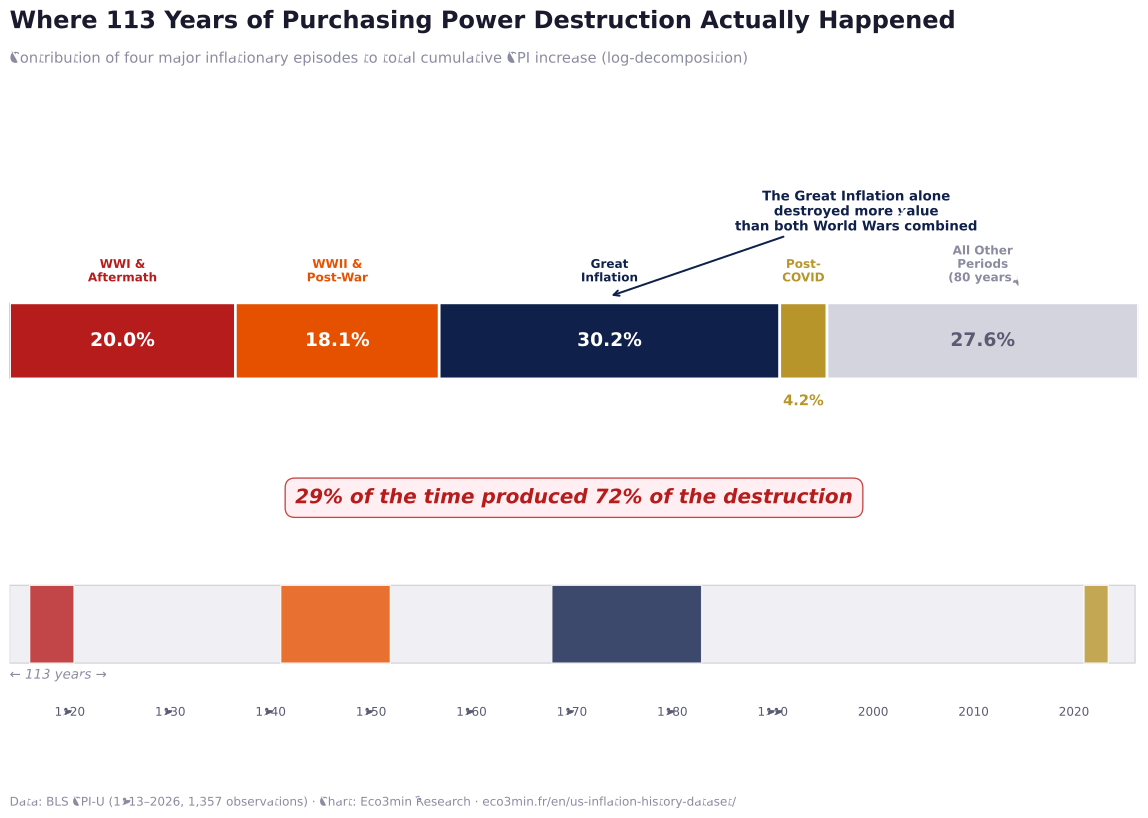
Pretty close to the 80/20 rule of thumb.
Take my downvote, clanker.
I'm not really convinced this data falsifies the narrative of a slow erosion. It's just the Pareto principle in action. I bet if you graphed the erosion of a hill you'd see the same pattern.
Really not interesting analysis. Four "concentrated episodes" totaling 30 years, hardly "concentrated episodes", especially when you have a "concentrated episode" that lasts for fifteen years. It's extremely unsurprising there are periods of inflationary growth that's higher, and some lower.
This is very obviously an AI generated comment which is against the guidelines.