 alt Hacker News
IMO the first graph would make a lot more sense when plotted in log scale.
Also this way of framing "As of February 2026, the US dollar has lost 96.9% of its purchasing power relative to January 1914. This means that $100 in 1914 would buy only approximately $3.05 worth of goods today" is of course math-correct but difficult to understand intuitively.
I think it makes more sense to explain it in the opposite direction or in both directions: "$100 in 1914 would buy only approximately $3.05 worth of goods today, or equivalently, $100 in 1914 is worth ~ $3278 nowdays (because 100 / 3.05 ~= 32.78 "
This also makes it easier to understand that the term "millionaire == person that has 1 million USD" only makes sense around 1914, because the equivalent amount of wealth nowdays would be "millionaire == person that has 32 million USD"
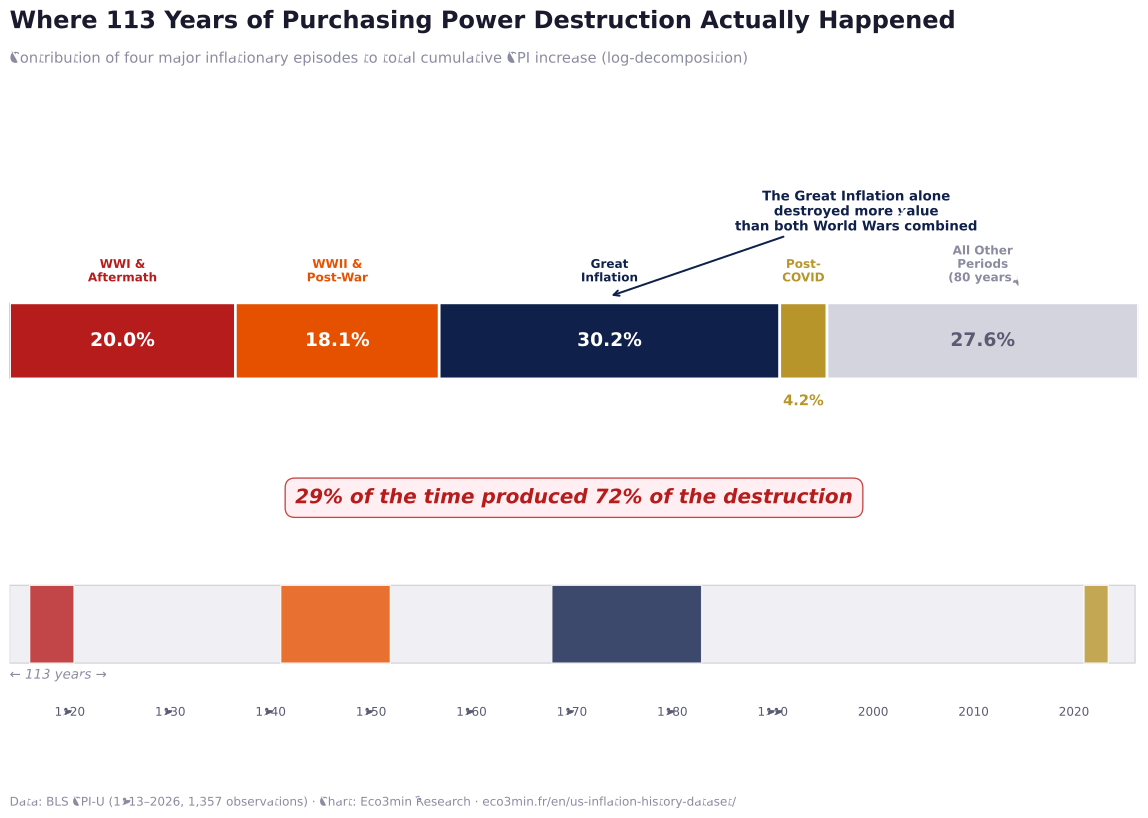
Anyways, I liked a lot this visualization https://mlde8o0xa4ew.i.optimole.com/cb:VNTn.d9a/w:auto/h:aut... that visualizes the compression in time of the big value changes.
Replies
Also if you had that $100 in 1914 dollar coins it would actually be worth $5,400 in silver.
If you had $100 in 1914 $10 coins you would have $24,800 in gold.
>Anyways, I liked a lot this visualization https://mlde8o0xa4ew.i.optimole.com/cb:VNTn.d9a/w:auto/h:aut... that visualizes the compression in time of the big value changes.
It's still a bad chart because of the "the great inflation destroyed more value than both world wars combined" claim, for two reasons:
1. It's not clear (from the chart at least), that the claim is true. 20.0% + 18.1% = 38.1%, greater than 30.2%, but the quote claims otherwise. True, the red and orange segments cover more than just ww1 and ww2, but if more granular data is available why not show it?
2. "destroyed more value" might be technically true if we define "value destroyed = inflation", but it's a non-intuitive definition to use. If you asked someone about the value destroyed in ww1/ww2, they'll talk about europe being bombed out, not higher inflation.