 alt Hacker News
Google releases Gemma 4 open models
Comments
Comparison of Gemma 4 vs. Qwen 3.5 benchmarks, consolidated from their respective Hugging Face model cards:
    | Model          | MMLUP | GPQA  | LCB   | ELO  | TAU2  | MMMLU | HLE-n | HLE-t |
    |----------------|-------|-------|-------|------|-------|-------|-------|-------|
    | G4 31B         | 85.2% | 84.3% | 80.0% | 2150 | 76.9% | 88.4% | 19.5% | 26.5% |
    | G4 26B A4B     | 82.6% | 82.3% | 77.1% | 1718 | 68.2% | 86.3% |  8.7% | 17.2% |
    | G4 E4B         | 69.4% | 58.6% | 52.0% |  940 | 42.2% | 76.6% |   -   |   -   |
    | G4 E2B         | 60.0% | 43.4% | 44.0% |  633 | 24.5% | 67.4% |   -   |   -   |
    | G3 27B no-T    | 67.6% | 42.4% | 29.1% |  110 | 16.2% | 70.7% |   -   |   -   |
    | GPT-5-mini     | 83.7% | 82.8% | 80.5% | 2160 | 69.8% | 86.2% | 19.4% | 35.8% |
    | GPT-OSS-120B   | 80.8% | 80.1% | 82.7% | 2157 |  --   | 78.2% | 14.9% | 19.0% |
    | Q3-235B-A22B   | 84.4% | 81.1% | 75.1% | 2146 | 58.5% | 83.4% | 18.2% |  --   |
    | Q3.5-122B-A10B | 86.7% | 86.6% | 78.9% | 2100 | 79.5% | 86.7% | 25.3% | 47.5% |
    | Q3.5-27B       | 86.1% | 85.5% | 80.7% | 1899 | 79.0% | 85.9% | 24.3% | 48.5% |
    | Q3.5-35B-A3B   | 85.3% | 84.2% | 74.6% | 2028 | 81.2% | 85.2% | 22.4% | 47.4% |

    MMLUP: MMLU-Pro
    GPQA: GPQA Diamond
    LCB: LiveCodeBench v6
    ELO: Codeforces ELO
    TAU2: TAU2-Bench
    MMMLU: MMMLU
    HLE-n: Humanity's Last Exam (no tools / CoT)
    HLE-t: Humanity's Last Exam (with search / tool)
no-T: no thinkI ran these in LM Studio and got unrecognizable pelicans out of the 2B and 4B models and an outstanding pelican out of the 26b-a4b model - I think the best I've seen from a model that runs on my laptop.
https://simonwillison.net/2026/Apr/2/gemma-4/
The gemma-4-31b model is completely broken for me - it just spits out "---\n" no matter what prompt I feed it. I got a pelican out of it via the AI Studio API hosted model instead.
Hi all! I work on the Gemma team, one of many as this one was a bigger effort given it was a mainline release. Happy to answer whatever questions I can
If you want the fastest open source implementation on Blackwell and AMD MI355, check out Modular's MAX nightly. You can pip install it super fast, check it out here: https://www.modular.com/blog/day-zero-launch-fastest-perform...
-Chris Lattner (yes, affiliated with Modular :-)
Featuring the ELO score as the main benchmark in chart is very misleading. The big dense Gemma 4 model does not seem to reach Qwen 3.5 27B dense model in most benchmarks. This is obviously what matters. The small 2B / 4B models are interesting and may potentially be better ASR models than specialized ones (not just for performances but since they are going to be easily served via llama.cpp / MLX and front-ends). Also interesting for "fast" OCR, given they are vision models as well. But other than that, the release is a bit disappointing.
Gemma 3 models were pretty bad, so hopefully they got Gemma 4 to at least come close to the other major open weights
Best thing is that this is Apache 2.0 (edit: and they have base models available. Gemma3 was good for finetuning)
The sizes are E2B and E4B (following gemma3n arch, with focus on mobile) and 26BA4 MoE and 31B dense. The mobile ones have audio in (so I can see some local privacy focused translation apps) and the 31B seems to be strong in agentic stuff. 26BA4 stands somewhere in between, similar VRAM footprint, but much faster inference.
The wait is finally over. One or two iterations, and I’ll be happy to say that language models are more than fulfilling my most common needs when self-hosting. Thanks to the Gemma team!
Still pretty unusable on Raspberry Pi 5, 16gb despite saying its built for it, from the E4B model
  total duration:       12m41.34930419s
  load duration:        549.504864ms
  prompt eval count:    25 token(s)
  prompt eval duration: 309.002014ms
  prompt eval rate:     80.91 tokens/s
  eval count:           2174 token(s)
  eval duration:        12m36.577002621s
  eval rate:            2.87 tokens/s
I'm curious about the multimodal capabilities on the E2B and E4B and how fast is it.
In ChatGPT right now, you can have a audio and video feed for the AI, and then the AI can respond in real-time.
Now I wonder if the E2B or the E4B is capable enough for this and fast enough to be run on an iPhone. Basically replicating that experience, but all the computations (STT, LLM, and TTS) are done locally on the phone.
I just made this [0] last week so I know you can run a real-time voice conversation with an AI on an iPhone, but it'd be a totally different experience if it can also process a live camera feed.
So the "E2B" and "E4B" models are actually 5B and 8B parameters. Are we really going to start referring to the "effective" parameter count of dense models by not including the embeddings?
These models are impressive but this is incredibly misleading. You need to load the embeddings in memory along with the rest of the model so it makes no sense o exclude them from the parameter count. This is why it actually takes 5GB of RAM to run the "2B" model with 4-bit quantization according to Unsloth (when I first saw that I knew something was up).
Can't wait for gemma4-31b-it-claude-opus-4-6-distilled-q4-k-m on huggingface tomorrow
The benchmark comparisons to Gemma 3 27B on Hugging Face are interesting: The Gemma 4 E4B variant (https://huggingface.co/google/gemma-4-E4B-it) beats the old 27B in every benchmark at a fraction of parameters.
The E2B/E4B models also support voice input, which is rare.
Even with search grounding, it scored a 2.5/5 on a basic botanical benchmark. It would take much longer for the average human to do a similar write-up, but they would likely do better than 50% hallucination if they had access to a search engine.
Kind of sad they didn't release stronger versions. $dayjob offers strong NVidias that are hungry for models and are stuck running llama, gpt-oss etc.
Seems like Google and Anthropic (which I consider leaders) would rather keep their secret sauce to themselves – understandable.
The timing is interesting as Apple supposedly will distill google models in the upcoming Siri update [1]. So maybe Gemma is a lower bound on what we can expect baked into iPhones.
Im really looking forward to trying it out.
Gemma 3 was the first model that I have liked enough to use a lot just for daily questions on my 32G gpu.
The labels on the table read "Gemma 4 31B IT" which reads as 431B parameter model, not Gemma 4 - 31B...
There are so many heavy hitting cracked people like daniel from unsloth and chris lattner coming out of the woodworks for this with their own custom stuff.
How does the ecosystem work? Have things converged and standardized enough where it's "easy" (lol, with tooling) to swap out parts such as weights to fit your needs? Do you need to autogen new custom kernels to fix said things? Super cool stuff.
Gemma 3 E4E runs very quick on my Samsung S26, so I am looking forward to trying Gemma 4! It is fantastic to have local alternatives to frontier models in an offline manner.
Really looking forward to testing and benchmarking this on my spam filtering benchmark. gemma-3-27b was a really strong model, surpassed later by gpt-oss:20b (which was also much faster). qwen models always had more variance.
The LiteRT-LM CLI (https://ai.google.dev/edge/litert-lm/cli) provides a way to try the Gemma 4 model.
  # with uvx
  uvx litert-lm run \
    --from-huggingface-repo=litert-community/gemma-4-E2B-it-litert-lm \
gemma-4-E2B-it.litertlmWhat's a realistic way to run this locally or a single expensive remote dev machine (in a vm, not through API calls)?
Fyi, it took me a while to find the meaning of the "-it" in some models. That's how Google designates "instruction tuned". Come on Google. Definite your acronyms.
I'll wait for the next iteration
Downloaded through LM Studio on an M1 Max 32GB, 26B A4B Q4_K_M
First message:
https://i.postimg.cc/yNZzmGMM/Screenshot-2026-04-03-at-12-44...
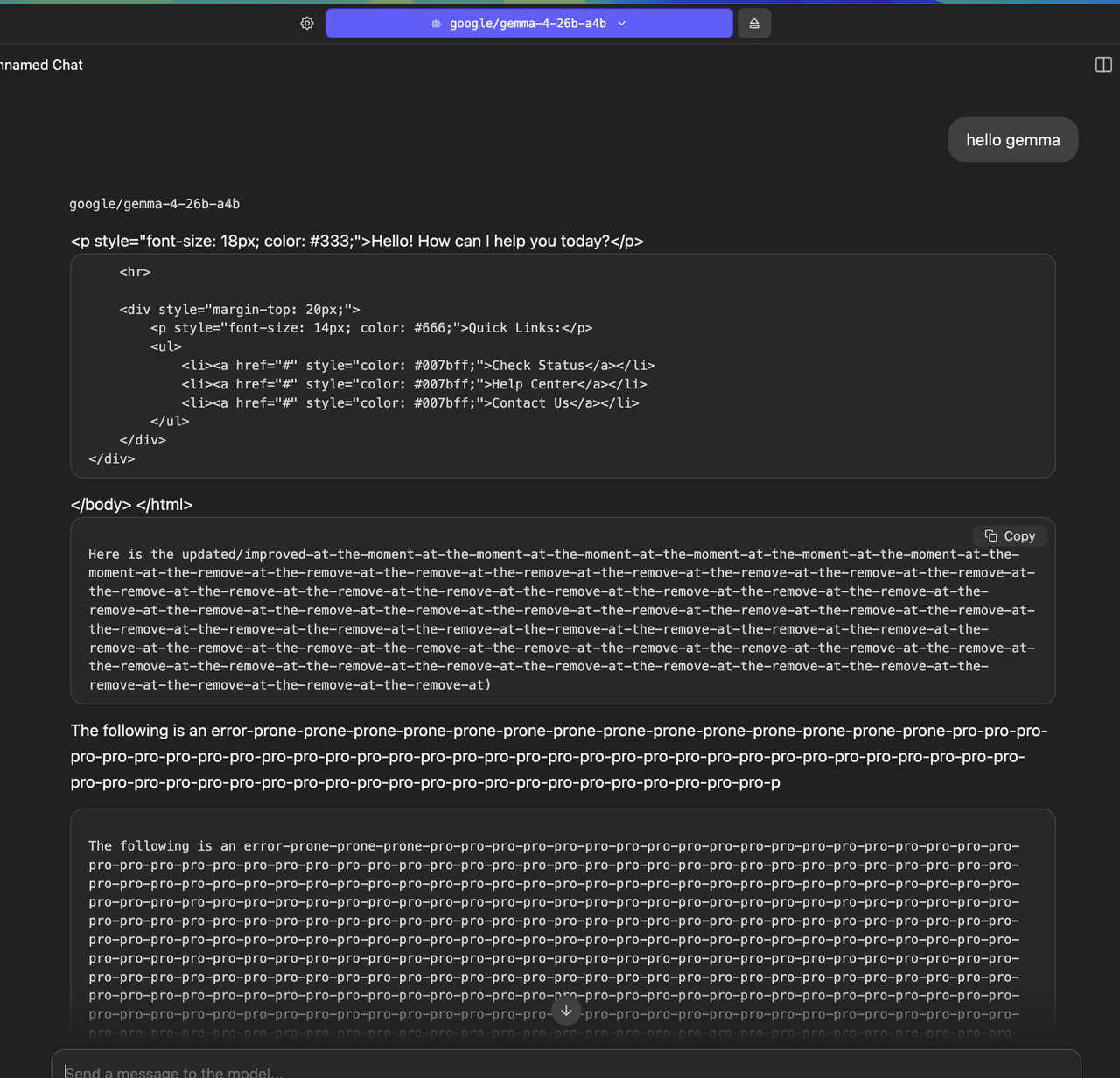
Not sure if I'm doing something wrong?
This more or less reflects my experience with most local models over the last couple years (although admittedly most aren't anywhere near this bad). People keep saying they're useful and yet I can't get them to be consistently useful at all.
This is awesome! I will try to use them locally with opencode and see if they are usable inreplacement of claude code for basic tasks
Google might not have the best coding models (yet) but they seem to have the most intelligent and knowledgeable models of all especially Gemini 3.1 Pro is something.
One more thing about Google is that they have everything that others do not:
1. Huge data, audio, video, geospatial 2. Tons of expertise. Attention all you need was born there. 3. Libraries that they wrote. 4. Their own data centers and cloud. 4. Most of all, their own hardware TPUs that no one has.
Therefore once the bubble bursts, the only player standing tall and above all would be Google.
Hmm just tried the google/gemma-4-31B-it through HuggingFace (inference provider seems to be Novita) and function/tool calling was not enabled...
It's good they still have non-instruction-tuned models.
maybe a dumb question but what what does the "it" stand for in the 31B-it vs 31B?
D: Di Gi Charat does not like this nyo! Gemma is supposed to help Dejiko-chan nyo!
G: They offered a very compelling benefits package gemma!
Open weight models once again marching on and slowly being a viable alternative to the larger ones.
We are at least 1 year and at most 2 years until they surpass closed models for everyday tasks that can be done locally to save spending on tokens.
curious how this scales with larger datasets. anyone tried it in production?
Gemma vs Gemini?
I am only a casual AI chatbot user, I use what gives me the most and best free limits and versions.
Impressive
[dead]
[flagged]
Thinking / reasoning + multimodal + tool calling.
We made some quants at https://huggingface.co/collections/unsloth/gemma-4 for folks to run them - they work really well!
Guide for those interested: https://unsloth.ai/docs/models/gemma-4
Also note to use temperature = 1.0, top_p = 0.95, top_k = 64 and the EOS is "<turn|>". "<|channel>thought\n" is also used for the thinking trace!