 alt Hacker News
Making ASCII Art in Vim
Comments
Neat. The quick and dirty way I use if I want to make something big and unmissable is to invoke figlet inside vim: ":r!figlet vim"
Visual block mode and virtual edit are such killer features of vim.
I also like plugins like https://github.com/nvim-mini/mini.move That allows you to move selected characters around; it's super useful to correct mistakes or reorder things quickly, and it's also very intuitive to make ASCII art with it!
Awesome! I added your blog to the docs for an ascii art color syntax I wrote for my vim-like editor, I'd love if you checked it out
https://civboot.github.io/lua/asciigame.html
Note: right now the editor crashes if you mis-type any of the syntax... it's not really fully launched, going to fix that soon hopefully but you can see a [screenshot](https://civboot.github.io/img/asciigame.png) of what it looks like
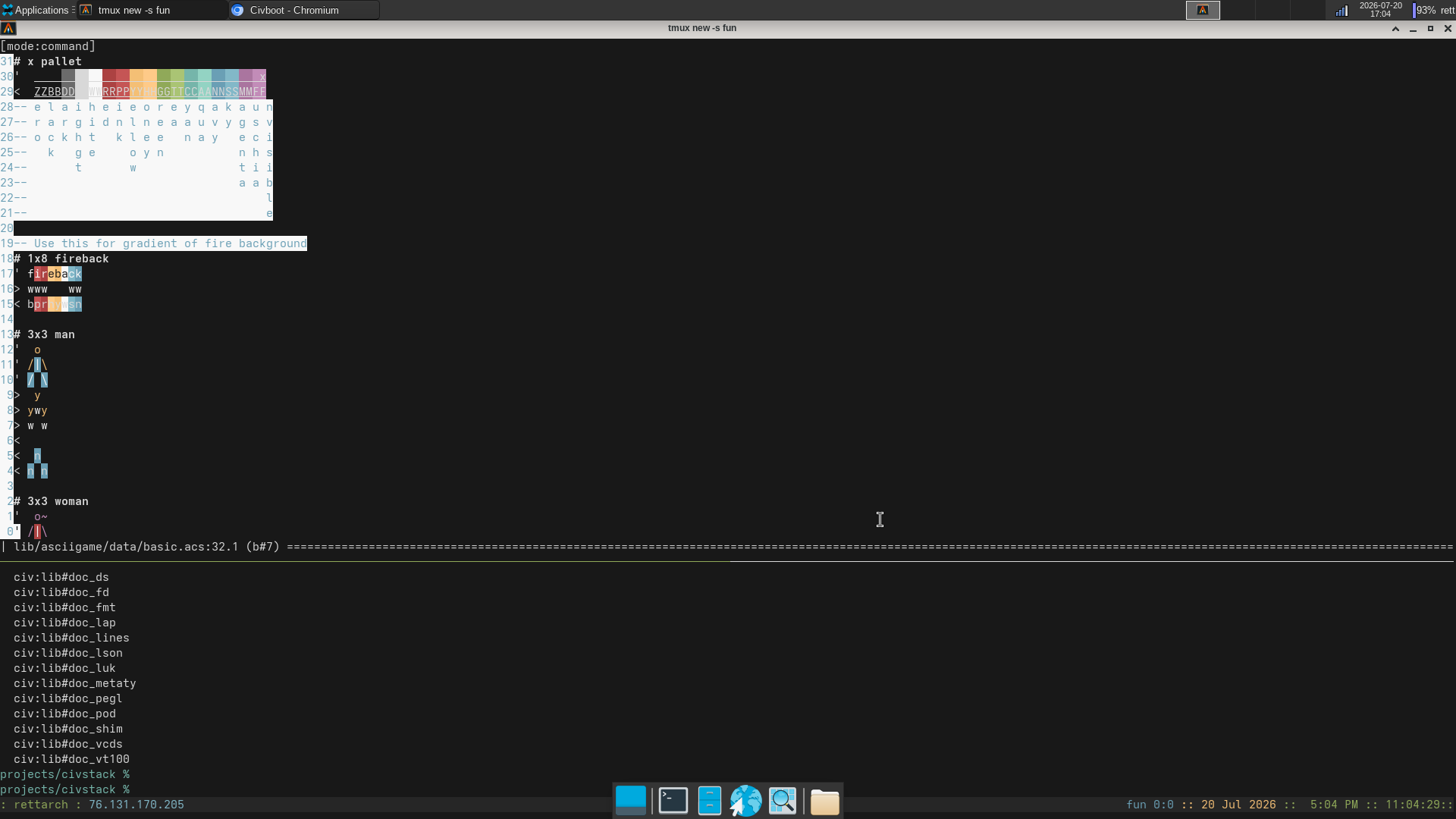
Also, if you know any other good references for getting into asciiart I'd love to reference them as well.
Note: the Ele editor isn't _quite_ ready for all the asciiart features in your blog post, notably virtualedit and macros are not implemented yet - but I just added basic visual mode so it's getting close!
It is convenient to draw flow chart or architecture of something using vim and just ASCII
Another slew of utility lies in `:help searchoffset`, often like the following: https://til.codeinthehole.com/posts/about-vims-semicolon-sea...
    /x/e-3
    /x/+1
    /x/;/yz
I know that AI will never replace me until it can generate ASCII art. So far it seems to struggle so I sleep well at night.
> It's also totally valid to not use this feature and just fill the buffer with spaces at the beginning of your session instead; just know that in Vim it's not absolutely necessary.
I actually set up a script to fill a temp file with a page worth of some "background" character and then open it with a special vimrc (mostly oriented around making it so that mouse drags use visual-block mode regardless of what mode I was in before).