 alt Hacker News
Inverse-Square Law
Comments
In a 3d world one can escape from the Earth's gravitational field. On the flat-world equivalent there is no escape. You can checkout but never leave. There ought to be a science fiction story based on this premise.
Things get interesting in 2d flatland.
There the field or force has to decay as 1/r because the circumference of the boundary scales as O(r). But that's the field, to get to the potential you need to integrate and then you get a function that is logarithmic with distance.
A consequence of that is the potential does not drop to zero as you go further away. Unlike what is the case for the 3d case.
If you have heard that about a random-walking bird that returns infinitely often but a random-flying bird one that doesn't, that's sorta related.
Totally unrelated, was quite thrilled to see this map of the sphere
https://substackcdn.com/image/fetch/$s_!8JEP!,f_auto,q_auto:...
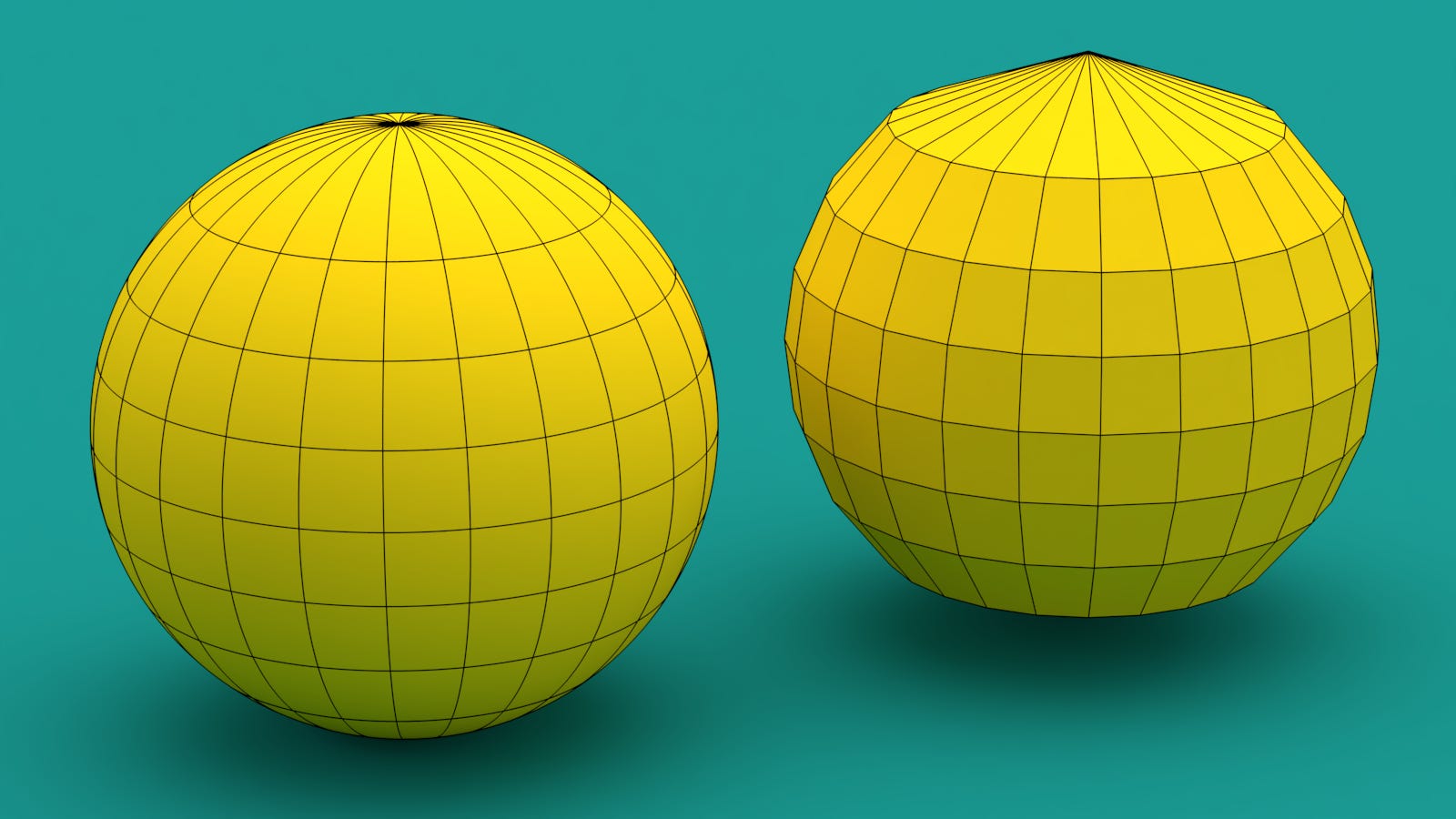
because I had been entertaining myself by making toy globes out of paper and it seems this polyconic map was the one I had used (an interrupted version of this).
The more conventional way is to use gores using interrupted sinusoidal that look like a string of lobes connected at their common equatorial hip.
https://www.wolframcloud.com/obj/resourcesystem/published/De...
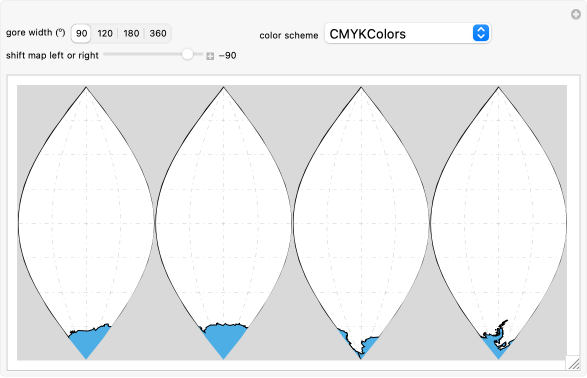
What I was working with were more like flowers, one for each hemisphere, with the pole at the center.
Thanks for putting the effort in on this. The author pointed out that no LLMs were used in the production of the blog post. To be honest the first thing I did was put the blog post into an LLM and asked it to simplify. The LLM did a great job of providing a very clear explanation for me.
This is one of the super powers I find for LLMs. I am certain that this particular derivation spoke to the author and seemed like the obvious approach. In my experience math derivations a highly personal. What resonates with me will not resonate with someone else. An LLM allows an infinite number of variations. Thanks again to the author.
It's fun to puzzle through why optical reflections, active radar, and things like that are inverse R^4. (It's just two inverse-square laws composed together).
Dipoles, like magnetic fields and planetary tidal forces, decay as an inverse R^3. That's less intuitive.
One thing I want remind people of is:
The inverse-square law is only valid if the source is a point.
That means for many sources it is either the wrong law (e.g. loudspeaker array¹, long neon bulbs) because of the shape or it falls apart as you go so close to the source that a significant arc-angle is covered by the source itself meaning the law is no longer accurate. E.g. if you move ever closer to a light source with some diameter, at some point the result will look more and more like an area source and less like a point source. If you move so close that your entire horizon is covered by the light source it would be absurd to apply that formula since whatever is in front of the lamp gets the light from multiple directions now.
As such it is a great and useful simplification, but knowing the limits is equally important.
¹: this array tech is is used to get a more even level falloff from the combined wavefront so you don't have to blast off the ears of the front row while being barely audible in the back.
While we're on this... it is arguably even more befuddling to recognize that the information content potential of space apparently correlates with the surface area rather than volume https://en.wikipedia.org/wiki/Holographic_principle
Why the typographic errors? " — we don’t judge — " em-dash should be used without spaces? En-dash belongs inside whitespace.
GenAI output?
That seems to be milking the explanation for all it's worth!
The short answer being that if something is radiating out 3-dimensinally in all directions, then at a given distance, r, that thing (light/whatever) is being spread out over an area equal to the surface area of a sphere of that radius, which is 4 x pi x r^2, i.e. the intensity is inversely proportional to the square of the distance (r^2).