 alt Hacker News
Why Switzerland has 25 Gbit internet and America doesn't
Comments
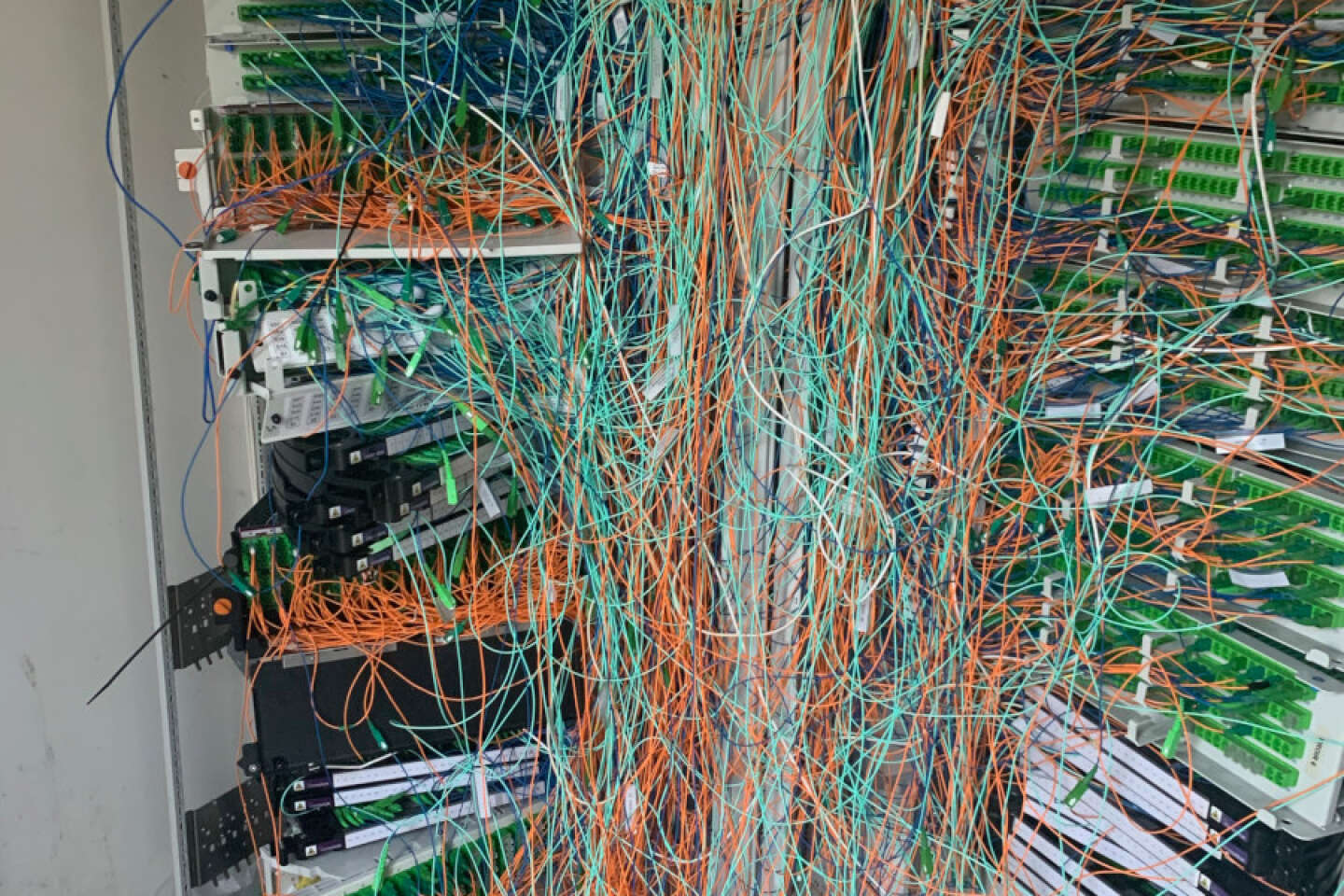
France has 90% FTTH coverage in 2025, with 60% of households over 1 Gbps. One of the incumbents, Free (my employer), deployed P2P fibers in very dense areas but is switching to P2MP for economic reasons (and because this was not a competitive advantage). It's unclear to me if Switzerland plans to achieve this coverage with P2P. What looks great in Switzerland is not that each household has four dedicated fibers to the CO, but that Swisscom has responsibility for these fibers. In France, we have competition between operators for both services and infrastructure. In very dense areas, each building can have its own infrastructure operator (with an obligation to share); in less dense areas, this is by district (with an obligation to share); and in rural areas, this is a subsidized network (with an obligation to share). The downside is that there are "mutualisation points" where each ISP can go to plug or unplug subscribers, and they become a mess (https://img.lemde.fr/2020/06/04/300/0/900/600/1440/960/60/0/...).
BTW, I am also disturbed by AI-generated images. The ones with the three workers laying cables look highly unrealistic and made me pause for a couple of minutes, wondering if they lay cables that way in Germany. The ones about how households are connected to CO look like you get multiple 720-fiber cables to the same household.
Most states in America ban municipal fiber. They saw EPB (Chattanooga) and said, no, we must make sure that doesn't ever happen again. That is how 'free' market is done in US, all the rules are to make sure the richest people become richer.
There should be more of shared infrastructure / government / law patterns, something like wikipedia but for running countries.
People all over the world seem to be fighting same little battles and falling into same traps all the time.
There are many known gems that present structure in ecosystems with correct incentives that do work, they should be known/discoverable and they should be consulted when making decisions.
Swiss here. Just a minor clarification on the article: fibre is not available everywhere in Switzerland. Actually the rollout has been quite slow, and chances are that if you live in a rural or suburban area (like me) or in an older building then you might not have fibre, and are limited to (fairly decent) copper.
I would argue that the Scandinavian countries are a much better example to use than Switzerland. In contrast to Switzerland Sweden leads the world in fibre access build out (while being geographically much larger). While I haven't seen 25 G internet 10G is relatively common and 1G is the default (at around 40-50 euro per month). The model has is quite similar to Switzerland though, open access fibre infrastructure with competition over providing the data, either using equipment of the main provider or using their own equipment.
In Canada our internet became much faster for cheaper with better customer support when the government allowed competition from smaller players. Telecom also got better when they allowed a foreign competitor to compete against the government mandated oligopoly. But the market is still heavily regulated in a way that benefits the existing monopolies.
I have a gentle rule, which is when discussing (geo)politics with friends, we should try not to use Switzerland as an example. It's just too good, too rational, too sensible, too well run, in myriad ways that other countries should be able to emulate, but consistently and constantly don't.
This article gets ahead of itself.
The issue isn’t the splitting. There is no fiber to even split in most places. A lot of places in America had their “network” infra built 50-100 years ago on copper and no one wants to pay to basically rebuild all of it.
I happen to live in an area where there are still above ground utilities.
We got >5 gig fiber fast. We have 700Mbps 5G. I literally watched them string the fiber on the poles.
It’s still not shared, but it’s fast because it’s new. Shared would be preferred, but you need destroy + “new” first, and most people are fine with what copper gives them. Shared may even be cheaper but most people don’t think we need to rebuild anything.
What is the benefit of 25Gbps home internet?
It's absolutely true that ISPs in the US are horrifically anti-competitive, and also that they should be treated as utility carriers, like electricity companies, not as "optional" services.
But that said, it took more than forty years to electrify the entire United States[0]. "The internet", as we think of it, hasn't even existed for 35 years yet. (Yes, I know there were networks before that that the current system arose from, but that's hair-splitting. I don't think the kind of Internet the average person might even consider using existed before, generously, ~1995-1996.) Yet, 95% of US adults use the Internet, implying a penetration at least as high[1].
The median Internet speed in the US is around 250mbps down and is in the top 10 in the world[3].
The problem is that access and speeds are not evenly distributed, not that we can't get 22gbps symmetric down/up. We don't need to give people in cities faster Internet; truly, you do not need that speed to do day-to-day tasks. You don't even need the 1gbps down/150mbps up that I have. What we need to do is make sure people in rural areas can access at least the median speed.
That said, I think we could give it another 15-20 years and see where our country with around 36 times the population and 238 times the landmass is at in terms of speeds.
[0] https://www.christenseninstitute.org/blog/how-the-history-of... [1] https://www.pewresearch.org/internet/fact-sheet/internet-bro... [2] https://tachus.com/internet-speeds-usa-vs-the-rest-of-the-wo...
Because it isn't a free market in the USA. And those that regulate it don't seem to care. Or maybe it is those that have been granted a monopoly do everything they can to retain said monopoly. Things would be different if we actually had a free market
1) Switzerland is tiny compared to the US. 2) FTTH is only available to about 60% of the population right now. It is not clear what percentage of those homes have access to 25 Gbit service.
While I think the model of having the government own the Fiber lines and selling access to providers has a lot of potential, it would be very expensive to build this out to even 60% of the US.
I don't understand the desire (fetish?) for high speed home Internet connections at home.
I have 25 Mbps up. 10 Mbps down. Have had it for years. It's fine.
It's fine when both my wife and I are working from home and doing calls. It's fine for software development. It's fine for email and web browsing, and everything other than downloading maddeningly large files, 99% of which shouldn't be that large anyway. It's fine for watching streaming shows. Maybe if our kids turn out to be YouTube addicts when they're older we'll upgrade; maybe we won't for that reason.
What are people doing with their higher-speed Internet connections that makes it valuable to have such fast ones??!
I wish this kind of perspective (international comparison) could be applied to several areas of the USA economy: tax compliance, campaign finance, and banking regulation. Good work, OP.
In Charlotte NC, I have 3 choices of internet providers, two of them fiber.
As you are doing with this post, "broaden the base." The vast majority of voters do not understand the issues here. That is your biggest obstacle.
My POV would call this regulatory failure vs free market lie. That way, the enemy is a smaller target.
Path to progress is to get a friendly state (WY, RI, TX) to pass the legislation. Then shop that around among activists in other states.
If people knew they were only getting 1/25 of a shared product, that would get political hackles up.
Thanks for taking the time to think this through and make your argument.
We already have this in Utah with Utopia with 53% coverage across the state (A state 5 times the size of Switzerland) so kind of weird the post is acting like Europe is special or something.
And there are lots of ISPs to choose from, several with 10Gbps symmetrical. Because it's dark fiber that you can literally purchase (I was quoted about $3k to purchase the fiber to the CO), there's nothing stopping you from putting 25Gbps optics on both ends if you are super determined.
While on surface scratch level this might be a good entry analysis it lacks deeper comparisons to other great networks nations Like Romania or South Korea. Is it cheaper there? What about coverage? Uptimes? Why is the service "better"? Why is it by the way a free market "lie"? ( For me a lie means a wrong information by purpose)
Because Switzerland is the size of Maryland. Imagine pouring all federal resources into one cramped state.
I thought spamming your own blog was not allowed here.
The comparison feels off because it treats Switzerland and the United States as interchangeable test cases for “free market vs. not,” when they operate under completely different constraints.
Switzerland is a small, highly cohesive country with strong local governance, high trust, and tightly scoped systems. The U.S. is a continental-scale federation with massive regional variation, different institutional layers, and far more heterogeneous populations.
At that scale, you’re not comparing “policy choices,” you’re comparing system complexity. Many policies that work in Switzerland don’t fail in the U.S. because they’re bad, they fail because they don’t scale cleanly across 330M people and 50 semi-autonomous states.
So using Switzerland as a counterexample to critique U.S. market dynamics isn’t really isolating “free markets” as a variable, it’s bundling in size, governance structure, and social cohesion, then attributing the difference to ideology. I know Switzerland is great, I've been there, but it feels like a bit of an unfair dunk and very much "punching down".
Very misleading article. There is only one provider init7 and coverage is definitely not good in rural areas. Here is an map : https://ftth.init7.net/
I get 10g symmetric in Austin for $150/m. I had Cox before, and it was $180ish for 1g down and ~50mb up. Things are improving!
Regardless if it's Switzerland, Germany or the USA. Everyone has better than we have in Australia. I can't wait to go back to Asia after citizenship to join the developed world again.
Init7 has on its blog another amazing write up https://blog.init7.net/en/die-glasfaserstreit-geschichte/
I'm in Zurich and I have 1Gb. My provider is offering higher for no additional cost - I'd have to put in a new modem/fiber-to-Ethernet adapter. However my home network is cat-5e and my switch is also 1Gb so I don't bother - it's pointless.
It's definitely because of the free markets. Only because Init7, the provider who actually provides the 25 Gbit/s, is constantly fighting Swisscom, the government-owned provider.
Switzerland also happens to have over 5x population density of USA, and 80% higher household median income based on quick google.
I'm jealous.
Even in Wireless / Mobile Carrier they have company like American Tower / China Tower that shares infrastructure cost. So none of this is new, I always thought the reason it is not done is because of company interest and politics. Internet should be treated just like Electricity and Water.
There are other things we could do without completely changing the dynamics or policy. We could mandate all home leasing and selling to have Internet Speed labeled. Giving consumer the knowledge and choice. And all future new home to have at least 1Gbps Internet and upgradable to 10Gbps or higher as standard. The market will sort itself out. And give government some space and room to further negotiate terms with companies.
Now the technical question, why no sharing? why point to point? why 4 fibre and not 2 or 8? And the no sharing is a little bit of gimmick, because at the end of the day everything is shared. The backbone has 100Gbps and you cant have 10 labours all using 25Gbps. I also dont think P2P make sense in a metropolitan city like Tokyo, New York or Hong Kong, especially in high rise, ultra high density buildings with limited space. When 50G-PON barely meet demands we are looking at 100G or 200G-PON. Individual fibre is simple not feasible in those settings.
So the author's proposed solution is more government control. Pass.
Good take, and most of the data in the article is quite correct. The problem is a total mix up of cause and effect. The US has had a decent communication network since way back. We had telegraph, telephone and telex. Bell and AT&T and all that stuff. We've invented and piloted modems, T1 and cable TV.
Our infrastructure at times goes back 200 years old. We have rules and words in today's networking linguo that go back 70 years old. You can't just go and tell that it would have been better this way. It absolutely would. And I'm happy for Swiss people who can have 25gpbs at a fraction of the cost. But you can't do that with an emerging tech that is trying to replace existing architecture.
Swiss guys built all that after the tech was wide-spread in the world, and they have built it over a very outdated infrastructure. It was a breeze.
US just unable to use this approach. We can't.
Should we come up with a new one? Yes. Should we look at the Swiss solution and try to replicate it. Yes. Is it awesome? Yes. Would it work here? No.
This factoring of a market to enable competition by centralizing minimal infrastructure seems the bedrock of best governmental practice. Are there other examples to lean on? How do we turn this into common knowledge?
This article is hard to take seriously when it presents 25 Gbps internet like it's available everywhere in Switzerland. Even the page you click on has an "Up to" and requires you to enter your address to check availability.
That's on top of the usual problems with comparing small European countries to all of America. Switzerland's entire population is barely larger than the population of New York City. There are several metro areas in the US with more people than Switzerland.
Switzerland is also very, very small. It's lands mass is equal to about 0.5% of the United States. We only have a handful of states smaller than Switzerland.
There are valid geopolitical discussions to be had, but it's hard to read these articles that single out tiny little European countries and compare them to the sprawling United States and ignore the elephant in the room.
Australia copied the Swiss model and in a very short period of time we went from 2Mbps flaky copper to now you can upgrade most properties to 2Gbps fiber for around $300 one-off fee.
I hear 10Gbps is coming soon. The only annoying thing is that ours, despite being terminated the Swiss way, isn’t symmetrical, I think due to congestion on the sea cables?
What? There is no free market with wired internet. State, federal, and municipalities entrenched local monopolies through "tax breaks", subsidies, over regulation, piles of permits, and many more.
The cable/fiber providers played all areas of government like a fiddle.
Im genuinely curious what is a use-case for 25GB Internet in a typical Switzerland household?
This is about urban Switzerland. Way out in the country, we still have crap copper up on poles, which maxes out at 25 Mbits.
But yes, Swisscom (owners if the old crap copper) do have to let the competitors use it.
Australia and the UK both have a similar business environment to the Swiss model (but without the superior bandwidth) due to the way that their government-owned telephone monopolies were privatised: Telecom Australia (now called Telstra) and British Telecom (now called BT) were required to allow their newly-formed competitors to sell services over their networks (for appropriate maintenance fees, of course).
The US and German models are consequences of just yelling 'Free market!' without stopping to think about what's actually being sold in that market, and how to encourage genuine competition.
Ho-lee smokes is that Speedtest screenshot even real? Have some mercy for those of us in third-world infrastructure (US).
What does one achieve with 25 GB internet? Are speeds actually usefully faster, or is there some other bottleneck that makes the practical speed the same as in the US?
Also any workload I have that is bandwidth heavy would be on clouds machines between data centres and generally very fast. Are there reasons why someone at home would benefit from 25GB internet beyond whatever is available?
Is this a case of over engineered central planning instead of a blow against the free market?
This article would be so much better without the generic AI-generated images everywhere.
why is it a lie? a natural monopoly doesn't bar other entrance, it's just naturally difficult, like space travel. also, unpopular comment but who cares? my Internet does everything I want it to and I'd wager that the price from the swiss government is highly subsidized. A market means a meeting of supply and demand, it's possible that currently the swiss speed is overboard for most users.
Path dependence is a thing.
Municipal and co-op broadband in the US needs subsidies, loans, replication, and expansion. Where I live has a farmer co-op for electricity and internet in a mostly sparse, rural area with various residential housing developments scattered around. What was GFiber in the regionally-nearby metropolitan area had beta 20 Gbps internet for $250 USD/mo. 1 Gbps symmetric fiber co-op is $100 USD/mo. Prices are high compared to Europe. Possibly not high prices compared to Australia.
How many Switzerlands is USA again
I think there’s quite a little bit missing here. As an example, Switzerland’s road/rail lines and US road:rail lines are both treated in this way and the outcomes are different. So I think the dominant effect isn’t in this form of building.
In addition, requiring fiber to each new home would expand housing costs in the US substantially because many are not located close by to existing fiber networks.
I’m not familiar with Swiss government policy but their government construction efforts are frequently far more successful for lower costs than ours. I cannot say whether Switzerland does it differently but usually in the US if there is surplus to be captured it is captured. As an example, if the Swiss system were to be implemented with US tools it would look like a government project would here: private companies would be invited to build the fiber to each home, and eventually one would win the contract and if the economic benefit would be $1b, they would charge $0.99b to construct it. M
If the government itself attempts to build it, it is constrained by its pension obligations and its desire to remain solvent to not actually have employees on staff. It therefore will use contractors in order to do things and we’re back in situation 1.
Governments originally formed for this kind of shared task and to enforce no free riding on it. But whatever factors drive US politics, US government purposes are to extract maximally from economically productive classes and redirect it to politically productive classes - through the use of selective government contracts and populist giveaways.
Before I start with my real comment I'll point out that the AI slop images really detract from this article and the author should stop.
To be fair to America here, it's pretty well served overall and is doing a lot better than the past. Average speeds are at around 100 Mbps with extremely widespread advanced 5G networks doing even better than that.
Cellular in particular is an area where the USA still seems to be ahead of most places, although they certainly pay for it. (Even that has gotten way, way better. I'm getting really nice MVNO service with unlimited data and even a decent unlimited tethering plan for less than $30/month)
25 Gigabit is nice but that's so expensive on the client device side to the point where it's basically unattainable for any consumer. Your average consumer primarily uses the Internet via WiFi devices that might max out at 300Mbps practical speeds or lower depending on when they purchased their devices and WiFi access point and their distance from it.
Then you've got the problem of the speed on the other end. 25Gb fiber is great until you realize that the server you are downloading from is only going to give you 1/100th a lot of the times.
I haven't even mentioned the fact that you're now adding CPU and SSD bottlenecks to the equation. I'm pretty sure 25Gb/s is higher than the maximum write speed on my SSD.
I have gigabit fiber at home and the ability to buy faster speeds from my ISP but I find the idea totally pointless when that means I would have to buy $500 in networking equipment (if not more) and possibly rewire my home (currently sketchy Cat 5e that seems to be installed poorly and I'm lucky to have that). I even have the latest WiFi 7 from a highly reputable prosumer brand along with very new WiFi 7 and 6E 6Ghz client devices but the highest speed I see using those devices where I want to use them is around 600Mbps.
This article is technically incorrect on so many levels I didn’t even bother to finish it.
1. There may be a territorial monopoly on cable. But there is nothing stopping other companies from laying fiber. There are areas - including where I use to live that had cable and the phone company laying fiber
2. Everyone on the internet is using a “shared” connection. The difference is whether it is shared at the last mile or upstream. If your ISP doesn’t provision enough upstream capacity, the last mile doesn’t matter.
3. Fiber is rarely shared at the last mile.
4. Just a little research says 25Gbps is not universal across Switzerland
5. When I did have AT&T Fiber that advertised at 1GB u/d, it didn’t slow down no matter what time of day.
Please don’t suffer from the Gell-Mann Amnesia Effect. M
Switzerland - self hosting paradise.
Why isn’t france your European example? Its larger and better served than switzerland
what a well written article.
makes me very much consider moving to Switzerland. I'd be happy with symmetric 5Gbit internet. Anything more would be overkill imo.
I hated working with ISPs in the states. Ever try cancelling Comcast? You literally get routed to a department whose sole reason for being is to talk you out of it.
I really like the idea, share the lines compete on execution.
One thing the article doesn't mention is in Germany the electricity and gas lines are more or less this approach. I can switch electricity providers like the article author can switch ISPs. It's a common practice to do so about 1x a year to take advantage of customer acquisition incentives.
In my small island community, I participated in a municipal committee whose mandate was to bring proper broadband to the island. Although two telecom duopolies already served the community, one of them had undersea fiber but zero fiber to the home (DSL remains the only option), whereas the other used a 670 Mbps wireless microwave link for backhaul and delivery via coaxial cable. And pricing? Insanely expensive for either terrible option.
Our little committee investigated all manner of options, including bringing municipal fiber across alongside a new undersea electricity cable that the power company was installing anyway. I spoke to the manager of that project and he said there was no real barrier to adding a few strands of fiber, since the undersea high voltage line already had space for it (for the power company’s own signaling).
Sadly, the municipality didn’t have any capital to invest a penny into that fiber, so one day, one of the municipal counselors just called up a friend who worked for a fiber laying company and asked them for a favor: put out a press release saying that they were “investigating” laying an undersea fiber to power a municipal fiber network on the little island.
A few weeks later, the cable monopoly engaged a cable ship and began laying their own fiber. Competition works, folks. Even if you have to fake it.