 alt Hacker News
No Signs of AI Payoff Outside the Tech Sector
Comments
Well, of course not. If you borrow a trillion dollars to build a 1¢ aspirin machine to compete with $1 generic aspirin, you are strongly incentivized to sell your aspirin for 99¢. We don’t see productivity gains, because approximately all of the gain is captured as revenue for AI companies.
It’s weird that this has to be spelled out for so many engineers and economists, but to be very clear: OpenAI et al wants your token spend to go to one-minus-epsilon of what you previously spent on payroll, and wants your productivity to go to one-plus-epsilon of what it previously was. If you want 10x productivity, spend 9.9x more on tokens.
They are in the business of enclosure and rent extraction, and any innovation that comes out of their research and development - regardless of how real an innovation it is - will be completely contained and bent totally towards that business. Any leakage of the innovation that you experience as a productivity boost is literally felt as lost profits by them.
"You can see the computer age everywhere but in the productivity statistics." -- 1987
I don't see why a payoff would have appeared yet. Many (but certainly not all) software companies have increased their output without hiring more people. But having software with more features doesn't necessarily drive immediate productivity gains in the rest of the economy. It will take time for those benefits to percolate. We've only had access to models good enough to majorly accelerate code writing since early-2026. I feel like we're in the very beginnings of the first part of this wave.
For sake of comparison, consider e-commerce. As a proxy for "impact on the economy", we can use Amazon's revenue. They went public in 1997 and that year had revenue of $148M (just 0.14% of Walmart's revenue that year). By 2000, revenue was $2.76B (1.65% of Walmart). Bricks and mortar didn't start feeling anything until probably 2011, when Amazon crossed 11% of Walmart's revenue. And it wasn't until 2025 that Amazon finally surpassed Walmart.
But, if you worked in tech in the e-commerce business, things were already feeling pretty hot by 2007. And at that point in time, the e-commerce sector was still miniscule compared to traditional retail (~4%). Software is very exciting these days and the most fantastic things are happening. They will eventually percolate out to the rest of the economy. But it will take many years before everyone notices the difference.
One industry example.. We have been giving students computing devices for years with the cost of educating students going up year after year.. Yet scores keep dropping.. No productivity gains here.. I do not think these results are unique to the education sector.. There are probably alot of businesses where nothing much will change except slight efficiencies.. not enough to move the needle..
We can use a non-deterministic system because we have test suites that act as validation gates.
Other industries don't, so they have no way of knowing if the AI is bullshitting them outside of manual validation, which makes it more expensive and slower than doing it yourself.
"AI does not understand accountability, trust, culture, unwritten rules, ethical trade-offs or fairness, all of which shape reputational risk and ultimately drive revenue growth and profit margins."
For a sec I thought he was talking about private equity.
I wonder if this is going to be something like the Solow Paradox, from Econ Nobel Laureate Robert Solow: https://www.brookings.edu/articles/the-solow-productivity-pa...
>You can see the computer age everywhere but in the productivity statistics. Robert Solow (1987)
I am in a tech role that straddles traditional business. Yes, LLMs are very adept at software development and of course we are early adopters, but the amount of other things that can be automated or at least significantly augmented hasn't scratched the surface.
At the start of this all, execs were clamoring for "AI" and at that time the models were superficially impressive but fell short. Now I think they are all underestimating the amount of improvement in the last year. There's loads of work that can be automated
There's a lot more to business in America than the corporate S&P. If you think AI isn't paying off for businesses, then you probably aren't a consultant right now. I have small/mid-size clients who, in pre-AI times, would have never been able to afford the work they're currently scoping out for me. Now I can quote them cheaper rates to build more custom solutions that they didn't even imagine was possible, and they are loving it.
> AI may be a great calculator, but in business, intelligence is mostly judgment. Judgment depends on context, and the answer varies with which human or which model you ask. Perhaps most importantly, AI does not understand accountability, trust, culture, unwritten rules, ethical trade-offs or fairness, all of which shape reputational risk and ultimately drive revenue growth and profit margins.
All of this is true, but the reality is that LLM agents free up time for people to make judgement by taking care of the grunt work, which means each person can do more. That increased efficiency can mean higher revenues in growth industries and higher profits (through reduced labor force) in stable or declining industries.
Paradigm shifts happen when old minds retire or die. Something like that, but for companies. If you’re starting a company now, you are _definitely_ hiring less people much later, and different profiles.
When I tried to use CoPilot at my day job, I set up a prompt to process scans of checks and invoices (with the MICR account bar code line covered w/ a pen so that there was no PII), it would sort of work for 20 files at a time to write a .bat file command to rename the source image based on the content of the check and invoice --- this removed the need to open up scans in batches of 50, read the Invoice ID, save using that, then run a .bat file to rename them based on the balance of information in the database.
The thing is, the failure rate was quite high --- often only 15 (sometimes fewer) lines were returned, and after a while, Microsoft imposed a limit on uploading more files, even though I was deleting the conversations immediately and quitting CoPilot and re-starting (long sessions seemed to have a progressively worse failure rate).
Since then, access to CoPilot has been removed and we're waiting on a test program to finish. Kind of curious how many tokens this was using up (and if there's a model which could be run locally which would work well and quickly enough).
No signs of AI payoff outside the tech sector...yet. I think it's partially because our harnesses are generally much, much better. And engineers seem to be more deft at figuring out where AI provides real benefit and where it needs a watchful eye.
I'm seeing non-engineers use AI to send more emails, have more meetings, create more documents, and create more dashboards. So much of the busy work that happens in corporate environments was never that valuable in the first place. A firehose of busy work doesn't move any needles that matter.
This is like saying that the internet hasn’t created positive value for all but the biggest firms in 1998. Give it a second.
I hear that a lot of language translators lost their jobs to AI ... I can't imagine this hasn't lead to cost reductions.
In video production, 3D modelling, editing etc, I think a lot of jobs are disappearing, with cost dropping. Not data backed, just from what I can see.
This is not surprising. AI in its current form is more obviously useful at generating software than it is at assisting with other kinds of knowledge work. Software can be automatically validated. Validation loops are what let these systems iterate toward acceptable solutions. If you want AI to produce a document for humans, you need to carefully review and revise the output. In that case there's little to be gained, as reviewing plausible but subtly incorrect information sentence by sentence is in some ways harder than authoring it yourself (a quote from someone who worked in like city planning). Depending on the company/industry, some of the non-tech sector workloads still involve phone calls, parcels, faxes, etc -- things AI can't really do.
Yes there are technical solutions to such problems; I'm sure there's probably a startup to make phone calls that's hooked into your company's knowledgebase, multi-LLM workflows for document review, etc. But non-tech companies aren't adopting those. Tech companies came for the software generation and stayed for the general knowledge worker productivity. Since 2023 they made the investments to procure services, change culture, and generally re-tool. Software companies are also uniquely positioned to deal with the limitations of AI in-house, like by building custom glue components to link systems, building controls to mitigate risk, etc.
So basically the tech sector leverages AI more than other sectors. At a company level, non-tech has less investment, less training, less integration of AI with business processes. At an individual level this looks like workers having fewer tools, not knowing how to use the tools they do have, not knowing even what the tools' capabilities are, and incorporating them into their work only superficially if at all.
Someone asked me for help using AI at their job (which is tech adjacent). They were trying to create a process document using ChatGPT. Their selected model was GPT Luna Light (!), and they were copying and pasting data between ChatGPT and SharePoint. There _was_ a SharePoint integration but it lacked write access. The model was not aligning the doc images. Their prompts were not specific. It was a bad experience. Their conclusion was that AI was stupid and not worth the trouble.
So even though the non-tech sector can't take advantage of AI to the same degree that the tech sector can, they're utilizing it even less than they could be.
„In SNP500 outside of tech”. This says little about general economy - and small companies are way faster in benefitting from CC.
Also, it’s been just 9 months of modern claude code, and for many companies less than 6 months since first employees outside of IT got access to Claude Code. What do they expect?
'a.i' is unlike software before - where it was build then deploy with lack of customization except of a few high ticket items such as SAP, Workday etc.
for 'A.I' to work for the rest of industry outside of software - you need high touch customization.
This is not just "Outside the Tech Sector", but "outside the magnificent 7"
"Tech sector" is supposed to be much bigger than just 7 companies, no matter how big those 7 are.
This looks to me more like just a huge centralization of wealth.
At a fundamental level LLMs reshape how we gather, shape, process and interact with information. Information is that which allows you to make a predictions with a probability better than chance. This will slowly change any industry where decisions are being made. So, it will touch all industries. And if we let it, all of life eventually. Better decisions, better survival.
I think most people in the tech sector and especially driving the AI hype have absolutely no clue how difficult it is to implement change in complex organisations. There are a bunch of technical reasons but half the reasons are not even technical - social, legal, etc. You have to shift the practices of humans and they have incredible inertia. Like decade level change response period. And during the change period they are less productive. Expect a decade type period before "productivity" impact manifests and even then it won't really be measurable directly because people will be doing different things.
This is a use case issue.
Right now, the most effective use case for AI is coding agents. Software development is a profit center for the tech sector, so it's not surprising that they're seeing big gains. In Corporate America, software development is part of IT which is a cost center, and the software landscape is 30+ years of bandaid-ed legacy systems, maintained by offshore contractors who submitted the lowest cost bid, so attempts to gain productivity via AI have not been as successful.
Where Corporate America has seen gains from AI in my experience is with customer support chatbots, but the customer service function overall in Corporate America is an unmitigated disaster, so the gains are hard to measure.
Beyond these two use cases, most people in Corporate America are just using ChatGPT to create slop and copy/pasting it wherever, and then goofing off in their newly freed spare time.
We need to see new AI use cases in Operations, Finance, Marketing, etc. that can handle business processes end to end before the productivity gains start showing up in the financials.
I think you could say the same thing of tech and the economy prior to AI.
No Signs of Tech Payoff Outside the Tech Sector. Manufacturing, basic science, education, etc languished while Big Tech reaped record profits and achieved stock heights for the last 15 years.
We’re heading into corporate budget season. Company after company is slashing their AI budget and the head cut wagons are circling around all the various “AI lab” teams that every company invested in two years ago with zero ROI to show for it. All while massive debt piles up to build data centers despite little evidence any of this is coming close to returning the ROI needed to justify any of it.
2027 is going to be very interesting. Buckle up.
I find it totally unsurprising and uninteresting that the tool makers themselves are the first to adopt the new tool they made.
this is literally the textbook historical process across every industry ever.
I dont even think theres a payoff in the software dev.... seems to be great to spin something up quick as a POC, then maintaining it requires people immediately who struggle with reading the amount of code it produces.
Article is spot on!
The only issue is that the benefits would be more enmeshed with other gains in other industries.,
Heck, even in Software Development, the real benefits are not with mass labor elimination resulting in cost savings but with increasing available throughput. Technology if used to the fullest potential should be able to expand the proverbial pie., which is where the gains are!
That is not to say people won't try to save cost by eliminating labor due to AI., which is super shortsighted and misses the forest for the trees, but the overarching goal should be to increase the quality and quantity of deliverables, as demanded by the market.
I would say the driving industry will get up-ended, but we'll see. It may just be workers get paid less because they only babysit the truck during very complicated times.
Robots still seem far off. Its just like war, air superiority might make the war winnable but its the boots on the ground that are needed to actually take the territory.
The best training comes from LLM users. Loads in software to train on.
Not so much in accounting, which is a much easier problem.
Software devs eagerly trained their replacement.
We're not seeing full automation for things that ought to be automatable now. Customer service chatbots still aren't very good. Salesforce ought to be taking over entire marketing operations, not just supporting sales but replacing it. The medical office side of insurance ought to be automatic now. The pick and place side of warehouse operations should be robotic. Shelf restocking in stores ought to be robotic. All of those things have been demoed, but didn't go to production.
This is a pretty pathetic analysis especially for an analysis from a firm like Apollo. A few notes:
1. Profit margins from the mag 7 are on an upward trend starting in 2020. This is pretty consistent with the insane topline growth had by covid and the most recent layoffs occurring over the last 6 years. To unilaterally attribute this to AI implementation is lazy.
2. Most non-tech firms are only implementing AI just now because we finally have better enterprise tooling required. We won't see the effects for another 12-24 months at least.
3. As a former management consultant, this might be the worst use of a stacked bar chart I've ever seen: https://www.apollo.com/content/dam/apolloaem/images/daily-sp...
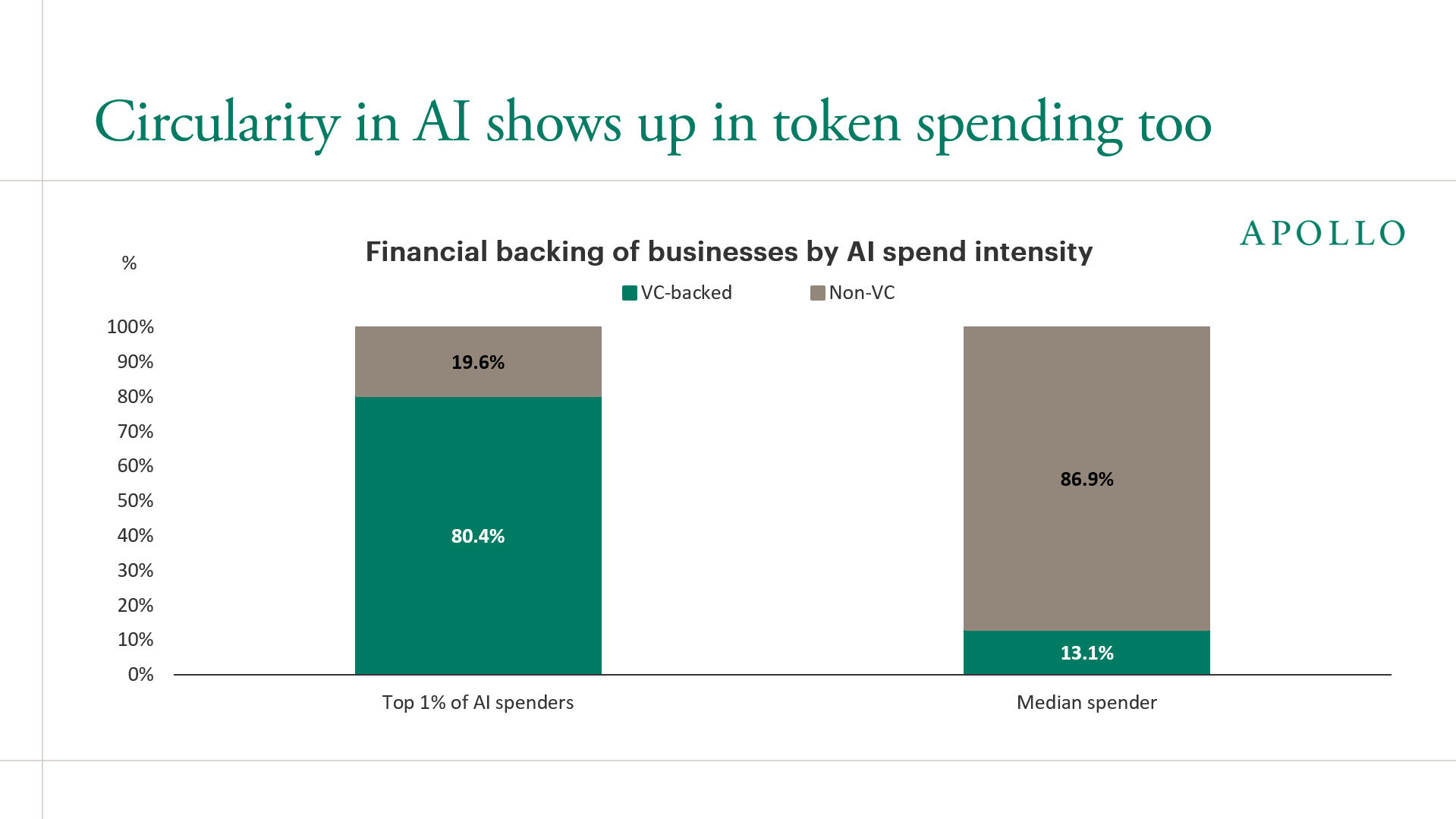
4. I don't know how you actually isolate AI productivity gains on a macro level. It seems pretty much impossible.
This whole thing is laughable.
“Tech sector is the first to adopt new tech” isn’t a groundbreaking revelation. I’m sure you could make similar charts for the computer, the internet and all other similar innovations.
I doubt Excel'ification happens this fast. To make it "payoff" it needs to become the next Excel-levels of usage.
The first giant web market collapse was because no-one could work out how to make money from it or do anything more useful than put the company brochure online.
Many will fall for the road to be paved. This is the most advanced discovery for humans to date. There is no doubt it will succeed and is here to stay. It is still new (gold rush) and deregulated. A mine field for govs and businesses. We may see to big to fail crashing (.com bubble style or worse) but no one will ever stop AI.
Ye, it was easiest to steal all of stackoverflow and sell it back to you.
My sector used it to make all the tools we wanted, then put it back in its box awhile ago. Just enjoying the fruits rent free.
Tell that to legal firms and patent guys
Well, writers can use it to speed up the draft review process. Not a big financial deal, but it's a 'payoff' for the craft.
no signs of mega tsunami damage outside of the shore - "News reporter says in the 50km radius shadow of a tsunami large enough to block out the sun"
Trickle-down AI economics here we go! Suuurely it will work this time, any minute now don't worry about it.
It's almost as if profit isn't directly related to your jira board.
I would expect new disruptors to eat the lunch of the old, but that's slow.
It's too early. There was a time where economist could not find productivity gains from PC products. I think I remember reading about it in the early 2000s over a decade after computers were common in business. Part of it is that companies aren't quick to throw what's work for tech that hasn't fully proven itself.
AI productivity gains are coming make no mistake about it. My guess is that we'll see them within the next 5 years.
Payoff doesn’t matter. The future potential (payoff) is what matters.
Just a thought, but I kind of think this undersells just how important technology is or eventually becomes in almost every other economic sector.
The tech sector is the most software-defined and virtual of all sectors, it's natural that they are first to change. Other industries need to make capital investments to adapt to change.
You can see a similar history with electrification. A few industries went quickly, but then it took like a decade of little growth before the true benefits showed up. As an example, take a factory that was built around hyrdo-power like a grain mill. You can't just take an electric motor and drop it in in place of the water wheel. It doesn't fit, the wheel is outside, there isn't room between the mill and the wall, etc. Only when you completely rebuild a new mill building designed around the features and limitations of the electric motor do you see the major benefits.
Same thing here; it will be new factories and new companies that are designed from the ground up around AI and its benefits and limitations that really move the needle.