 alt Hacker News
Replies to comments on my "LLMs are eroding my career" post
Comments
AI maximalism is making a lot of assumptions that I think are not a given
* The curve of AI improvement will continue at the current pace
* AI companies will have the capital continue to expand infrastructure
* there will be some kind of functioning economy if all knowledge workers are replaced
There are strong headwinds to all three of these.
Hey it may come to pass but it’s very speculative at this point. I see a lot of tech people simply overlaying the progress curve of previous tech booms which is reductive.
> On novel work:
> Work that introduces new methods, highly creative ideas, or solutions that have not been used or experienced before. More generally, an approach that introduces an innovative strategy to solve a complex problem.
Something that I've been thinking about for the past year or so is coming to grips with the fact that the vast majority (anecdote) of software engineering work is not novel (and maybe that's okay). Few opportunities lend themselves to doing truly novel work. Other than infrastructure work and highly specialized software, pause and ask yourself when you last encountered software were you said "how the hell did they do that?" or "damn, that's nice" (for me, the most recent was Ghostty). I think much of the angst that people have when they fear for their job is coming to the realization that LLMs can do most of the "standard" work that a lot of highly compensated individuals currently do. We've built livelihoods around this and the threat of that coming to an end is genuinely frightening.
Just kudos to OP for coming back. One thing I almost "hate" is that nowadays everyone can put something out there... videos, articles, etc., but when confronted with questions, you never see the discussion continue. YT videos are an example... SO MANY VIDEOS... People genuinely asking some good questions... and radio silence.
In my social network, there are two people impacted by LLMs. One was a security operations manager whose company reduced headcount upon introduction of some new LLM powered security tools. The other was UX designer. Both have been unemployed for 6+ months, and neither are likely to land a job in their field. The government hasn't stepped in and provided them with Universal Basic Income, and I wonder what will happen when my career is similarly impacted? Luckily I'm on the verge of retirement and should be able to support myself. However I have other friends who tried to day trade their 401k instead of work, and although back in the workforce, no longer have a nest egg. What's going to happen to them when they're inevitably put to pasture by AI?
I strongly agree with the author replies. I cannot grasp the reasonment of those who underestimate the power of these tools and their growing potential. We should remember that the outside world care about things that work, not about how good they are inside sadly.
> The demand for software most certainly has an upper limit.
No, it does not. There is no ceiling for complexity.
I agree, his takes should not be dismissed lightly. I'm not sure about "demand is fixed" though. I feel like software demand has been declared saturated at least a few times.
"There's this talk about Jevons Paradox but I disagree."
In my position, our team is clearly displaying "increased demand due to increased efficiency". I admit our position may be situational -- but my anecdote seems more substantive and speculative than "I disagree" from my vantage at least.
Every freelancer that switched to AI feels exactly what happened even if they can't name it.
We became for AI what our clients were for us. Some hate it, some love it.
To feel safe in life our clients needed to have an actual business. Now when we are the clients of our AI we are scared, because now we need to have an actual viable business. Economic machine that works. Because the old model of just selling our time and effort to a client no longer works, when we are the clients.
I agree with all of it, and I think author did a really good job at actually saying what's true, it's almost like developers don't want to hear it.
I feel that OP has reach that point because he went out of the basic tooling like Claude Code (at least in its default state) and embrace multi-model, automatic reviewing, fuse, loops and so-on, when it's done right, well, failure rate to solve issues is <1%, this is exactly why you arrive to that kind of depressing thoughts afterward and it's spot-on.
Many people will disagree because they are still at the vibe coding stage, not "as much as I can prompt will be automatically done stage". Claude Code imo is deliberately not implementing the best ways for users to work, they have recently implemented Workflows but that's almost a year late, many companies are doing this since always and that's just part of basic tooling nowadays.
People talk about models and benchmarks score while genuinely I'm baffled because they seem to ignore that that same benchmark can reach 99% by levering tooling intelligently, we don't really need better models (at least for coding), we just need adoption of proper methods. The day developers will discover that they are already able to solve 300 issues in a single day with ZERO supervision in complex Rust codebases, I'm sure they'll change their mind.
Our bottleneck in our team is currently just having the mental bandwidth to type as much as possible, it's kinda sad, it is becoming all absurd.
If you are still watching the output of the model for coding tasks, I bet you haven't challenged your own methodologies, yet.
I think people are far too dismissive of just how well-suited programming is to the exact form of LLMs.
Extremely formal syntax, limited ambiguity, simple verifiable testing procedures, and colossal well-documented training sets.
I don't yet buy that the successes of coding agents will apply nearly as well to other professions. "Correct more often than not when asked a random accounting question" really isn't any indication to me that they'll get there.
> If the models (and harnesses) keep getting better at the same pace for the foreseeable years, we are heading to a world where the profession is commoditized to the ground. There's this talk about Jevons Paradox but I disagree. The demand for software most certainly has an upper limit.
This entire section is backwards to me.
The current state of a lot of different domains I've been in is that they tend to center around 2-3 major, generic products that all get retrofitted to fit those smaller/medium-sized businesses. Now that the economics have shifted, it makes sense for those businesses to bring on software devs to build software tailored to their problem specifically.
And you can't compare copyrighting. It's a totally different field, with different goals and different time tables.
"I'm finding LLMs also competent at explaining and giving advice on other domain stuff I'm totally new to, which I have cross-checked with Legal/Product Managers and is usually right."
"Usually" is the keyword. Until it becomes "always" (counterintuitive for heuristic systems) or "almost always" some human experts will (/may?) be needed to babysit.
P.S. "_are_ usually right" since they are "LLMs". Methinks running the response through an LLM could've made it more "right".
>Agents used to be bad at this kind of stuff in my workplace as well, but newer models + agent-friendly documentation + AGENT.md begging agents to read the fucking docs before coding changed this landscape for us here.
Wouldn't that be true for humans as well? If you have documentation explaining a rule and you read it, you may not need to reach out to coworkers.
Otherwise I think the author's concerns are 100% valid.
> > This anonymous article is likely more FUD from the AI industry. "Just give up,you can't beat the machine. Please go quietly, we want to take your place and it's easier for everybody if you don't resist because you believe it's pointless"
> > So blog with single post hyping LLMs. Oh and the domain name "human-in-the-loop". Call me suspicious.
> If after reading what I just said in the reply above you still think I'm an "AI shill" or "lab shill", there's nothing I can do for you.
Yes there isn’t. Because they look indistinguishable.
Replacement Inevitability with a human face, along with all the human concern; “I am part of it and it scares me.”
> Yeah, that's what I'm doing right now. I'm one of the engineers who's constantly committing to improve our agentic tooling, I use different models to do adversarial code reviews, I keep a toolbelt of skills and prompts, etc. I have effectively become the so-called "AI-native engineer" (gosh, I hate that term).
Some CEO gloating about replacing all-knowledge-work gets skepticism, eye-rolls and resentment. Someone in the trenches having human feelings about it generates both sympathetic and ecocentric fear.
---
And maybe autor intent does not matter? The original submission was massively “popular”. It served its purpose.
Tax I could do to some extend but I once (for laughs) had a go at scripting up Dutch work hour laws because no one could do it in their head. This was so terrifyingly complex that I'm convinced many laws should be rewritten to make it easier to code.
The problem looks something like (not a real example): Type Z hours maximum A per day, B per week, C per month, D per year. E more hours than A is allowed every F weeks but no more than G per month and H per year. More than B is allowed... etc Minimum rest hours I per day, J per week, K per two weeks, L per month. More is allowed every 7.5 days unless it is full moon and maximum hours per day were exceeded at least 3 times in the last 82 days except from solar eclipses or if the Kings is married 12.5 years or if the employee gave birth in the last 472 hours.
My employer has software to make the schedules. It cant tell where shifting around shifts is possible but you can try do it and it will tell you why it isn't possible.
I was hoping to calculate if multiple shifts can be shifted around to facilitate someones day off. Sometimes it just cant be made to work but if people are willing and there is a hole you end up doing it anyway. (I've done a triple shift once because the coworker wanted to bring his wife to the hospital.) Employees earn undocumented days off... and then you end up with multiple schedules, the real one and the official one. Possibly extra copies depending on who knows what is really going on. This cant be the way...
Better just have modern laws that make sense in code.
You are correct that your career is changing, but it's not like AI is going to go away.
In the 1990s when crypto went to court. It was determined that really anything coming from AI is protected speech. Very few exceptions, AI cant export a few things.
So you're never seeing AI go away, which means you need to transition/adapt.
A part of the puzzle that rarely gets discussed is something that predated LLMs entirely-- "software engineering" and "programming" have been conflated for a long time now and there's a huge gamut of roles out there.
The practice of writing code, or programming, in recent years has really fallen into two buckets:
The vast majority of folks are given a task, they write code to complete that task, and the task completion then counts towards some objective (eg; a new feature, product or fixing a bug). Perjoratively, they've been known as "ticket takers".
A much smaller group have instead worked in the other direction-- identifying where improvements can be made to a product, piece of infrastructure, or pain point and transformed that into tasks that can then be solved via code.
How much of a role you play in that strategy and formulation has been the real differentiator. Not so much what you know. While these are correlated, they're very different.
At a high level, it's been the difference between "developer" and "engineer" but the reality is the titles have become somewhat meaningless in recent years where many "engineers" are just doing the same CRUD tasks over and over.
The reason this matters is that at some point, you can only abstract so far... the requirements for what to build have to come from somewhere. At the most extreme case, there's only the CEO and a company that's nothing but AI agents. In the least extreme case (today) each line worker could manage 1 or more LLMs/agents.
It's not entirely clear to me or frankly a large portion of those in the industry that we're suddenly on pace for one outcome vs another. But I do think that software isn't particularly unique here other than it was an initial starting point for LLMs to deliver value. All white collar work is at risk including CEOs.
And if that happens it would be outlandish to think a utopia emerges... the opposite is far more likely.
Whenever someone complaints about LLMs eroding their career, I advise them to read The Profession by Isaac Asimov.
TLDR: there will be less programmers and they will be better on average.
> The models will learn good engineering principles at some point.
This is just silly. It's fairly clear that the current design (by which I mean the entire concept of the deep neural network) has its limits and that they just aren't that good. We're seeing lots of other AI and software engineering brought to bear, but there's nothing 'inevitable' that means this is close.
"at some point" is so vague as to be irrelevant. Fusion might be the dominant source of electricity "at some point". Equally, AI knowing good principles could be 30 years away.
Don't assume that hard intellectual challenges are solvable on faith. Look at what's currently possible.
AI has always been a field where https://imgs.xkcd.com/comics/tasks.png applies heavily.
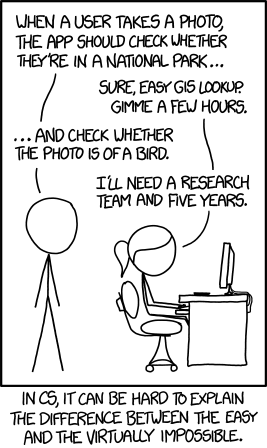
> Domain knowledge can be learnt much quicker than how to apply good engineering principles.
This is a particularly ignorant thing to say.
[dead]
[flagged]
[flagged]
Some food is mass-produced in factories.
It tastes bad, and poisons you slowly.
Some (less) food is produced on farms and kitchens.
It tastes good, and keeps you healthy.
I don't really care who/what wrote the code. I don't even really care about the code at all. What I care about is the end product.
The problem is not "code quality" the problem is that billionaire sociopaths have removed human judgement (and human morality) from the dev loop. This started long before AI.
Coders are hyperfocused on style and missing the substance. We are entering a world where rich bastards can produce evil software without any checks whatsoever.
At least when humans were required to write the code, they had to find and retain unscrupulous humans. Now they're completely unfettered, and we're soon going to learn the precise shape of the digital prisons they're constructing.
I don't entirely disagree, but as with many other posts on this topic…
> They will come for finance, biology, law, marketing, all knowledge work. That's their stated goal and they're already teasing it with "ChatGPT for Health" and similar launches. They're working on "harnesses" for other fields, it's just a matter of time before we have "Claude Finance Analyst" or something.
…
> Beg to disagree. The models will learn good engineering principles at some point.
…
> Stop and think, don't try to predict the future using (bad) past examples.
Don't try to prediction the future based on the past.
Also, here is my doomsday prediction.
Thats kind of ironic.
Heres a more thoughtful take: everything is an s curve.
Things start out fast, then they slow down.
It happens in learning, in tech, in literally everything.
The question (unanswered) is where we are in that curve.
Will they get better? Yes.
A lot better? A bit better? /shrug
I've had quite a few conversations and read many thoughts on the subject of job security in the software industry through the years. New technologies, various crisis and crashes, just age, incoming "hordes" of less prepared developers, or whatever.
If I had to highlight the one thing all those conversations had in common it would be precisely this:
And it never does.